Friday, February 21, 2020

Novel Coronavirus (2019-nCoV) Was Predicted


A mother sends her son on a camping trip with a leader who has led this trip into the mountains 16 times before without mishap; that is until this time. Every single camper and leader and driver die with no explanation. As the grieving mother who is the protagonist begins to accept the fact that her son, Danny, is dead she starts getting vicious bully-like attacks from nowhere saying he is not dead, such as writing on chalk boards, words from printers and other various 'signs'. Along with her new friend, Elliot Stryker, Christina Evans sets out to find out what could have possibly happened on the day that her son 'died'.

A virus called Wuhan-400 causes outbreak … in a Dean Koontz thriller from 1981. How is it that some books appear to prophesy events?
The Eyes of Darkness features a Chinese military lab in Wuhan that creates a virus as a bioweapon; civilians soon become sick after accidentally contracting it
In fact, the one lab in China able to handle the deadliest viruses is in Wuhan and helped sequence the novel coronavirus the world is currently battling.

The Eyes of Darkness, a 1981 thriller by bestselling suspense author Dean Koontz, tells of a Chinese military lab that creates a virus as part of its biological weapons programme. The lab is located in Wuhan, which lends the virus its name, Wuhan-400. A chilling literary coincidence or a case of writer as unwitting prophet?
In The Eyes of Darkness, a grieving mother, Christina Evans, sets out to discover whether her son Danny died on a camping trip or if – as suspicious messages suggest – he is still alive. She eventually tracks him down to a military facility where he is being held after being accidentally contaminated with man-made microorganisms created at the research centre in Wuhan.
If that made the hair on the back of your neck stand up, read this passage from the book: “It was around that time that a Chinese scientist named Li Chen moved to the United States while carrying a floppy disk of data from China’s most important and dangerous new biological weapon of the past decade. They call it Wuhan-400 because it was developed in their RDNA laboratory just outside the city of Wuhan.”


In another strange coincidence, the Wuhan Institute of Virology, which houses China’s only level four biosafety laboratory, the highest-level classification of labs that study the deadliest viruses, is just 32km from the epicentre of the current coronavirus outbreak. The opening of the maximum-security lab was covered in a 2017 story in the journal Nature, which warned of safety risks in a culture where hierarchy trumps an open culture.

Fringe conspiracy theories that the coronavirus involved in the current outbreak appears to be man-made and likely escaped from the Wuhan virology lab have been circulated, but have been widely debunked. In fact the lab was one of the first to sequence the coronavirus.
In Koontz’s thriller, the virus is considered the “perfect weapon” because it only affects humans and, since it cannot survive outside the human body for longer than a minute, it does not demand expensive decontamination once a population is wiped out, allowing the victors to roll in and claim a conquered territory.
It’s no exaggeration to call Koontz a prolific writer. His first book, Star Quest, was published in 1968 and he has been churning out suspense fiction at a phenomenal rate since with more than 80 novels and 74 works of short fiction under his belt. The 74-year-old, a devout Catholic, lives in California with his wife. But what are the odds of him so closely predicting the future?

Albert Wan, who runs the Bleak House Books store in San Po Kong, says Wuhan has historically been the site of numerous scientific research facilities, including ones dealing with microbiology and virology. “Smart, savvy writers like Koontz would have known all this and used this bit of factual information to craft a story that is both convincing and unsettling. Hence the Wuhan-400,” says Wan.
British writer Paul French, who specialises in books about China, says many of the elements around viruses in China relate back to the second world war, which may have been a factor in Koontz’s thinking.

“The Japanese definitely did do chemical weapons research in China, which we mostly associate with Unit 731 in Harbin and northern China. But they also stored chemical weapons in Wuhan – which Japan admitted,” says French.
Publisher Pete Spurrier, who runs Hong Kong publishing house Blacksmith Books, muses that for a fiction writer mapping out a thriller about a virus outbreak set in China, Wuhan is a good choice.
“It’s on the Yangtze River that goes east-west; it’s on the high-speed rail [line] that goes north-south; it’s right at the crossroads of transport networks in the centre of the country. Where better to start a fictional epidemic, or indeed a real one?” says Spurrier. (Spurrier works part-time as a subeditor for the Post.)


In bestselling suspense author Dean Koontz’s 1981 thriller The Eyes of Darkness, a virus to be used as a biological weapon is developed in Wuhan, China, but humans end up contracting it. Photo: ShutterstockIn bestselling suspense author Dean Koontz’s 1981 thriller The Eyes of Darkness, a virus to be used as a biological weapon is developed in Wuhan, China, but humans end up contracting it.
In bestselling suspense author Dean Koontz’s 1981 thriller The Eyes of Darkness, a virus to be used as a biological weapon is developed in Wuhan, China, but humans end up contracting it.
The Eyes of Darkness, a 1981 thriller by bestselling suspense author Dean Koontz, tells of a Chinese military lab that creates a virus as part of its biological weapons programme. The lab is located in Wuhan, which lends the virus its name, Wuhan-400. A chilling literary coincidence or a case of writer as unwitting prophet?
In The Eyes of Darkness, a grieving mother, Christina Evans, sets out to discover whether her son Danny died on a camping trip or if – as suspicious messages suggest – he is still alive. She eventually tracks him down to a military facility where he is being held after being accidentally contaminated with man-made microorganisms created at the research centre in Wuhan.
If that made the hair on the back of your neck stand up, read this passage from the book: “It was around that time that a Chinese scientist named Li Chen moved to the United States while carrying a floppy disk of data from China’s most important and dangerous new biological weapon of the past decade. They call it Wuhan-400 because it was developed in their RDNA laboratory just outside the city of Wuhan.”
In another strange coincidence, the Wuhan Institute of Virology, which houses China’s only level four biosafety laboratory, the highest-level classification of labs that study the deadliest viruses, is just 32km from the epicentre of the current coronavirus outbreak. The opening of the maximum-security lab was covered in a 2017 story in the journal Nature, which warned of safety risks in a culture where hierarchy trumps an open culture.


Fringe conspiracy theories that the coronavirus involved in the current outbreak appears to be man-made and likely escaped from the Wuhan virology lab have been circulated, but have been widely debunked. In fact the lab was one of the first to sequence the coronavirus.
In Koontz’s thriller, the virus is considered the “perfect weapon” because it only affects humans and, since it cannot survive outside the human body for longer than a minute, it does not demand expensive decontamination once a population is wiped out, allowing the victors to roll in and claim a conquered territory.
It’s no exaggeration to call Koontz a prolific writer. His first book, Star Quest, was published in 1968 and he has been churning out suspense fiction at a phenomenal rate since with more than 80 novels and 74 works of short fiction under his belt. The 74-year-old, a devout Catholic, lives in California with his wife. But what are the odds of him so closely predicting the future?


Albert Wan, who runs the Bleak House Books store in San Po Kong, says Wuhan has historically been the site of numerous scientific research facilities, including ones dealing with microbiology and virology. “Smart, savvy writers like Koontz would have known all this and used this bit of factual information to craft a story that is both convincing and unsettling. Hence the Wuhan-400,” says Wan.
British writer Paul French, who specialises in books about China, says many of the elements around viruses in China relate back to the second world war, which may have been a factor in Koontz’s thinking.


“The Japanese definitely did do chemical weapons research in China, which we mostly associate with Unit 731 in Harbin and northern China. But they also stored chemical weapons in Wuhan – which Japan admitted,” says French.
Publisher Pete Spurrier, who runs Hong Kong publishing house Blacksmith Books, muses that for a fiction writer mapping out a thriller about a virus outbreak set in China, Wuhan is a good choice.
“It’s on the Yangtze River that goes east-west; it’s on the high-speed rail [line] that goes north-south; it’s right at the crossroads of transport networks in the centre of the country. Where better to start a fictional epidemic, or indeed a real one?” says Spurrier. (Spurrier works part-time as a subeditor for the Post.)
Albert Wan runs the Bleak House Books store in San Po Kong, Hong Kong.
Hong Kong crime author Chan Ho-kei believes that this kind of “fiction-prophecy” is not uncommon.
“If you look really hard, I bet you can spot prophecies for almost all events. It makes me think about the ‘infinite monkey’ theorem,” he says, referring to the theory that a monkey hitting keys at random on a typewriter keyboard for an infinite amount of time will almost surely type any given text.
“The probability is low, but not impossible.”

Chan points to the 1898 novella Futility, which told the story of a huge ocean liner that sank in the North Atlantic after striking an iceberg. Many uncanny similarities were noted between the fictional ship – called Titan – and the real-life passenger ship RMS Titanic, which sank 14 years later. Following the sinking of the Titanic, the book was reissued with some changes, particularly in the ship’s gross tonnage.
“Fiction writers always try to imagine what the reality would be, so it’s very likely to write something like a prediction. Of course, it’s bizarre when the details collide, but I think it’s just a matter of mathematics,” says Chan.
Many of Koontz’s books have been adapted for television or the big screen, but The Eyes of Darkness never achieved such glory. This bizarre coincidence will thrust it into the spotlight and may see sales of this otherwise forgotten thriller jump.

Amazon is currently offering it on Kindle for just US$1. Perhaps, like Futility, it will also be reissued with some updates to make it really echo the current outbreak.


You want more?


China wasn’t original villain in book ‘predicting’ coronavirus outbreak – it was Russia
Dean Koontz’s The Eyes of Darkness originally contained details of a man-made virus called Gorki-400 from the Russian city of Gorki
The change to Wuhan came when the book was released in hardback under Koontz’s own name in 1989 – at the end of the Cold War

The 1981 book by US thriller writer Dean Koontz that appeared to predict the coronavirus outbreak in China initially had the virus originating in Russia.
The book appears to have been rewritten after the collapse of the Soviet Union meant the country was no longer seen as a communist bogeyman.
Koontz’s The Eyes of Darkness made headlines in the past week after readers noted the story concerned a man-made virus called Wuhan-400 developed in a biological weapons lab in Wuhan – ground zero of the current coronavirus outbreak – and described as the “perfect weapon”.
“They call the stuff ‘Wuhan-400’ because it was developed at their RDNA labs outside the city of Wuhan, and it was the four-hundredth viable strain of man-made organisms created at that research centre,” Koontz writes in the book.
However, Wuhan wasn’t even originally mentioned in The Eyes of Darkness. The first edition of the book, written under Koontz’s pseudonym Leigh Nichols, concerns a virus called Gorki-400 that was created by the Russians and emerged from “the city of Gorki”.

The change to Wuhan came when the book was released in hardback under Koontz’s own name in 1989. The year of the book’s re-release is significant – 1989 marked the end of the Cold War. And with the collapse of the Soviet Union, the country was no longer communist.
“Starting in 1986, relations between the US and the Soviet Union began improving,” says Jenny Smith, co-founder of indie bookshop Bleak House Books in Hong Kong and a student of Russian history. “Mikhail Gorbachev came in in 1985 and was very interested in making the Soviet Union a more open society and improving relations. By 1988, it is our friend and not our enemy.”

An American author pointing the fictional finger of blame at Russia would not have gone down well in that climate, so The Eyes of Darkness needed a new villain. There were only so many places with bio-weapons facilities – think France, Britain and Japan – and most, as far as the US was concerned, were the good guys.

“China is the only place that comes to my mind that would have had an active programme and it’s likely there was a deep suspicion [in the US] of China covering a lot of things in this period,” says Smith, who wrote her PhD on Soviet technology at the Massachusetts Institute of Technology in the United States.
This was in the immediate aftermath of the 1989 student demonstrations and the bloody Tiananmen crackdown that followed. It was a period when there were rumours swirling about leaks and cover-ups at biological weapons facilities, says Smith, and the US would have been aware of the repression of these rumours.


The switch from Gorki-400 to Wuhan-400 in the book was a literal cut-and-paste and appears to reflect the shift in mentality after the Cold War.
“Everyone was thinking in terms of two great powers – America and the Soviet Union, the good guys and the bad guys. It’s easy to see how you might substitute one bad guy for another, Gorki for Wuhan,” says Smith.
It is not known whether Koontz himself requested this change or his publisher made it.

Leigh Nichols wasn’t the only pen name Dean Koontz wrote under in his early career. He also used David Axton, Deanna Dwyer and K.R. Dwyer.
“It’s not unusual to use a pen name when you are starting off in your career. To play it safe, you don’t want to be as exposed,” says Albert Wan, Smith’s husband and the co-founder of Bleak House Books. “When his books started to take off in popularity, he may well have decided to use real identity.”
As for the Gorki referenced in the book, it could be one of a number of Russian towns with that name. The largest, just south of Moscow, is home to 3,500 people today. Compare that with Wuhan, with its population today of more than 11 million – even in 1989, Wuhan’s population topped 3.3 million.
The revised edition of The Eyes of Darkness brought the book closer to possibility, but it’s still some way off what’s happening with Covid-19. Significantly, contracting the fictional Wuhan-400 is a certain death sentence, while only 2 per cent of Covid-19 cases are fatal.

“It might run as science fiction, but it’s not impossible as it has happened in the past and people would be aware of it,” Smith says. “Think of the cover-up over anthrax – a lot of these stories are stranger than real life.”
Meanwhile, readers are also pointing to a passage in a book by the late Sylvia Browne, an American author who claimed to be psychic, that predicted an international outbreak of a virus this year.
“Around 2020, a severe pneumonia-like illness will spread throughout the globe, attacking the lungs and the bronchial tubes and resisting all known treatments,” Browne wrote in the book End of Days. “Almost more baffling than the illness itself will be the fact that it will suddenly vanish as quickly as it arrived, attack 10 years later, and then disappear completely.”

  1.  "Novel predicted Wuhan virus 40 years before Coronavirus outbreak. Internet is stumped". India Today. 2020-02-17. Retrieved 2020-02-18.
  2. ^ "Did a Chinese Novel Predict Coronavirus 40 Years Ago? 'Wuhan-400' Leaves Twitter Baffled". CNN News18, Delhi. 2020-02-17. Retrieved 2020-02-18.
  3. ^ "Wuhan 400: Novel predicted coronavirus 40 years ago, Internet stumped". GN Media, United Arab Emirates. 2020-02-18. Retrieved 2020-02-18.
  4. ^ Koontz, Dean (December 2, 2008). Afterword for The Eyes of Darkness. Berkley; Reissue edition. pp. 369–374ISBN 978-0425224861.
  5. ^ "Lee Rich Propping Four TV Features". varietyultimate.com: Variety. November 16, 1989. Retrieved June 30, 2014.

https://www.patreon.com/user?u=32891948

Thursday, February 20, 2020

2019 Novel Coronavirus stolen from Canada?!


Natural pandemics can be horrific and catch us completely off guard. For example, three years elapsed between the first officially documented US AIDS cases in 1981 and the identification of HIV as its cause. It took another three years to develop and approve the first drug treating HIV. While antiretroviral treatments now allow those living with HIV to manage the disease effectively (that is, if they can afford the treatment), we still lack a promising HIV vaccine.

Yet as ill-equipped as we may be to fight newly emergent natural pathogens, we are even less prepared to cope with engineered pathogens. In the coming decades, it may become possible to create pathogens that fall well outside the range of infectious agents modern medicine has learned to detect, treat, and contain.

Worse yet, malicious actors might build disease-causing microbes with features strategically tailored to thwart existing health security measures. So while advances in the field of synthetic biology will make it easier for us to invent therapeutics and other technologies that can defend us from pandemics, those very same advances may allow state and nonstate actors to design increasingly harmful pathogens.

For example, new gene-synthesis technologies loom large on the horizon, allowing for the automated production of longer DNA sequences from scratch. This will be a boon for basic and applied biomedical research — but it also will simplify the assembly of designer pathogens.

First story

A Chinese scientific paper has suggested careless biosecurity at a disease research laboratory just 280 yards from the market where the outbreak was originally detected was responsible for the Covid-19 Chinese Corona Virus.


Did coronavirus originate in laboratory? Scientists believe killer disease may have begun in research facility 300 yards from Wuhan wet fish market
  • Beijing-sponsored South China University of Technology concludes that ‘the killer coronavirus probably originated from a laboratory in Wuhan’
  • It points to research on bats and respiratory diseases carried by the animals at  the Wuhan Center for Disease Control and the Wuhan Institute of Virology
  • WCDC is just 300 yards from the seafood market and is adjacent to the hospital
PUBLISHED: 00:22 AEDT, 17 February 2020 | UPDATED: 03:00 AEDT, 17 February 2020
Chinese scientists believe the deadly coronavirus may have started life in a research facility just 300 yards from the Wuhan fish market.
A new bombshell paper from the Beijing-sponsored South China University of Technology says that the Wuhan Center for Disease Control (WHCDC) could have spawned the contagion in Hubei province.
‘The possible origins of 2019-nCoV coronavirus,’ penned by scholars Botao Xiao and Lei Xiao claims the WHCDC kept disease-ridden animals in laboratories, including 605 bats. 
It also mentions that bats – which are linked to coronavirus – once attacked a researcher and ‘blood of bat was on his skin.’
The abstract of the paper.
The possible origins of 2019-nCoV coronavirus
The 2019-nCoV has caused an epidemic of 28,060 laboratory-confirmed infections in human including 564 deaths in China by February 6, 2020. Two descriptions of the virus published on Nature this week indicated that the genome sequences from patients were almost identical to the Bat CoV ZC45 coronavirus. It was critical to study where the pathogen came from and how it passed onto human. An article published on The Lancet reported that 27 of 41 infected patients were found to have contact with the Huanan Seafood Market in Wuhan. We noted two laboratories conducting research on bat coronavirus in Wuhan, one of which was only 280 meters from the seafood market. We briefly examined the histories of the laboratories and proposed that the coronavirus probably originated from a laboratory. Our proposal provided an alternative origin of the coronavirus in addition to natural recombination and intermediate host.

[PDF] The possible origins of 2019-nCoV coronavirus

Xiao, L Xiao - researchgate.net
The 2019-nCoV coronavirus has caused an epidemic of 28,060 laboratory-confirmed
infections in human including 564 deaths in China by February 6, 2020. Two descriptions of
the virus published on Nature this week indicated that the genome sequences from patients …


The paper cited above does not go into detail about exactly what the Wuhan laboratory was doing with their infected animals, but careless biosecurity is a plausible explanation for what happened; researchers in constant close contact with infected mammals, obviously not wearing proper protective clothing to prevent injury or contamination, getting scratched and urinated on, not taking proper precautions, would have created plenty of opportunities for cross over and hybridisation between bat and human Corona viruses, and whatever else they were keeping in their cages.
If the claim of careless biosecurity is correct, the emergence of a dangerous hybrid virus capable of infecting humans was always a possibility. Through their carelessness, the virus researchers may have been inadvertently creating and incubating a stream of increasingly dangerous hybrid pathogens, until finally a potential pandemic escaped their laboratory.

report from a scientist at the prestigious South China University of Technology in Guangzhou China. A pre-print published by Botao Xiao and Lei Xiao, titled "The possible origins of 2019-nCoV coronavirus" whose abstract is the following…
The 2019-nCoV has caused an epidemic of 28,060 laboratory-confirmed infections in human including 564 deaths in China by February 6, 2020. Two descriptions of the virus published on Nature this week indicated that the genome sequences from patients were almost identical to the Bat CoV ZC45 coronavirus. It was critical to study where the pathogen came from and how it passed onto human. An article published on The Lancet reported that 27 of 41 infected patients were found to have contact with the Huanan Seafood Market in Wuhan. We noted two laboratories conducting research on bat coronavirus in Wuhan, one of which was only 280 meters from the seafood market. We briefly examined the histories of the laboratories and proposed that the coronavirus probably originated from a laboratory. Our proposal provided an alternative origin of the coronavirus in addition to natural recombination and intermediate host.
… and an especially ominous conclusion:
In summary, somebody was entangled with the evolution of 2019-nCoV coronavirus. In addition to origins of natural recombination and intermediate host, the killer coronavirus probably originated from a laboratory in Wuhan.
Who is Botao and should anyone listen to him? Well, yes: this is what we find about the research group of the Harvard post-doc:
The Xiao group study mainly in the fields of cellular and molecular biomechanics, single molecule biophysics and engineering. Current research areas are: protein-ligand interactions, DNA and RNA assembly, high-throughput nanometer measurements and manipulation, mathematical modeling and quantitative analysis. The experimental techniques include: magnetic tweezers, optical tweezers, biomembrane force probe, fluorescent microscopy, genetic engineering, and chromatography. An project example is using high-throughput single molecule techniques to study the modulation of protein drugs on interactions of integrins and their ligands such as TGF-beta. We also study von Willebrand Factor and glycoproteins on platelets. We collaborate with a number of well-known universities and institutions, and a few enterprises. Our research will be of relevance for the prevention and treatment of cancer, immune and cardiovascular diseases.
But what is far more interesting, and important, is that the paper was supported by China's National Natural Science Foundation, which means that the paper would likely never see the light of day if someone in Beijing did not stand to gain politically by endorsing the contrarian theory that a Wuhan biolab was indeed the source of the infection.
Which begs the question: is China's political elite set to change the narrative it has been spinning since day one about the origins of the coronavirus, and in order to appease an increasingly angry population, points the finger to one or more scientists at the Wuhan Center for Disease Control and Prevention and/or Wuhan Institute of Virology. Perhaps even the same scientists we highlighted two weeks ago, and which led to our twitter ban?
And until we eagerly await the answer, here is the gist of Botao's paper, which we repost here just in case it does disappear after all (ResearchGate link here):
The possible origins of 2019-nCoV coronavirus
Botao Xiao1,2* and Lei Xiao3
1 Joint International Research Laboratory of Synthetic Biology and Medicine, School of Biology and Biological Engineering, South China University of Technology, Guangzhou 510006, China
2 School of Physics, Huazhong University of Science and Technology, Wuhan 430074, China
3 Tian You Hospital, Wuhan University of Science and Technology, Wuhan 430064, China
Corresponding author: xiaob@scut.edu.cn
Tel / Fax: 86-20-3938-0631
The 2019-nCoV coronavirus has caused an epidemic of 28,060 laboratory-confirmed infections in human including 564 deaths in China by February 6, 2020. Two descriptions of the virus published on Nature this week indicated that the genome sequences from patients were 96% or 89% identical to the Bat CoV ZC45 coronavirus originally found in Rhinolophus affinis 1,2. It was critical to study where the pathogen came from and how it passed onto human.
An article published on The Lancet reported that 41 people in Wuhan were found to have the acute respiratory syndrome and 27 of them had contact with Huanan Seafood Market 3. The 2019-nCoV was found in 33 out of 585 samples collected in the market after the outbreak. The market was suspected to be the origin of the epidemic, and was shut down according to the rule of quarantine the source during an epidemic.
The bats carrying CoV ZC45 were originally found in Yunnan or Zhejiang province, both of which were more than 900 kilometers away from the seafood market. Bats were normally found to live in caves and trees. But the seafood market is in a densely-populated district of Wuhan, a metropolitan of ~15 million people. The probability was very low for the bats to fly to the marketAccording to municipal reports and the testimonies of 31 residents and 28 visitors, the bat was never a food source in the city, and no bat was traded in the market. There was possible natural recombination or intermediate host of the coronavirus, yet little proof has been reported.
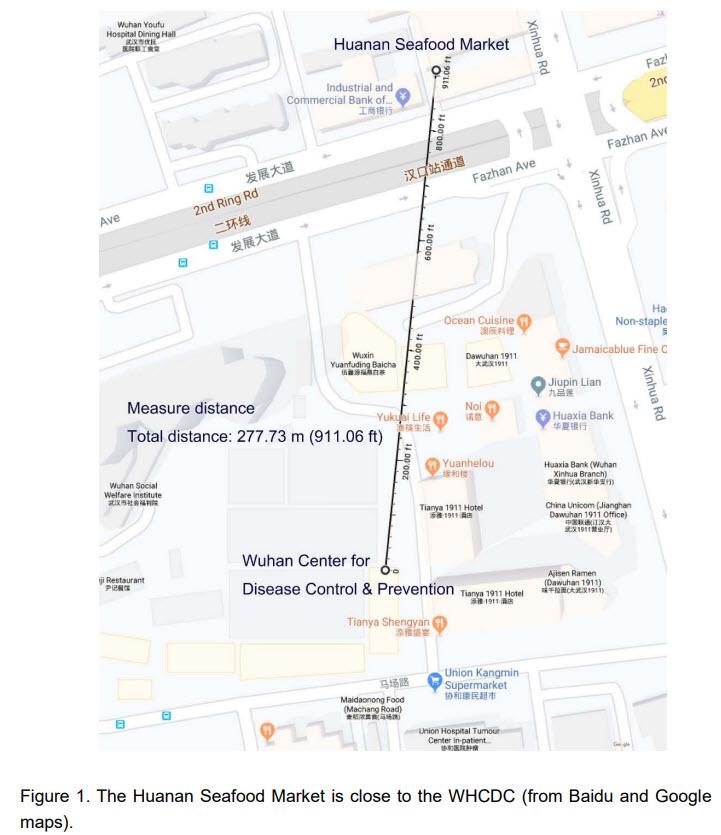
Was there any other possible pathway? We screened the area around the seafood market and identified two laboratories conducting research on bat coronavirus. Within ~280 meters from the market, there was the Wuhan Center for Disease Control & Prevention (WHCDC) (Figure 1, from Baidu and Google maps).
WHCDC hosted animals in laboratories for research purpose, one of which was specialized in pathogens collection and identification 4- 6. In one of their studies, 155 bats including Rhinolophus affinis were captured in Hubei province, and other 450 bats were captured in Zhejiang province 4. The expert in collection was noted in the Author Contributions (JHT). Moreover, he was broadcasted for collecting viruses on nation-wide newspapers and websites in 2017 and 2019 7,8. He described that he was once attacked by bats and the blood of a bat shot on his skin. He knew the extreme danger of the infection so he quarantined himself for 14 days 7. In another accident, he quarantined himself again because bats peed on him. He was once thrilled for capturing a bat carrying a live tick8.
Surgery was performed on the caged animals and the tissue samples were collected for DNA and RNA extraction and sequencing 4, 5. The tissue samples and contaminated trashes were source of pathogens. They were only ~280 meters from the seafood marketThe WHCDC was also adjacent to the Union Hospital (Figure 1, bottom) where the first group of doctors were infected during this epidemic. It is plausible that the virus leaked around and some of them contaminated the initial patients in this epidemic, though solid proofs are needed in future study.
The second laboratory was ~12 kilometers from the seafood market and belonged to Wuhan Institute of Virology, Chinese Academy of Sciences 1, 9, 10This laboratory reported that the Chinese horseshoe bats were natural reservoirs for the severe acute respiratory syndrome coronavirus (SARS-CoV) which caused the 2002-3 pandemic 9The principle investigator participated in a project which generated a chimeric virus using the SARS-CoV reverse genetics system, and reported the potential for human emergence 10A direct speculation was that SARS-CoV or its derivative might leak from the laboratory.
In summary, somebody was entangled with the evolution of 2019-nCoV coronavirus. In addition to origins of natural recombination and intermediate host, the killer coronavirus probably originated from a laboratory in Wuhan. Safety level may need to be reinforced in high risk biohazardous laboratories. Regulations may be taken to relocate these laboratories far away from city center and other densely populated places.
Acknowledgements
This work is supported by the National Natural Science Foundation of China (11772133, 11372116).
Declaration of interests
All authors declare no competing interests.
References
1. Zhou P, Yang X-L, Wang X-G, et al. A pneumonia outbreak associated with a new coronavirus of probable bat origin. Nature 2020. https://doi.org/10.1038/s41586-020-2012-7.
2. Wu F, Zhao S, Yu B, et al. A new coronavirus associated with human respiratory disease in China. Nature 2020. https://doi.org/10.1038/s41586-020-2008-3.
3. Huang C, Wang Y, Li X, et al. Clinical features of patients infected with 2019 novel coronavirus in Wuhan, China. The Lancet 2019. https://doi.org/10.1016/S0140- 6736(20)30183-5.
4. Guo WP, Lin XD, Wang W, et al. Phylogeny and origins of hantaviruses harbored by bats, insectivores, and rodents. PLoS pathogens 2013; 9(2): e1003159.
5. Lu M, Tian JH, Yu B, Guo WP, Holmes EC, Zhang YZ. Extensive diversity of rickettsiales bacteria in ticks from Wuhan, China. Ticks and tick-borne diseases 2017; 8(4): 574-80.
6. Shi M, Lin XD, Chen X, et al. The evolutionary history of vertebrate RNA viruses. Nature 2018; 556(7700): 197-202.
7. Tao P. Expert in Wuhan collected ten thousands animals: capture bats in mountain at night. Changjiang Times 2017.
8. Li QX, Zhanyao. Playing with elephant dung, fishing for sea bottom mud: the work that will change China's future. thepaper 2019.
9. Ge XY, Li JL, Yang XL, et al. Isolation and characterization of a bat SARS-like coronavirus that uses the ACE2 receptor. Nature 2013; 503(7477): 535-8.
10. Menachery VD, Yount BL, Jr., Debbink K, et al. A SARS-like cluster of circulating bat coronaviruses shows potential for human emergence. Nature medicine 2015; 21(12): 1508-13.
The original pre-print is below (link):


Second story
Canada’s national police force is investigating “possible policy breaches” after researchers were escorted from a lab at Canada’s National Microbiology Laboratory in Winnipeg, CBC News reported earlier this week (July 14). Prominent virologist Xiangguo Qiu, her colleague and husband Keding Cheng, and an unknown number of her students from China were removed from the lab on July 5. 
The Public Health Agency of Canada (PHAC) said that it advised the Royal Canadian Mounted Police (RCMP) about “possible policy breaches” in May, according to Reuters. The University of Manitoba, where Qiu held a non-salaried adjunct faculty position, cut ties with Qiu as a result of the RCMP investigation, according to CBC News.
Qiu had made regular trips to Beijing, and recent requests for trips were denied, according to the CBC. Sources also told the outlet that IT specialists entered her office after hours and replaced her computer several months ago.
Qiu was part of the team that developed ZMapp, an experimental treatment for Ebola used during the 2014 outbreak in West Africa. Heinz Feldmann, the former head of the National Microbiology Lab’s special pathogens program where Qiu worked, tells the National Post, “I still hope that this is a big misunderstanding. She is a great researcher, she has been a great collaborator, she has been a great interacter in the field.” A conference bio says she joined Cancer Care Manitoba in 1997 and NML in 2003, according to the National Post. The facility where she worked is the only biosafety level 4 lab in Canada, meaning that it is equipped to work with the most dangerous pathogens. 
PHAC and the RCMP refused to comment on Qiu’s removal from NML, according to Reuters. “There is no employee from the NML under arrest or confined to their home,” Eric Morrisette, spokesman for the PHAC, tells Reuters. “We can assure Canadians that there is no risk to the public and that the work of the NML continues in support of the health and safety of all Canadians.”
Chia-Yi Hou is an intern at The Scientist. Email her at chou@the-scientist.com.

This story was published on Oct. 3, 2019.
A Canadian government scientist at the National Microbiology Lab in Winnipeg made at least five trips to China in 2017-18, including one to train scientists and technicians at China's newly certified Level 4 lab, which does research with the most deadly pathogens, according to travel documents obtained by CBC News.


Xiangguo Qiu — who was escorted out of the Winnipeg lab in July amid an RCMP investigation into what's being described by Public Health Agency of Canada as a possible "policy breach" — was invited to go to the Wuhan National Biosafety Laboratory of the Chinese Academy of Sciences twice a year for two years, for up to two weeks each time.
"This will be third-party funded, and therefore no cost to [the Public Health Agency of Canada]," say the documents, obtained through access to information requests. The identity of the third-party was redacted.
During a Sept. 19-30, 2017, trip, she also met with collaborators in Beijing, the documents say, but their names have also been blacked out.
Qiu, her husband Keding Cheng and her students from China were removed on July 5 from Canada's only Level 4 lab — one equipped to work with the most serious and deadly human and animal diseases, such as Ebola. Security access for the couple and the Chinese students was revoked, sources who work at the lab previously told CBC News.


The CCP regards the intellectual property theft as a critical strategy for its rise becoming a great nation and its invasion of the world. Many Chinese researchers are either the CCP’s spies or lacking moral consciousness. Some of them cannot resist the temptation of huge benefits provided by the CCP and some of them feel obligatory with the calling of patriotism. They use the convenience of their work and research in the West to steal technologies and stealthily, provide them to the CCP. In this incidence, two Chinese-Canadian scientists secretly stole biological viral samples, which provided valuable data and samples for viral research, to the CCP, and should be hold responsible for the outbreak of coronal virus in Wuhan.

We have some possibly wild speculation. link
Chinese economic spying has been rampant. I find the possibility that China stole virus material to be at least somewhat credible. I really do not understand the web sites that say it couldn’t have happened. Read more: https://gnews.org/92280/

etc, etc.

You want more? 
WUHAN VIROLOGY INSTITUTE, CHINESE BIOLOGICAL WARFARE AND CHINESE-CANADIAN SPY


Our conclusion


Beyond developing new global standards and practices, we need to adopt more flexible countermeasures to face off the threat of bioengineered pathogens. As noted in a recent CHS report, “One of the biggest challenges in outbreak response, particularly for emerging infectious diseases, is the availability of reliable diagnostic assays that can quickly and accurately determine infection status.”

Diagnostics based on cutting-edge genome sequencing methods could provide detailed information about all the viruses and bacteria present in a blood sample, including even completely novel pathogens. Meanwhile, as genome sequencing technology becomes less expensive, it could be more widely applied in clinics to provide unprecedented real-time insights into genetic diseases and cancer progression.

We also need to invest more in developing antivirals that hit a wider range of targets. Such broad-spectrum drugs may stand a better chance of slowing the proliferation of an engineered bug than treatments specific to single known pathogens.

And we should also develop “platform” technologies that allow rapid vaccine development. Currently, the process of designing, testing, and manufacturing a vaccine to prevent the spread of a new pathogen takes years. Ideally, we could immunize all at-risk individuals within months of identifying the pathogen. Accelerating vaccine development will require us to innovate new and likely unconventional technologies, such as vectored immunoprophylaxis or nucleic acid vaccines.

Even as we pursue and accelerate such research, we should also be mindful of the possibility of self-inflicted wounds. To avert a terrible accident, the international biomedical community should establish firmer cultural guardrails on the research into pathogens.

Currently, career advancement, financial gain, and raw curiosity motivate biologists at all levels to push the envelope, and we all stand to gain from their efforts. However, these same incentives can sometimes lead researchers to take substantial and perhaps unjustified risks, such as evolving dangerous strains of influenza to be more contagious or publishing instructions for cultivating a close cousin of the smallpox virus. It’s important for biologists to do their part to promote a culture in which this adventurous intellectual spirit is tempered by caution and humility.

Underlying the prescriptions above is the need to approach the problem with the sense of urgency it warrants. As our biotechnological capabilities grow, so too will the threat of engineered pathogens. An engineered pandemic won’t announce itself with a towering mushroom cloud, but the suffering of the individuals it touches will be no less real. 

Zeljko Serdar, CCRES

Friday, February 14, 2020

The world number one in renewable energy


Europe has the ambition to be the world number one in renewable energy. To fulfil this objective it must lead the development of the next generation of renewable technologies, but also integrate the energy produced from renewable sources into the energy system in an efficient and cost-effective manner. To attain these goals, ambitious R&I targets have been set for 5 renewable technologies with great potential for cost-reductions, performance improvements and large-scale deployment worldwide – off-shore wind energy, the next generation of solar photovoltaics (PVs), ocean energy, concentrated solar power (CSP) and deep geothermal energy.

In 2018, renewable energy accounted for 21% of the total energy used for heating and cooling in the European Union (EU). This share has increased steadily since the beginning of the data collection in 2004, when the share was 12%. Increases in industry, services and households have all contributed to the growth in renewable energy used for heating and cooling.

Sweden stood out among EU Member States with almost two thirds (65%) of the energy used for heating and cooling in 2018 stemming from renewable sources. More than half of the energy used for heating and cooling came from renewable energy sources in Latvia (56%), Finland (55%) and Estonia (54%). My Croatia (37%).

In contrast, renewable sources contributed the least to heating and cooling in Ireland and the Netherlands (both 6%), Belgium (8%) and Luxembourg (9%).


Becoming the world’s first climate-neutral continent by 2050 is the greatest challenge and opportunity of our times. To achieve this, the European Commission presented the European Green Deal, the most ambitious package of measures that should enable European citizens and businesses to benefit from sustainable green transition. Measures accompanied with an initial roadmap of key policies range from ambitiously cutting emissions, to investing in cutting-edge research and innovation, to preserving Europe’s natural environment.

Supported by investments in green technologies, sustainable solutions and new businesses, the Green Deal can be a new EU growth strategy. Involvement and commitment of the public and of all stakeholders is crucial to its success.

Above all, the European Green Deal sets a path for a transition that is just and socially fair. It is designed in such a way as to leave no individual or region behind in the great transformation ahead.

https://europa.eu/!nP74Qm


Actions

Overview of the European Green Deal
Advantages for individuals, businesses and society
The role, influence and need for a strong EU voice on the world stage
Targeted support in the transition towards the green economy
A funding plan to become the first climate-neutral continent
Zeljko Serdar, CCRES

Thursday, February 13, 2020

Coronavirus (COVID-19) and 5G


Many people claims that Wuhan, China, the centre of the new coronavirus outbreak, was where 5G was first rolled out. It suggests that 5G has damaged peoples’ immune systems and so boosted the virulence of the common cold. The main implication of the claim—that 5G can impact immune systems—is totally unfounded. There is no evidence linking the new coronavirus to 5G.

It’s true that Wuhan does have some 5G coverage. 

The local government listed a number of venues with 5G coverage in August 2019. We can’t find evidence it was the very first city with 5G but we’ve seen reports saying Wuhan was one of several Chinese cities where early 5G trials took place. Another said Wuhan was “one of the first pilot cities of the 5G network in China”.

Claim

Wuhan is where 5G was rolled out first.

5G wrecks immune systems and that is why people in Wuhan are suffering with this illness.


Venues with 5G coverage in Wuhan now

Source: hubei.gov.cn 08/27/2019 15:08:10
With the debuts of 5G mobile phones, a growing number of consumers begin to concern about where they can have access to 5G service in Wuhan.
At present, the venues for the 7th CISM Military World Games, airport, railway station and major business circles, some universities have achieved 5G coverage, according to the three major communication operators, China Mobile, China Telecom and China Unicom in Wuhan on August 26. (hubei.gov.cn by Ruan Xinqi)
http://en.hubei.gov.cn/news/newslist/201908/t20190827_1409062.shtml


China completes third phase of national 5G trial program

Chinese vendors Huawei and ZTE as well as the country’s three state-owned carriers took part in the trials
China’s IMT-2020 (5G) Promotion Group said it has completed a third phase of non-standalone trials, Chinese press reported.

The tests were based on 3GPP’s Release 15 standards unveiled last year.

Tests in this phase included both indoor and outdoor trials, core network and base station functions. Huawei, ZTE and the China Information and Communication Technologies Group completed trials using the 3.5 GHz and 4.9 GHz frequency bands, according to the reports.

The IMT-2020 Promotion Group said that more than 20 companies participated in the third phase of China’s 5G trials, including Ericsson, Nokia Shanghai Bell, Samsung, Qualcomm, Intel and Rohde & Schwarz.

The group’s next step is to conduct interoperability tests on system and chip system terminals.

China’s 5G R&D tests started in 2016 and have involved three phases: key technologies testing, the verification of technology and solution and 5G system verification.

The IMT-2020 (5G) promotion group was jointly established in 2013 by the Chinese Ministry of Industry and Information Technology, the National Development and Reform Commission, and the Ministry of Science and Technology, based on the original IMT-Advanced Promotion Group. In China, it is the primary platform through which 5G research and international exchange and cooperation is conducted.

Operators participating in the IMT-2020 Promotion Group include China Mobile, China Telecom, China Unicom and Japanese telecoms operator NTT DoCoMo.

The IMT-2020 Promotion Group completed the initial phase of its trial program in 2016. That phase included testing wireless technologies including massive multiple-input-multiple-output, novel multiple access, new waveforms, advance coding, ultra-dense network implementations and high-frequency communications. The trial phase also included network slicing, edge computing and network function reconstruction. The second phase of the national 5G tests were fully completed during last year.

Earlier this year, the Chinese government had authorized carriers to test 5G technology in major cities across the country. Under this initiative, state-run telcos have been deploying 5G networks in 16 cities to trial the technology.

China Mobile, the world’s largest mobile operator in terms of subscribers, had plans to carry out external field test in the cities of Hangzhou, Shanghai, Guangzhou, Suzhou, and Wuhan and deploy more than 100 base stations in these locations. China Mobile also has said it would conduct 5G network application demonstrations in 12 cities including Beijing, Chengdu, and Shenzhen.

Last year, China Mobile announced plans to deploy more than 10,000 5G base stations by 2020. The telco expects to launch a pre-commercial 5G service this year.

China Unicom’s 5G trials plans center around 16 cities including Beijing, Tianjin, Qingdao, Hangzhou, Nanjing, Wuhan, Guiyang, Chengdu, Shenzhen, Fuzhou, Zhengzhou, and Shenyang.

China Telecom has also said it plans to test 5G technology in six cities including Xiong’an, Shenzhen, Shanghai, Suzhou, Chengdu and Lanzhou.

https://www.rcrwireless.com/20181004/5g/china-completes-third-phase-national-5g-trial-program


Hubei sets up over 300 5G base station

WUHAN, May 27 (Xinhua) -- Central China's Hubei Province has built more than 300 5G base stations and achieved full 5G signal coverage in its prefecture-level cities, local telecom sources said.The China Mobile's Hubei branch said more than 300 5G base stations have been built since February 2018, and a dozen 5G experience centers have been completed in cities including Xiaogan, Yichang and Jingmen.In the experience centers, visitors can learn knowledge about 5G technology and are allowed to experience 5G networks and high-tech products such as VR glasses, robotic arms and robots. Visitors will also learn about the close connection of 5G products in their daily lives.Wuhan, capital of Hubei, is one of the first pilot cities of the 5G network in China. So far, 5G technology has been applied in various fields in the city, including intelligent education, intelligent medical treatment, driverless vehicles, intelligent tourism, smart transportation and intelligent enterprises.
In October 2019, China’s three state telecoms companies announced they would be rolling out phone services that use 5G, and that big cities including Beijing, Shanghai, Guangzhou and Hangzhou were already covered by the network.5G is the next generation of wireless network technology, following on from 4G. Like 4G, 3G and 2G before it, 5G mobile data is transmitted over radio waves—a small part of the whole electromagnetic spectrum (which includes microwaves, visible light and X-rays).These radio waves are non-ionising, (meaning they don’t damage the DNA inside cells), as X-rays, gamma rays and UV rays are able to do. 5G, although at slightly higher frequencies than previous networks, is still in this radio part of the electromagnetic spectrum.
BEIJING (Reuters) - China’s three state telecoms on Thursday announced the roll-out 5G mobile phone services, marking a key step in Beijing’s ambitions to become a technology superpower at a time when it remains locked in trade tensions with Washington.China Mobile’s, China Unicom and China Telecom’s said on their websites and online stores that 5G plans, which start from as low as 128 yuan a month, will be available from Friday, allowing Chinese consumers nationwide to use the ultra-fast mobile internet service.Beijing had originally said it would launch the ultra-fast mobile internet service, which promises to support new features such as autonomous driving, early next year. But it accelerated its plans as tensions with the United States, especially over its boycott of telecoms giant Huawei Technologies, heated up.
“China will have the largest commercial operating 5G network in the world on Friday, and the scale of its network and the price of its 5G services will have a pivotal impact throughout the supply chain,” Bernstein said in a report this week.Authorities have said that they plan to install over 50,000 5G base stations across 50 Chinese cities in the country by the end of this year, and that big cities, including Beijing, Shanghai, Guangzhou, and Hangzhou, are already covered by the 5G network.Chinese companies from Xiaomi to Huawei have also unveiled new products in anticipation of the 5G roll out, with Huawei saying that it anticipates to start seeing a revenue uplift from the sector next year.

As for the claim that the new coronavirus observed in Wuhan is the “normal cold” with boosted virulence—that is simply not the case. 
5G?
Conclusion
Wuhan was one of the first places with 5G trials, as well as several other large Chinese cities, like Beijing, Shanghai and Guangzhou but we don’t know if it was the first.These days 5G is blamed for everything, from cancer to bushfires, so it is not surprising that conspiracy theories that 5G caused, or helped spread coronavirus have been shared into the anti-5G groups.
Some people claimed Wuhan was where 5G was first rolled out, and 5G “wrecked immune systems and thereby boosted the virulency of the normal cold”. Wuhan was one of a few places where 5G was rolled out in China in 2020, along with other parts of the world. There is no evidence (yet) that 5G weakens immune systems or is harmful to humans. Novel coronavirus is probably with us beyond this season, beyond this year.


Monday, February 3, 2020

Bat-SARS-Like Coronavirus


Make no mistake: this disease is, in fact, a military biological weapon.


Two separate components of genetic sequencing from HIV-1, the virus which causes AIDS, were added to Bat-SARS-Like coronavirus in the laboratory, thereby allowing it to infect human lungs via the ACES2 receptors in our lungs, and to disrupt the human body ability to fight it off, by reducing human leukocytes.

The disease sequence from the original Bat coronavirus was uploaded to the National Center for Biotechnology Information at the US National Library of Medicine, in the year 2018 by China's Institute of Military Medicine, Nanjing Command. That Bat-SARS-Like coronavirus was issued Reference ID: AVP 70833.1 by the National Center for Biotechnology Information at the U.S. Library of Medicine.


The present outbreak of "novel Coronavirus" was uploaded to that same National Center for Biotechnology Information in January of this year by the Shanghai Public Heath Clinical Center and was issued Reference ID: QHD3418.1. Using the test facilities known as BLAST (Basic Local Alignment Search Tool) from the U.S. National Library of Medicine researchers have determined that the "virus envelope" of those two separate diseases, are 100% identical! We are currently witnessing a major epidemic caused by the 2019 novel coronavirus (2019- nCoV). The evolution of 2019-nCoV remains elusive. We found 4 insertions in the spike glycoprotein (S) which are unique to the 2019-nCoV and are not present in other coronaviruses. Importantly, amino acid residues in all the 4 inserts have identity or similarity to those in the HIV-1 gp120 or HIV-1 Gag. 


Interestingly, despite the inserts being discontinuous on the primary amino acid sequence, 3D-modelling of the 2019-nCoV suggests that they converge to constitute the receptor binding site. The finding of 4 unique inserts in the 2019-nCoV, all of which have identity /similarity to amino acid residues in key structural proteins of HIV-1 is unlikely to be fortuitous in nature. There is no way in nature that the Bat coronavirus could fortuitously acquire the HIV genetic sequences, without causing a mutation of the Virus Envelope. The only way the virus envelope could obtain the HIV genetics and still remain 100% identical to the 2018 sample, is if the HIV genes were added in a laboratory.


So what the human race is now facing, is an accidentally-released military bio-weapon. The original Bat-SARS-Like Coronavirus was identified by China's People's Liberation Army, through the Institute of Military Medicine, Nanjiang Command in the year 2018. They uploaded the virus sequence and they were the sole entity in possession of the virus. Here we are, two years later, and the virus they had has been changed in a way that cannot occur in nature without mutating the virus envelope protein.

Remember this text and its publication date. 

Saturday, February 1, 2020

2019-nCoV


2019 Novel Coronavirus


The Croatian Center of Renewable Energy Sources (CCRES) is closely monitoring an outbreak of respiratory illness caused by a novel (new) coronavirus first identified in Wuhan, Hubei Province, China. Chinese authorities identified the new coronavirus, which has resulted in thousands of confirmed cases in China, including cases outside Wuhan City. Additional cases have been identified in a growing number of other international locations, including the United States. There are ongoing investigations to learn more.

2019 Novel Coronavirus (2019-nCoV) is a virus (more specifically, a coronavirus) identified as the cause of an outbreak of respiratory illness first detected in Wuhan, China. Early on, many of the patients in the outbreak in Wuhan, China reportedly had some link to a large seafood and animal market, suggesting animal-to-person spread. However, a growing number of patients reportedly have not had exposure to animal markets, indicating person-to-person spread is occurring. At this time, it’s unclear how easily or sustainably this virus is spreading between people.

Much is unknown about how 2019-nCoV, a new coronavirus, spreads. Current knowledge is largely based on what is known about similar coronaviruses. Coronaviruses are a large family of viruses that are common in many different species of animals, including camels, cattle, cats, and bats. Rarely, animal coronaviruses can infect people and then spread between people such as with MERS, SARS, and now with 2019-nCoV.

Most often, spread from person-to-person happens among close contacts (about 6 feet). Person-to-person spread is thought to occur mainly via respiratory droplets produced when an infected person coughs or sneezes, similar to how influenza and other respiratory pathogens spread. These droplets can land in the mouths or noses of people who are nearby or possibly be inhaled into the lungs. It’s currently unclear if a person can get 2019-nCoV by touching a surface or object that has the virus on it and then touching their own mouth, nose, or possibly their eyes.

There is currently no vaccine to prevent 2019-nCoV infection. The best way to prevent infection is to avoid being exposed to this virus. However, as a reminder, CDC always recommends everyday preventive actions to help prevent the spread of respiratory viruses, including:

Wash your hands often with soap and water for at least 20 seconds. Use an alcohol-based hand sanitizer that contains at least 60% alcohol if soap and water are not available.
Avoid touching your eyes, nose, and mouth with unwashed hands.
Avoid close contact with people who are sick.
Stay home when you are sick.
Cover your cough or sneeze with a tissue, then throw the tissue in the trash.
Clean and disinfect frequently touched objects and surfaces.

If you were in China in the last 14 days and feel sick with fever, cough, or difficulty breathing, you should:

Seek medical care right away. Before you go to a doctor’s office or emergency room, call ahead and tell them about your recent travel and your symptoms.
Avoid contact with others.
Not travel while sick.
Cover your mouth and nose with a tissue or your sleeve (not your hands) when coughing or sneezing.
Wash hands often with soap and water for at least 20 seconds to avoid spreading the virus to others. Use an alcohol-based hand sanitizer that contains at least 60% alcohol if soap and water are not available.
Zeljko Serdar, CCRES


U siječnju 2020. godine,  točno dvije godine prije nego što je virus SARS-Cov-2 cijeli svijet bacio na koljena, američki diplomatski dužnosnici Washingtonu su poslali dva izvješća čiji je sadržaj bio klasificiran kao 'osjetljivo, ali ne i povjerljivo'.

Na početku je cijela priča izgledala kao teorija zavjere, ali sada je stvar puno ozbiljnija
Znanstvenici iz SAD-a krajem 2017. godine posjetili su Wuhanski institut za virologiju (WIV) u sklopu šireg istraživanja te su ostali zatečeni slabom razinom biosigurnosti koja ne priliči laboratoriju u kojem se ispituju potencijalno smrtonosni virusi.

Prvo izvješće, u koje je imao uvid novinar Washington Posta, upozorava na činjenicu da laboratorij u Wuhanu ispituje tipove koronavirusa analizirajući potencijal njihove transmisije sa šišmiša na čovjeka, a da zbog izuzetno loših sigurnosnih standarda u laboratoriju postoji opravdana zabrinutost oko nove pandemije virusa tipa SARS.

Američki su znanstvenici, piše, tijekom posjeta wuhanskom laboratoriju upozorili svoje kineske kolege da im nedostaje stručnog osoblja i opreme koja poštuje sigurnosne zahtjeve laboratorija visoke razine kontaminacije. Wuhanski centar za kontrolu bolesti, koji se također spominje u izvješćima kao moguće rodno mjesto zaraze, posluje na biosigurnosnoj razini 2, što je osjetno niže od razine 4 koju koriste ostali centri takve vrste.

Amerikanci su se tijekom tog službenog posjeta susreli i sa Shi Zhenglijom, voditeljicom istraživačkog projekta koji se bavio analizom koronavirusa. Njezin je tim u studenom 2017. godine objavio istraživanje u kojem je dokazano kako su šišmiši iz pećine u provinciji Yunnan najizgledniji nosioci virusa SARS koji je eskalirao 2003. godine.

„Najbitnija informacija u njezinom istraživanju bila je da koronavirusi tipa SARS mogu doći u kontakt s ljudskim receptorom ACE2, što govori u prilog zaključku da se koronavirusi mogu prenijeti sa šišmiša na čovjeka. Iz perspektive javnoga zdravstva, smatramo da je od ključne važnosti s velikom dozom pažnje nadzirati buduća istraživanja toga tipa virusa, zato što zbog slabe sigurnosti u laboratoriju postoji velika opasnost od eskalacije“ stoji u izvješću poslanom 19. siječnja 2020. godine Washingtonu, uz naputak kako postoji bojazan da se kineski znanstvenici nepotrebno izlažu riziku zaraze.

„Izvješće je bilo upozorenje kojim se Washington pokušalo alarmirati na pripravnost“ izjavio je jedan američki dužnosnik za Washington post, ali je zbog prirode svog posla želio ostati anoniman.

To se sporno obavještajno izvješće pojačano spominje na vašingtonskim hodnicima posljednjih tjedana, a Trumpova administracija navodno već danima sumnja da je izvor virusa upravo Wuhanski institut za virologiju.

Prema informacijama New York Timesa, američka obavještajna služba nije željela javno iznijeti dodatne kompromitirajuće informacije, ali je jedan dužnosnik CIA-e istaknuo da posjeduju još nekoliko ključnih podataka koji govore u prilog tezi da je 'rodno mjesto' virusa SARS-Cov-2 WIV.

S tim se slažu i vodeći američki stručnjaci, koji su od početka tvrdili da tvrdnja o nastanku virusa na wuhanskoj tržnici 'ne drži vodu'.

Izvješće kineskih službenika objavljeno u siječnju 2020. godine za prvog pacijenta navodi osobu koja nije imala nikakvu povezanost sa spornom tržnicom; baš kao ni više od jedne trećine prvozaraženih pacijenata. Također, navode, tržnica je prodavala morske plodove, a ne šišmiše koji su se dokazali kao uzročnici ovoga virusa.

Dok je kineska vlada u potpunosti onemogućila dolazak do informacija koje se odnose na porijeklo virusa, WIV kategorički odbija optužbe za vlastitu ulogu u svjetskoj pandemiji.

Američki znanstvenici upozoravaju; „Ovo nije pitanje za teoretičare zavjere, a ne treba se niti prstom tražiti krivac. No, važno je saznati kako je došlo do njegove nekontrolirane eskalacije zato što se jedino tako može spriječiti buduća katastrofa.“

Isto je u sinoćnjem intervjuu na Fox Newsu kazao i američki državni tajnik Mike Pompeo.

"Wuhanski institut za virologiju nalazi se samo nekoliko kilometara od tržnice koju je Peking naveo kao epicentar zaraze. Kina mora transparentno surađivati u ovoj istragi" naglasio je Pompeo, dodavši da će Washington poduzeti sve raspoložive mjere da što prije dođe do relevantnih informacija o porijeklu virusa.

Treba još jednom naglasiti kako ovo nije poticanje još jedne u nizu teorija zavjere oko porijekla virusa. Kao što je već cijeli niz stručnjaka istaknuo, trenutno ne postoje nikakva kredibilna istraživanja koja govore u prilog tome da je virus SARS-Cov-2 nastao u laboratoriju, već su složni u tome da se na čovjeka prešao sa životinje.

Međutim, postoji razlika između toga je li se transmisija dogodila da wuhanskoj tržnici ili je došlo do velikog sigurnosnog propusta u laboratoriju koji se bavi istraživanjem i drugih tipova potencijalno smrtonosnih virusa.

Zeljko Serdar, HCOIE