Italy is ramping up its green energy game with the updated National Energy and Climate Plan (PNIEC), aiming for climate neutrality by 2050. The plan sets ambitious 2030 targets to slash fossil fuel reliance through massive solar, wind, and green hydrogen rollout, aligning with the EU's Fit for 55 and REPowerEU goals. While progress is strong (e.g., renewables hit ~37% of electricity in 2022), hitting these marks will require turbocharged growth amid challenges like grid bottlenecks and permitting hurdles.
Key Targets for 2030.
Total Energy Consumption: 39.4% share from renewables in gross final energy consumption (up from ~19.6% in 2023 and the old plan's 30%).
Electricity Generation: 63.4% share from renewables (up from 37.1% in 2022; targeting ~237 TWh production, with 80 GW solar and 28 GW wind capacity).
Heating & Cooling: 35.9% share from renewables (up from 20.6%; boosted by heat pumps, biomass, and district systems).
Transport Sector: 34.2% share from renewables (exceeding EU's 29%; via e-mobility, biofuels, biomethane, and ~6.5M electric vehicles).
Green Hydrogen: 42% of industrial hydrogen needs met by renewables (targeting 5 GW electrolysers and ~0.7 Mton/year production; key for hard-to-abate sectors).
Context & Ambition
Submitted to the EU in 2024, this revised PNIEC pushes for energy security post-Russia-Ukraine disruptions (Italy cut Russian gas dependence from 46%). It emphasizes diversification with renewable gases, biofuels, and innovation like agrivoltaics and offshore wind, while exceeding some EU minima for a pragmatic, affordable transition.
Challenges & Growth
Italy's renewables grew to ~40% of electricity by 2023, but needs ~7-8 GW annual solar additions to reach 80 GW total. Hurdles include permitting delays, land constraints, and grid upgrades, but projects like the SoutH2 Corridor (hydrogen backbone), Tyrrhenian Link (HVDC grid), and NRRP-funded offshore wind farms (€3.6B for smart grids) are accelerating progress. With €55M+ in NRRP for renewables/hydrogen, the path to 2030 looks promising—if execution ramps up.
While growth is promising, challenges like permitting delays persist. Initiatives like the 2025 Grid Development Plan aim to add over 65 GW of renewables by 2030, focusing on solar (to 79 GW) and wind (to 28 GW).
In the mid-2010s, the global energy landscape appeared precarious. Oil prices had plummeted from over $100 per barrel in 2014 to under $30 by early 2016, driven by a supply glut from U.S. shale production and sluggish demand amid economic uncertainty. Geopolitical tensions in the Middle East loomed large, and forecasts painted a picture of persistent volatility, with many experts predicting prolonged dependence on volatile imports and a slow, uneven transition to renewables.
Fast-forward to November 2025, and the world confronts a strikingly different reality: an era of energy independence and abundance that few could have anticipated just six or eight years prior. This shift, marked by surging production, plummeting renewable costs, and diversified supply chains, has reshaped economies, bolstered security, and accelerated decarbonization efforts. This post explores whether this transformation holds true, examining historical predictions against current trends, the drivers of abundance, and the implications for a sustainable future.
Historical Predictions:
A Landscape of Caution and ConstraintSix to eight years ago—spanning 2017 to 2019—energy outlooks were dominated by caution. The International Energy Agency's (IEA) World Energy Outlook 2017 projected global oil demand to rise steadily to 104 million barrels per day (mb/d) by 2023, but with warnings of supply risks from OPEC+ cuts and underinvestment in upstream projects. Renewables were seen as promising but niche; the IEA forecasted solar photovoltaic (PV) capacity to reach about 600 gigawatts (GW) globally by 2023, a figure that seemed ambitious given grid integration challenges and subsidy dependencies.
Natural gas was hailed as a bridge fuel, but LNG exports were expected to grow modestly, with the U.S. potentially becoming a net exporter only by the early 2020s—if shale economics held.In the U.S., the shale revolution was already underway, but independence was far from assured. The Energy Information Administration (EIA) in 2018 predicted the country would remain a net petroleum importer until at least 2020, citing refining constraints and export infrastructure lags.
Globally, abundance felt elusive; McKinsey's Global Energy Perspective 2017 warned of "energy trilemmas"—balancing security, affordability, and sustainability—amid rising demand from Asia. Predictions emphasized scarcity risks: peak oil debates lingered, coal's decline was gradual, and electric vehicles (EVs) were projected to capture just 2-3% of global car sales by 2025. The consensus? Energy security would hinge on diplomatic maneuvering, not domestic booms or technological leaps.
These forecasts, while prescient in some areas, profoundly underestimated the pace of innovation and market forces. By 2025, reality has outstripped expectations, delivering not just stability but surplus.The U.S. Model: Achieving Independence Through Shale and DiversificationThe United States stands as the poster child for this unforeseen independence. In 2019, the U.S. became a net energy exporter for the first time since 1957, a milestone the EIA confirmed with exports surpassing imports by energy content.
By 2023, exports hit record highs, with oil production peaking at over 13 mb/d, and 2025 projections show sustained output around 13.2 mb/d despite some moderation in shale drilling.
Natural gas liquids (NGLs) and LNG exports have exploded, with the U.S. shipping 14.9 billion cubic feet per day of LNG in 2025—25% more than 2024—bolstered by new facilities like Plaquemines LNG.
This wasn't predicted in 2017-2019 outlooks, which anticipated net imports persisting into the 2020s. Instead, policy shifts under the Inflation Reduction Act (IRA) and technological efficiencies in fracking have intertwined fossil fuels with renewables. U.S. CO2 emissions have declined as cheap gas displaces coal, while solar and wind capacity has surged to over 200 GW combined by mid-2025.
Reports from the Conference Board underscore this: "The US has achieved a long-desired goal: energy independence," but warn of challenges like permitting delays that could erode gains.
Abundance here means not just self-sufficiency but export prowess, with LNG reshaping global trade and shielding allies from Russian supply shocks.Global Trends: From Scarcity Fears to Supply SurfeitsBeyond the U.S., the world has embraced abundance on multiple fronts. Global energy demand grew 2.2% in 2024—faster than the 2013-2023 average—but was met with renewables claiming 38% of supply growth, outpacing natural gas (28%) and coal (15%).
Electricity demand surged 4.3%, the largest absolute increase ever (outside recessions), yet renewables filled the gap: solar alone added 306 terawatt-hours (TWh) in H1 2025, a 31% jump, pushing its global share to 8.8%.
By mid-2025, renewables overtook coal in electricity generation for the first time, at 34.3% versus 33.1%.
Oil and gas production trends further defy early predictions. World supply rose to 105 mb/d in 2025, up 1.8 mb/d from 2024, with non-OPEC+ nations like the U.S., Brazil, Guyana, and Canada driving 1.4 mb/d of growth.
OPEC+ added 1.4 mb/d, unwinding cuts amid softening prices, leading to a projected surplus of 2.7 mb/d in Q3 2025.
Brent crude averaged $69/b in 2025, down from peaks, thanks to this glut—far from the $80+ forecasts of 2018.
LNG supply waves from North America and Qatar promise lower prices, enhancing security post-Ukraine invasion.
Renewable abundance is even more pronounced. Solar PV capacity exceeded 3,000 GW by end-2025, with China (47%) and Europe (20%) leading; costs have plunged, making behind-the-meter solar/battery systems viable for households and businesses.
IRENA's 2025 Global Renewables Summit declared: "We are entering the age of renewable abundance," with investments up 14% annually since 2018 despite shocks.
This contrasts sharply with 2017's modest projections, where solar growth averaged under 20% annually.Key Metric
2017-2019 Prediction (by 2025)
2025 Reality
Global Solar Capacity
~600-800 GW
>3,000 GW
Yet, this era is tentative.
Permitting bottlenecks, trade tensions, and uneven transitions in developing nations could reverse gains. Policymakers must prioritize grid upgrades, equitable access, and innovation to sustain abundance. In retrospect, the mid-2010s' pessimism underestimated human ingenuity; today, that same drive beckons us toward a truly sustainable tomorrow. The question isn't whether abundance arrived—it did. It's how we ensure it endures. Zeljko Serdar, CCRES.
Marine Cloud Brightening Program studies clouds, aerosols and pathways to reduce climate risks
Global climate change is about more than just greenhouse gas emissions — among the many complex systems that impact Earth’s climate, one of the most important is how much sunlight is reflected back into space by bright surfaces such as snow, ice, and clouds. Clouds play a particularly powerful role in the climate system since they can change rapidly and have a strong effect on Earth’s reflectivity. That’s why researchers with the UW Marine Cloud Brightening Program, an international scientific initiative, are working to better understand clouds, and how both inadvertent and possibly intentional changes to atmospheric particles affect clouds.
“Atmospheric particles, also called aerosols, can have a strong effect on sunlight reflection by clouds,” said Sarah Doherty, program director of the Marine Cloud Brightening Program and a senior research scientist with the UW Cooperative Institute for Climate, Ocean and Ecosystem Studies. “As humans make changes to aerosol emissions, we need a stronger scientific understanding of these effects in order to better understand the potential risks and benefits, and to limit unintended effects.”
The role of clouds and aerosols
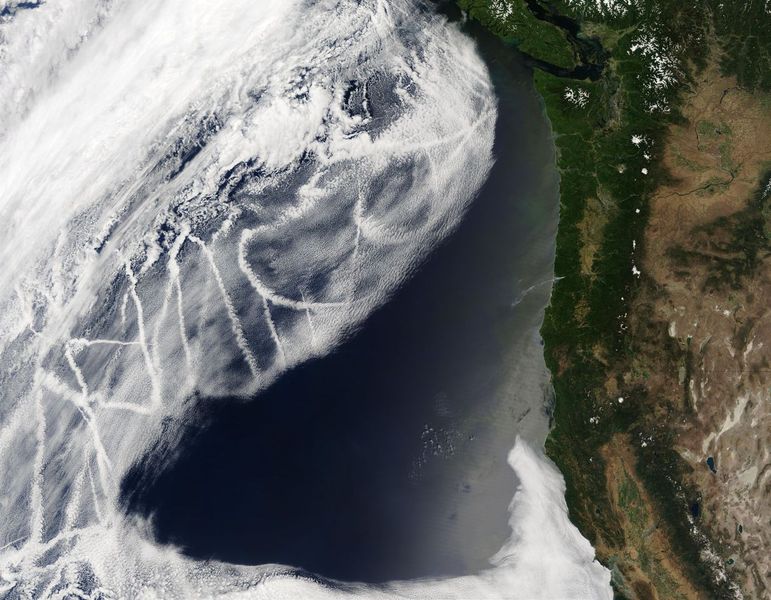
Particulate emissions from ships produce bright tracks in clouds over the Pacific Ocean.
When tiny aerosol particles are released into the atmosphere from both natural sources (such as biological emissions and sea spray) and human activities (such as from burning fossil fuels, wood and vegetation) they mix into clouds and can cause them to brighten and reflect more sunlight back into space. This has a cooling effect on the Earth’s climate.
The idea to better understand the role of clouds in climate — and humans’ effect on it — came about when scientists observed that clouds were being made more reflective, or “brighter,” in regions where they were influenced by air pollution.
A particularly striking version of this is seen in “ship tracks,” the trails of brightened clouds along the routes of ships caused by the small aerosol particles their engines emit. The tracks are bright enough and big enough to be observed from space. In order to reduce this pollution and improve global air quality, recent regulations have significantly reduced shipping and other emissions — but in doing so, they have also reduced the reflectivity of clouds, which could be accelerating global warming.
“There’s now strong evidence that reductions in ship emissions starting in 2020 contributed in part to the anomalously warm waters recently observed in the north Atlantic Ocean,” said Robert Wood, professor of atmospheric sciences and lead investigator of the Marine Cloud Brightening Program. “This really speaks to the remarkably strong influence these tiny particles in the atmosphere can exert on clouds and the absorption of sunlight by the Earth. But the truth is that we still don’t have a very good handle on how big of an effect aerosol changes can have globally because cloud responses to aerosols can vary enormously depending on the type of cloud and on meteorology.”
As scientists investigate these questions, they have also identified new questions: if ship emissions could cause clouds to brighten and reflect sunlight back into space, could a non-polluting version of that phenomenon be used to help cool the planet? And if so, should it?
These are complex topics, and as climate change becomes an everyday reality for people around the world, scientists and governments have recognized the importance of investigating them by recommending further research. In studying the ways that aerosols and clouds interact, the Marine Cloud Brightening Program seeks to inform future decisions by helping humanity understand not just the technical challenges of this kind of climate intervention, but the suite of potential benefits and risks that come along with it.
Understanding marine cloud brightening
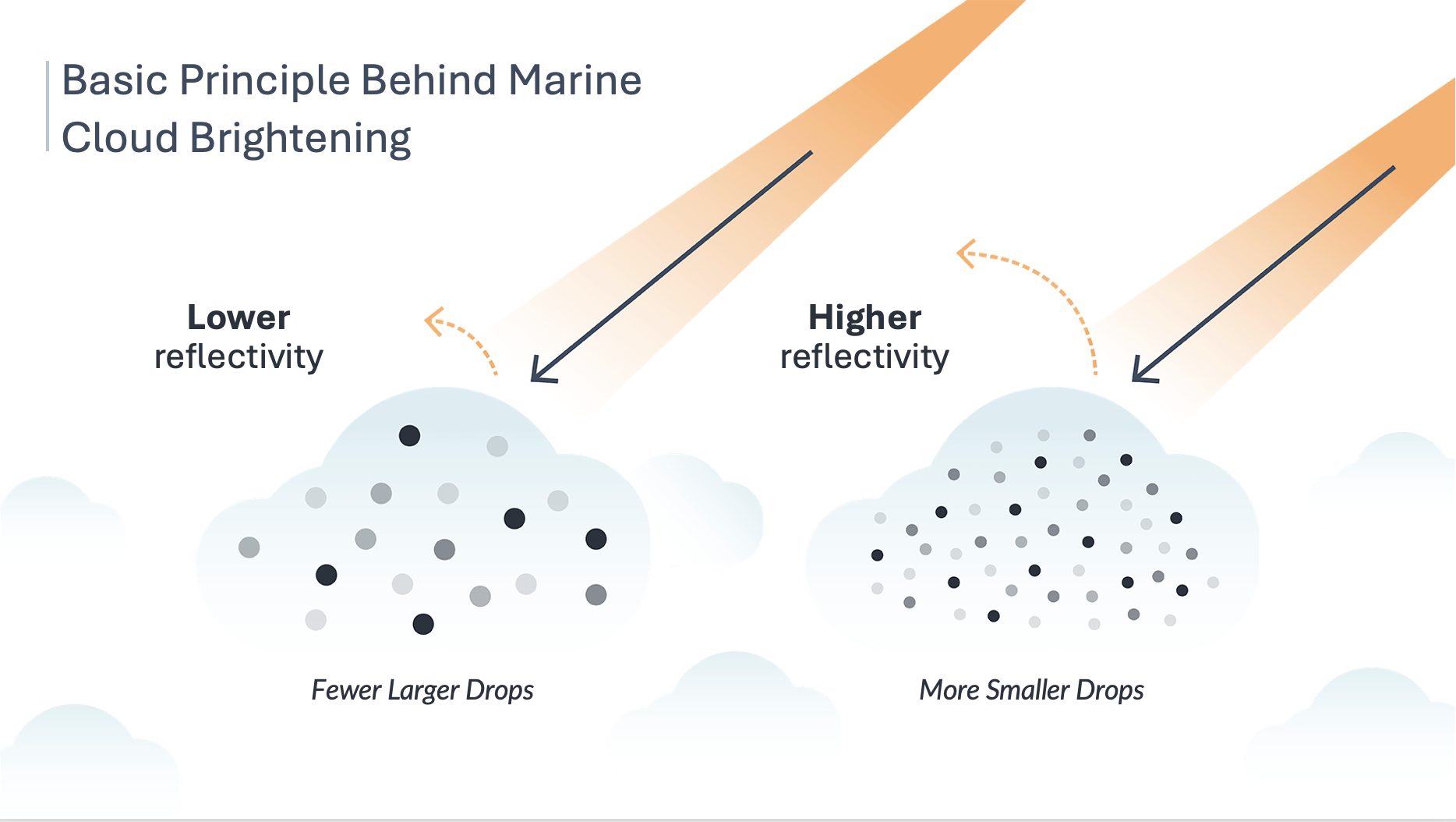
Changes to the size and number of droplets in clouds can change how much sunlight those clouds reflect back into space.
Marine cloud brightening (MCB) is one of several proposed climate interventions collectively known as solar radiation modification, or SRM. In this approach, tiny sea salt particles generated from ocean water would be sprayed from ships into areas of low-lying clouds. Once emitted, the particles would remain in the atmosphere for only a few days, brightening clouds over parts of the ocean in order to reduce climate warming.
But before any intervention like this can be considered, it is crucial to fully understand how it will affect the climate system, our oceans and our terrestrial ecosystems.
“The goal of the MCB Program is to understand whether it might even be possible to predictably and reliably brighten low marine clouds, and if so, how doing this in different regions of the globe would affect temperatures, precipitation and climate both globally and locally — as well as any other possible side effects,” said Doherty. “As atmospheric scientists, we think it’s critically important that society has the answers to these questions before making any decisions about whether or not to actually use marine cloud brightening in an effort to reduce climate risks.”
In order to better understand how aerosol particles interact with clouds, and how intentionally brightened clouds would interact with our global climate system, the Marine Cloud Brightening Program researchers are taking a multi-pronged approach.
Computer simulations
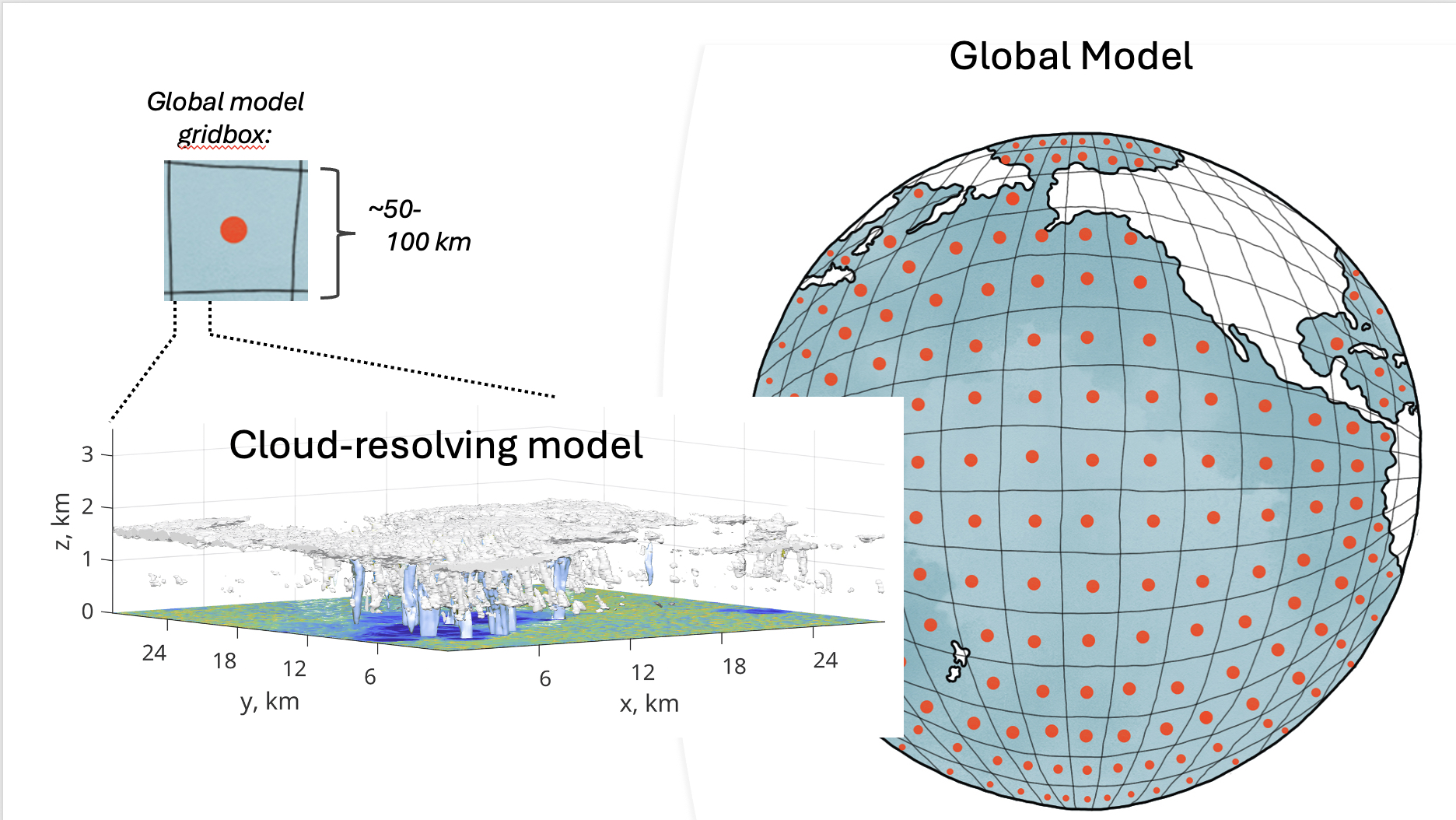
Researchers use computer models to simulate how clouds respond to aerosols locally to inform projections of the effects on climate globally.
The first phases of research have focused on computer modeling. The team is working with models at the global scale to study how aerosol-cloud interactions affect climate, testing the accuracy of their simulations against observations in the field and using them to understand how different MCB implementations would affect future climate. The team is also working with smaller-scale models that simulate the details of clouds to better understand how their reflectivity and other properties are affected by aerosol changes.
“But as with any computer simulations, we need to validate these detailed models against observations because the real world always introduces variables you weren’t expecting,” Doherty said.
Small-scale field studies
To validate the models and measure real-world cloud responses, the team has developed a new approach for controlled studies of aerosol-cloud interactions. That’s where CARI — the cloud aerosol research instrument — comes in.
“In the past when we’ve tried to study how clouds are affected by aerosols, we’ve had to just observe clouds in polluted regions, where it’s difficult to distinguish between changes in the clouds due to aerosols versus other meteorological factors,” said Wood. “Being able to add known quantities of sea salt particles to clouds and compare clouds with different concentrations of aerosols, but that are otherwise the same, will be a powerful new research capability.”
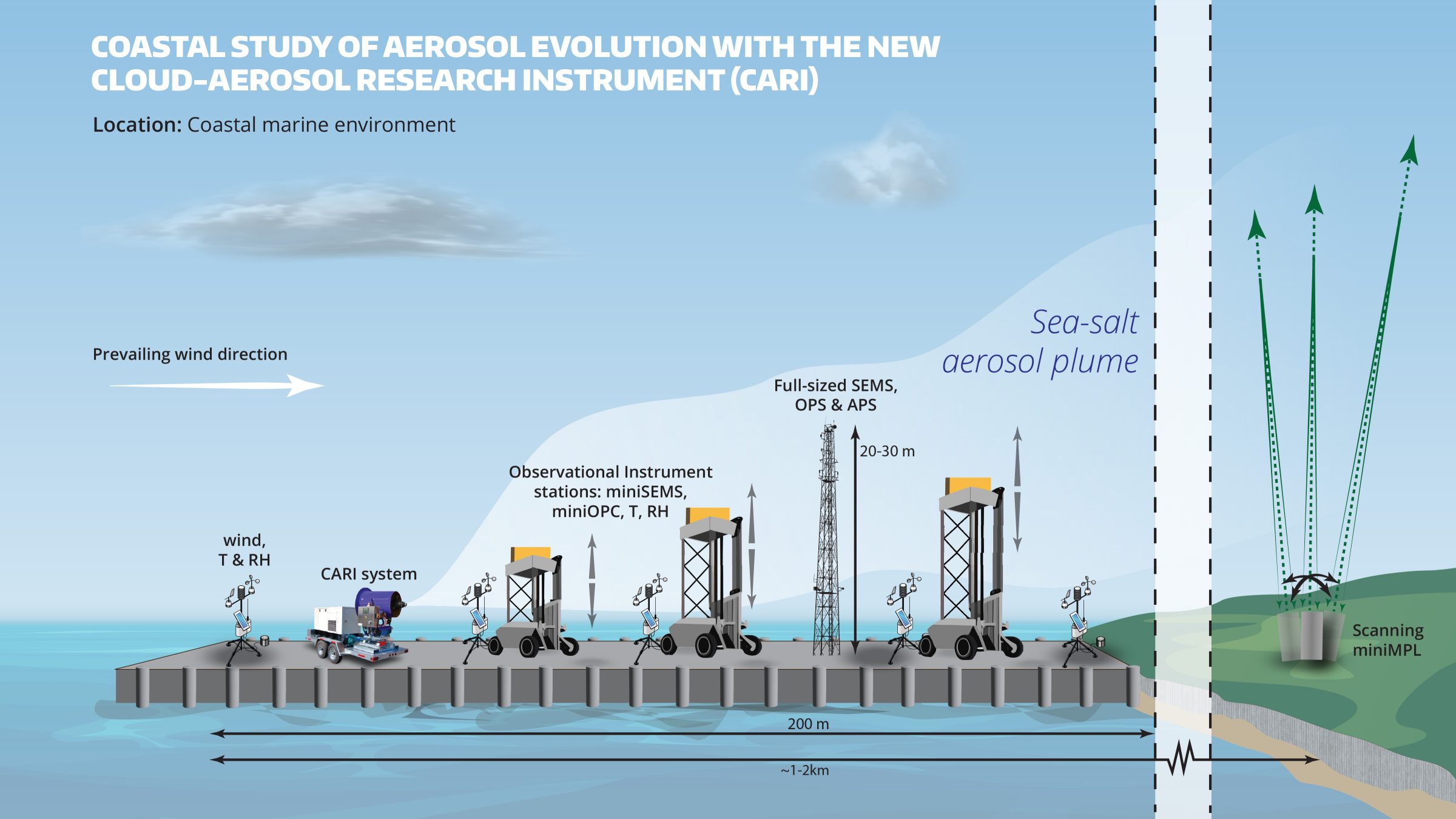
The Cloud-Aerosol Research Instrument (CARI) generates a sea salt plume, then measures the generated aerosol downwind to compare with computer simulations.
This spring, the Marine Cloud Brightening Program researchers are putting CARI to the test at a new research facility they’ve established onboard the USS Hornet Sea, Air and Space Museum — a Smithsonian affiliate — in Alameda, CA. There they have begun a series of small-scale studies in which CARI generates a sea salt plume, then measures the generated aerosol at multiple points downwind to compare with simulations generated from high resolution models.
Importantly, these studies are not large enough to have any effect on local weather conditions — naturally occurring sea spray from crashing waves along the coast puts more sea salt mass into the air than CARI, which will also only be run for 30 minutes or less at a time. But the researchers’ sensitive instruments will still be able to gather important data from these experiments.
Partnering with the public and other scientists
In addition to revealing new insights about how aerosols interact with clouds, these early outdoor studies are an opportunity to engage with other stakeholders and members of the public.
To that end, the program has established the Coastal Atmospheric Aerosol Research and Engagement (CAARE) facility, also housed at the USS Hornet Sea, Air and Space Museum. Open to scientists, students, community members, government officials, global stakeholders and members of the public, the research site is also an exhibit.
“This research is of the utmost importance to society, so transparency is crucial,” said Maya Tolstoy, Maggie Walker Dean of the UW College of the Environment. “I’m grateful to our researchers and partners for prioritizing engagement with the public, the scientific community and regulators in line with the University of Washington’s commitment to the public good.”
What’s next for marine cloud brightening?
Whether intentional marine cloud brightening should ever be used to address climate risks is a question that requires extensive scientific research, assessment by scientific experts, and informed and equitable decision-making by a global community of stakeholders.
Beyond the scientific questions being addressed by the Marine Cloud Brightening Program, the effort will continue to expand its direct engagement with the public to help inform, educate and receive input on the research. A high degree of openness and engagement is a critical part of the work, given that both pollution aerosols and any human climate intervention have the potential for far-reaching impacts on people, the climate and wildlife.
The researchers are motivated by a stark reality: As climate change worsens, it becomes increasingly likely that society will look to climate interventions such as MCB to help avoid the worst impacts of climate change. The Marine Cloud Brightening Program aims to provide the information needed to understand their potential benefits and risks.
“Improving our understanding of the influence of aerosols on clouds and climate is essential to understanding near-term climate risks, and whether and how marine cloud brightening could help reduce them,” said Doherty. “If we don’t improve our knowledge now, we’ll be flying blind. The international community needs the best information it can get in order to chart a responsible course into a future with a rapidly changing climate.”
The Farm to Fork Strategy is at the heart of the European Green DealSearch for available translations of the preceding aiming to make food systems fair, healthy, and environmentally friendly.
Food systems cannot be resilient to crises such as the COVID-19 pandemic if they are not sustainable. We need to redesign our food systems which today account for nearly one-third of global GHG emissions, consume large amounts of natural resources, resulting in biodiversity loss and negative health impacts (due to both under- and over-nutrition), and do not allow fair economic returns and livelihoods for all actors, in particular for primary producers.
Putting our food systems on a sustainable path also brings new opportunities for operators in the food value chain. New technologies and scientific discoveries, combined with increasing public awareness and demand for sustainable food, will benefit all stakeholders.
The Farm to Fork Strategy aims to accelerate our transition to a sustainable food system that should:
*have a neutral or positive environmental impact
*help to mitigate climate change and adapt to its impacts
*reverse the loss of biodiversity
*ensure food security, nutrition, and public health, making sure that everyone has access to sufficient, safe, nutritious, sustainable food
*preserve the affordability of food while generating fairer economic returns, fostering the competitiveness of the EU supply sector, and promoting fair trade.
The own-initiative report, adopted by MEPs during the plenary session in Strasbourg, was put together in reaction to the Commission’s organic action plan, unveiled back in March 2021.
The plan outlines a three-pronged attack designed to incentivize organic produce production and consumption across the bloc, in line with the ambitious target of 25% of agricultural land farmed organically by 2030, as outlined in the EU’s flagship Farm to Fork (F2F) food policy.
However, an explicit mention of the target was notably absent from the finalized text.
Farm2Fork: Do you have the appetite for change?
Instead, the report emphasizes the need for market-driven solutions, more support for member states in drawing up their national organic strategies, and research in organic farming to increase production in line with demand.
The report only expresses the position of the European Parliament – one of the two branches in the EU lawmaking process – on the matter. Still, it is not legally binding and will not amend the Commission’s political ambition either.
Welcoming the report’s adoption, center-right MEP Simone Schmiedtbauer, the Parliament’s author of the EU action plan on organic agriculture, stressed the sector will “only grow if the market for organic products grows.”
“The market should determine the extent of the growth of the organic sector, not any pre-set target figure,” Schmiedtbauer said, underscoring the need to focus on “practical issues of supply and demand”.
“The EU must support farmers to increase organic production and also consumers to find their way to these products”, she said.
For Schmiedtbauer, a “good mix of the right instruments, incentives and sufficient flexibility” is needed to allow each EU country the opportunity to “further develop its organic sector individually and bring the European organic vision into its own national or regional organic strategies”.
She said this, combined with clear labeling, controls, and certification, to help build consumer trust and stimulate demand.
Likewise, the EU organics association IFOAM welcomed its the own-initiative report, saying it “recognizes that organic contributes to more sustainable food systems and delivers ecosystem services,” including climate change, mitigation, biodiversity, and soil protection.
However, for Green MEP and shadow rapporteur on the organic action plan, Claude Gruffat, who tabled the rejected amendment to include the target in the report explicitly, the adopted text was sorely lacking in ambition.
“I deplore the rejection of various amendments that aimed to improve the unambitious text adopted in committee, including those aimed at including the objective of 25% of agricultural land in organic farming as well as the one for increased support for the introduction of organic products in school canteens and collective catering in Europe,” he said.
The second amendment tabled by the MEP, also rejected by the plenary, aimed to improve the place of organic products in collective catering by supporting local authorities and territorial actors in their action project in favor of a sustainable and resilient healthy food system.
This was put forward to stimulate demand by promoting organic products in collective catering, particularly in schools, by supporting local authorities and territorial players in their action, according to the MEP, who lambasted the Parliament for its lack of ambition in this area.
“I do not understand the lack of willpower on the part of my fellow MEPs,” he lamented.
Final thoughts
Building sustainable food systems together’ is an annual gathering of European stakeholders interested in helping to shape the EU’s path towards sustainable food systems. This means “we are more on track,” the head of CCRES, Zeljko Serdar.
Croatia has approximately 1.5 million hectares (ha) of used agricultural land and 2.5 million ha of forests. Croatia has favorable conditions for diverse farming but is self-sufficient only in the production of wheat, corn, poultry, eggs, and wine. Imports of agricultural and food products continue to grow. Responding to these challenges requires a science- and expertise-based approach, one that addresses the broad range and complexity of these issues holistically and sustainably. Agri-food systems are dynamic structures, in a state of constant change and adjustment, which makes building effective collaborations with all its stakeholders extremely complex, but also necessary for transformation. These are the challenges that all of us are facing.
The adoption of the text will now be followed by the publication of a midterm review from the Commission on the action plan planned for 2024. Stakeholders across the food value chain, public authorities, international and civil society organizations, as well as other citizens and the interested public are invited to join the debate every year and contribute to the implementation of the Farm to Fork Strategy Search for available translations of the preceding for a fair, healthy and environmentally friendly food system.
Members of the European Parliament have voted to ban the sale of new petrol and diesel cars by 2035. The move aims to step up the fight against climate change through the faster development of electric vehicles.
The voting was held on an amendment that would have allowed some auto emissions from new vehicles after 2035, which was rejected by Members of Parliament.
The European Union assembly voted in Strasbourg, France to require automakers to cut carbon-dioxide emissions by 100 percent by the middle of the next decade. The mandate would amount to a prohibition on the sale in the 27-nation EU of new cars powered by gasoline or diesel.
Members of the European Parliament still have to negotiate the final law with ministers from the EU’s 27 national governments. Yesterday's vote has however increased the pressure on governments for a clear end to the internal combustion engine in the EU single market of 447 million people.
Negotiations to determine the final shape of the law are set for later this year. If an agreement is reached, it effectively spells the end of the combustion-engine car in Europe, marking a radical overhaul of a form of transport.
EU lawmakers also endorsed a 55 percent reduction in CO2 from automobiles in 2030 compared with 2021.
The move deepens an existing obligation on the car industry to lower CO2 discharges by 37.5 percent on an average by the end of the decade.