Pitomi kesten
Kesten je jednodomna biljka, pri kojoj se na istom stablu nalaze razdvojeni muški i ženski cvjetovi. Ženski cvjetovi združeni su po 2 - 3 u grozdove i nalaze se na kraju listnih izdanaka. Muški cvjetovi združeni su u kitice (dihazije, mačice) i razvijaju se pri osnovi ljetnih izdanaka. Kesten cvate u lipnju i srpnju. Oprašivanje vrše vjetar i kukci (pčele). Važno je da se posade razne sorte kestena radi međusobnog oprašivanja. Plod je crvenkasto-smeđe boje i glatke površine. Raste unutar bodljikave košuljice koja se raspukne u jesen kada plod sazrije. Listanje kestena započinje u travnju. Listovi su duguljasti, krupno nazubljeni, 8 - 18 cm dugi i 3 - 6 cm široki, na licu goli, a na naličju dlakavi.Drvo kestena je u srodstvu s bukvom i hrastom, dugovječno, može narasti u visinu do 25 m s bujnom, velikom krošnjom i godišnje dati preko 200 kg plodova. Kora mu je glatka i sivosmeđa. Može doseći starost preko 500 godina. Botaničari kesten ubrajaju u voćke, no zbog načina i mjesta rasta spada i u šumsko drveće. Mjestimično čini i šume, a često se javlja u zajednici s hrastom kitnjakom i grabom.Agroekološki uvjeti za podizanje nasada kestena
TemperaturaPitomi kesten je voćka toplih krajeva i pripada grupi heliofilnih biljaka kojima je potrebno puno svjetlosti. Pitomom kestenu najviše odgovara mediteranska i umjereno-kontinentalna klima sa srednjom godišnjom temperaturom od 11 - 15 °C. Uspješna proizvodnja moguća je na temperaturama do 37 °C i -26 °C jer temperature veće od 37 °C i manje od 26 °C onemogućavaju plodonošenje.VodaVoda je od izuzetne važnosti u periodu razvijanja cvjetnih pupoljaka, cvjetanja, zametanja plodova i njihovog porasta. Za dobar rast i razvoj cjelokupnog debla potrebno je provođenje navodnjavanja tijekom uzgoja. U periodu sađenja, mladicama treba osigurati najmanje 60 l vode raspoređeno na tri dijela po 20 l.TloIzbjegava se vapno i vapneni dodatci jer na takvim mjestima kesten slabije uspijeva. Vrlo je važno da tlo bude dobro strukturirano i duboko tako da se u njemu može razvijati kestenov snažan korijen. Najpogodnija su ilovasto-pjeskovita zemljišta u kojima je odnos gline prema pjesku 60:40 i pH vrijednost se kreće od 4,0 do 6,0.Agrotehnika pri podizanju nasada kestena
Priprema tla za sadnjuIako je kesten šumska biljka, dobro reagira na gnojenje dušikom, a može mu se dodati i nešto fosfora i kalija. Teren se čisti od krupnog kamenja, panjeva, žila ostalog drveća i žbunja. Tlo se zatim ravna kako bi se obavila gnojidba, oranje i sadnja. Ukoliko je teren na kojem se planira podizanje nasada pitomog kestena suviše strmo, potrebno je napraviti terase. Poslije pripreme tla za sadnju obavlja se rigolanje na 60 - 80 cm dubine.GnojidbaU periodu starosti, ako se mjerama rezidbe pitomi kesten pomlađuje, potrebno je gnojiti dušičnim gnojivima da bi se što bolje i više razvile mladice na kojima se razvijaju cvjetovi i plodovi. U periodu pune rodnosti, da bi se ostvario prinos od 10 000 kg/ha potrebo je u tlo aplicirati 135 kg/ha dušika, 40 kg/ha fosfora i 150 kg/ha kalija. Radi održavanja humusa u tlu na najmanje 3 %, treba svake godine u jesen zaorati po 10 000 kg/ha stajnjaka.Održavanje nasadaVrši se međuredna kultivacija. Zemljište se obavezno praši, tj. usitnjava sloj zemlje na dubini 5 - 7 cm. Usitnjavanje se vrši i poslije navodnjavanja, kako se ne bi stvorila pokorica i na taj način brzo gubila vlaga. Zemljište u nasadu pitomog kestena se u toku ljeta obrađuje uglavnom do kraja srpnja, što zavisi od učestalosti i obilnosti kiša. Zemljište od polovice kolovoza ne bi trebalo obrađivati jer bi se stvorili uvjeti za produžetak vegetacije i stabla kestena bi u period mirovanja ušla sa nesazrelim mladicama koje bi zbog mraza mogle izmrznuti. Kesten se orezuje kada je u fazi mirovanja i to uglavnom u svrhu pomlađivanja, tj. uklanjanja starih grana.Proizvodnja sadnicaSadnice pitomog kestena proizvode se generativno (sjetvom plodova u kojima se nalazi jedan ili više sjemenih zametaka) i vegetativno (izdancima i kalemljenjem). Obavljaju se operacije odabiranja, stratifikacije, zasnivanje rastila (priprema zemljišta za sadnju i njegu podloga), kalemljenje, uzgoj sadnica, vađenje, trapljenje, pakovanje i prijevoz sadnica.Prije sadnje na stalno mjesto, žile na sadnicama se prorjeđuju i skrate za 1/3. Potapaju se u homogenu smjesu napravljenu od goveđeg gnoja, ilovače i vode.Izbor položaja za podizanje nasada kestena
Najprimjereniji položaj za kesten je položaj koji je osvjetljen i s kojega voda dobro otječe, s rahlim tlom bogatim humusom, i što je važno, blago kiselim. Takvi su južni, jugoistočni i istočni položaji.Izbor uzgojnog oblika kestena
Kesten se uzgaja u piramidnu ili kotlastu krošnju. Orezivanje je ograničeno na najnužnije zahvate, a obuhvaća čišćenje krošnje i usmjeravanje grana. Sve rane nastale orezivanjem potrebno je premazati voskom za cijepljenje.
Vrijeme i tehnika sadnje kestena
Prilikom sadnje, sadne jame moraju biti nešto veće (70 - 80 ili 100 cm dubine). Potrebno je osigurati dovoljnu količinu humusa. Zemlji kojom se zatrpava jama oko sadnice treba dodati 2 kg kompleksnih mineralnih gnojiva (NPK 0:15:30). Razmak sadnje mora omogućiti dovoljno širok hranjivi prostor i maksimalan razvoj krošnje te što lakše kretanje mehanizacije. Najbolji rezultati i najviše sadnica se posadi ako se sadi po principu jednakostraničnog trokuta.Kada se sadi u jesen, što je i najpogodnije, sadnica se ne zalijeva, već se oko nje nabaci zemlja u vidu humka (visine 15 cm) i tako ostavi do proljeća. Na isti se način vrši sađenje i u toku zime. Ako se sadi u proljeće, oko svake sadnice napravi se ljevkasto udubljenje i zalije s 8 - 10 l vode. Kada zemlja upije vodu, udubljenje treba prekriti sitnom zemljom ili zrelim stajskim gnojem u sloju od 4 - 5 cm.Berba i skladištenje kestena
U rujnu, kada plodovi zore, mogu se lako otresti, ili se pak pusti da sami popadaju s drveta. Ljuštenje plodova iz ježinaca koji su pali na tlo, pospješuje se tako da se ježinci pograbljaju na hrpu i tako ostave nekoliko dana. Plodovi nakon nekoliko dana dodatnog zorenja sami ispadaju iz ježinaca i tada su i ukusniji.Plodovi kestena pohranjuju se u spremišta ili skladišta pri 80 % relativne vlažnosti zraka i pri temperaturi od 0 °C. U takvim uvjetima plodovi mogu izdržati dva do tri mjeseca.Troškovi osnivanja nasada
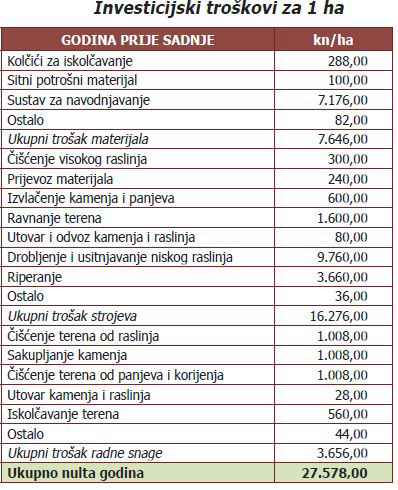
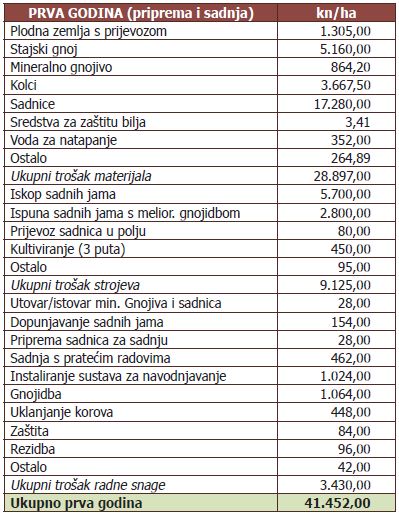
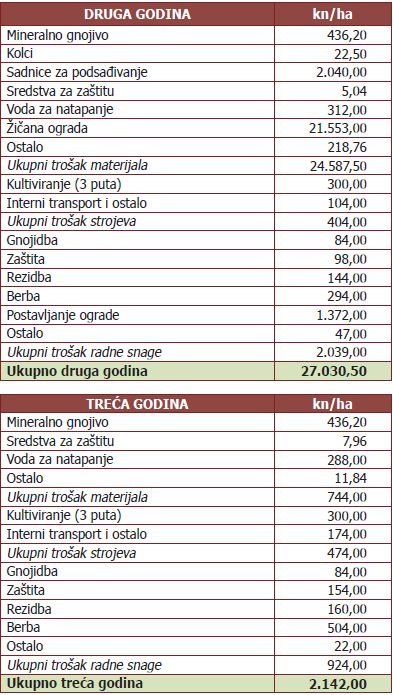
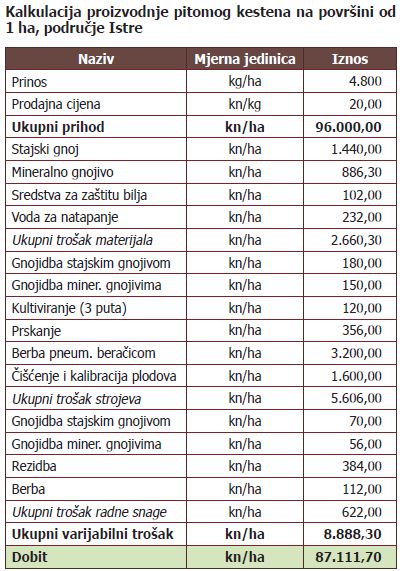
Za 1 ha površine potrebno je 120-150 sadnica kestena, za koje je potrebno od 15.000- 20.000 kn, a koje mogu dati 3-5 tona ploda u punoj rodnosti. Kada plodovi dozore moguće ih je otresati, bilo ručno čime je moguće ubrati oko 15 kg ploda dnevno, bilo strojno – usisivačima koji dnevno beru 200-250 kg ploda. Cijena takvog stroja iznosi 8-12.000 €. Plodove je moguće i pustiti da sami padnu na tlo, pa onda obaviti berbu. Skladište se pri relativnoj vlazi zraka od 80% i temperaturi od 0°C, te ih je u tim uvjetima moguće čuvati 2-3 mjeseca.U investiciji najveći udio imaju troškovi sadnica s udjelom od 19% u ukupnoj investiciji. To je i razumljivo budući da je za dobar urod nužna sadnja selekcioniranih sadnica visoke kvalitete koje imaju visoku nabavnu cijenu.Sadnja sjemenjaka nije preporučljiva jer se dobivaju biljke neujednačene kvalitete i rodnosti. U intenzivnim nasadi ma ovakvoga tipa neophodno je navodnjavanje, da bi sadnice razvile svoj genetski potencijal i dale očekivani urod. Sustav za navodnjavanje čini 8% troška investicije. Kesten se prodaje na tržištu za konzumaciju u svježem stanju ili za preradu. Ranosezonski kesten ostvaruje veću prodajnu cijenu od kasnojesenskog. U Hrvatskoj se kesten uglavnom konzumira na tradicionalan način, kuhan ili pečen, i to samo u sezoni sazrijevanja dok je tržište ostalih prerađevina kestena jako skromno. Treba napomenuti da u kalkulaciju nisu ušli fiksni troškovi kao što su amortizacija, te trošak stalno zaposlenih radnika. Ovakav prinos je moguće ostvariti samo uz visokokvalitetne sadnice njegovane odgovarajućim agrotehničkim mjerama, uključujući natapanje. Kalkulacija je rađena za godine pune rodnosti nasada, koje se kod pitomog kestena ostvaruju oko 15. godine starosti. U troškovima se ističe trošak berbe s udjelom od 36%, koji bi u slučaju ručne berbe bio još puno veći. Uzgoj pitomog kestena može biti zanimljiv, osobito uzgoj maruna koji postiže i duplo višu otkupnu cijenu od ostalih sorti kestena , ali je potrebno kod podizanja nasada koristiti kvalitetne sadnice, uz korištenje natapanja za ostvarivanje visokih prinosa. Investicija u nasad traje četiri godine, a nasad u puni rod ulazi oko 15-te godine. Zbog raka kestenove kore, koji napada europske sorte kestena i marune, u osnivanju nasada je potrebno razmisliti o sadnji križanaca europskog kestena s japanskim ili kineskim, jer njih osim otpornosti na rak kore karakterizira i raniji ulazak u rodnost, što može povećati ekonomičnost, ali se kao ograničenje javlja osjetljivost na kasne mrazeve.Odlučite li se za sadnju kestena maruna bitno je znati:pH zemljišta mora biti ispod 6,5 (blago kisela)kesten marun voli prozračna i ocijedita tla gdje se voda ne zadršava dulje vrijeme (blagi nagibi su idealni)birajte sorte ili hibride otporne na rak kestenove kore, osu šiškaricu i trulež korijenaprvih godina voli da ga se navodnjava, a kasnije je navodnjavanje dodatan plussadnice kojima je korijen mikoriziran micelijem mikoriznih gljiva jamče veću otpornost na sušu, fitoftoru, brži rast i veću apsorpciju hranjivih tvari iz zemljeranije sorte su osjetljive na kasni proljetni mraz kao i orasi pa im više odgovaraju povišena mjesta 300 – 600 m ili mjesta gdje su rijetki jači mrazevivoli sunce, no mlade sadnice je potrebno zaštiti od prejakoga sunca bojanjem stabla vapnom ili stavljanjem zaštitnih tuba koje ujedno štite voćku od glodavacaprilikom obrezivanja ili jačeg ranjavanja kore obavezno je voćarskim voskom premazati ranu kako bi se spriječila eventualna gljivična infekcijabirajte sorte ili hibride pogodne za vašu klimu i svrhu (plodovi, drvo, med)maruni u pravilu nisu samooprašivi pa je potrebno zasaditi barem dvije ili više sortimogući je ekološki uzgoj ili konvencionalni kao i kod većine voćnih vrstamaruni rode već od svoje treće godine starosti, dok se puni prinos očekuje nakon 10. godinemožete iskoristiti bespovratna sredstva iz EU fondova za podizanje trajnog nasadaOd kada je sredinom prošlog stoljeća sa kineskoga kestena prenešena gljivična infekcija (tzv. rak kore) na europski kesten došlo je do devastacije velikog djela kestenovih šuma što je uzrokovalo porast cijene kestena. Srećom razvijeni su hibridi koji imaju visoku otpornost, a pojedini sorte su i same stekle imunitet.Posljednjih godina cijena maruna u maloprodaji kod nas kretala se od 45 kn/kg za talijanske marune te 60 kn/kg za krupnije španjolske i portugalske.Na jedan hektar plantažeri prosječno sakupe od 3000-4000 kg, a neki čak i do 6000 kg prema španjolskim izvorima, ovisno o agrotehničkim mjerama i sustavu sadnje, što kesten marun čini vrlo profitabilnom i zanimljivom voćnom vrstom kako za profesionalce tako i za one koji imaju viška zemlje, a ne žele poput većine saditi lješnjake ili orahe.Kod podizanja plantažnog nasada kestena maruna bitno se držati gore nabrojenih preduvjeta, odlučiti se za sklop sadnje koji se najčešće kreće od 6 x 6m, 7 x 9m, 10 x 10m pa na više, odabrati idelane sorte, njihov omjer i nabaviti kvalitetne sadnice.Obavezno obratite pažnju na podlogu na koju je cijepljena plemka. Ona bi također trebala biti vegetativno razmnoženi hibrid (klon) otporan na trulež korijena te koji je kompatibilan sa plemkom. Podloge izrasle iz sjemena kestena (tzv. sjemenjaci) to nisu te vam dugoročno ne jamče otpornost na trulež korijena kao ni kompatibilnost sa plemkom pa može doći do pucanja kore i infekcije rakom kore.
Thursday, August 13, 2020
Pitomi kesten - uzgoj





Monday, August 3, 2020
To Prune or not to Prune

Just for a moment, think about the last time you chomped on a mouthful of juicy peaches, savored freshly-made apricot jam or tasted a slice of warm apple pie. We take great delight from these and a variety of other fruits that grow in great abundance throughout the Croatia. It’s hard to imagine life without them.
One key to preserving these delicious traditions is maintaining the health and productivity of the fruit trees in your own backyard through proper pruning methods. Pruning will improve the overall health and growth of your fruit tree. Pay attention to the structure of your tree annually, and you’ll add years of better production.
The ideal time to prune your fruit trees is in the late winter and early spring before bud-break, bloom and leaf emergence. This is when the trees are dormant, which reduces stress and allow cuts to heal or harden off. No foliage makes pruning easier. There may be rare occasions when it’s necessary to prune in the summer, for instance if you need to open a canopy for greater light penetration.
Thinning overgrown trees to remove dead or unhealthy limbs/branches to allow for better light infiltration is one of several reasons to prune your fruit trees. The more leaves exposed to good light, the more energy that is produced. Thinning the limbs also helps produce fruit with less bruising and scarring.
Pruning controls the height of a tree and the size of the branches. Three or four main branches with smaller limbs will carry fruit better than long, thin branches and improves weight distribution on your fruit tree.
Pruning makes it possible for you to shape the tree. You can decide the height of the branches for picking fruit and/or how low to the ground they are for mowing around them.
Although fruit trees are generally pruned to a height comfortable for picking, it’s important to understand that each species or type of fruit tree should be pruned differently.

Fruit trees that produce “pome fruits,” including apples and pears, have a core of several small seeds surrounded by a tough membrane.
For these types of fruit trees, we recommend the “central leader” style of pruning, which creates a sort of pyramid shape with a strong center. To do this, preserve a single main, vertical trunk by removing competing upright shoots. Select and prune around three or four scaffold branches about 20-30 inches up from the ground with three or four upper scaffold branches about 18-20 inches above the first set. All the scaffold branches should be angled about 45-60 degrees from the trunk.
Apples and pears both develop better fruit on horizontal branches. Keep in mind that fruiting buds on apple and pear trees produce more fruit on terminal buds or buds at the end of a branch or spur, so take care to preserve as many of these buds as possible when pruning. Apples and pears produce fruit on 2-year-old branches/spurs.
For these types of fruit trees, we recommend the “central leader” style of pruning, which creates a sort of pyramid shape with a strong center. To do this, preserve a single main, vertical trunk by removing competing upright shoots. Select and prune around three or four scaffold branches about 20-30 inches up from the ground with three or four upper scaffold branches about 18-20 inches above the first set. All the scaffold branches should be angled about 45-60 degrees from the trunk.
Apples and pears both develop better fruit on horizontal branches. Keep in mind that fruiting buds on apple and pear trees produce more fruit on terminal buds or buds at the end of a branch or spur, so take care to preserve as many of these buds as possible when pruning. Apples and pears produce fruit on 2-year-old branches/spurs.

Peaches and apricot trees should be pruned on an open vase system. Fruiting buds on peach and apricot trees only occur on the second year of growth on branches. Prune out about 50 percent of the branches that produced last year and leave enough new growth for the fruit to bloom. Pay attention to the weight distribution. Cutting that much of the tree out will stimulate new growth for next year’s production and pruning. Remove all suckers, shoots coming from the roots or stem below the graft, on a regular basis. Once harvested, enjoy your peaches and apricots dried, frozen, canned/bottled, made into jam or eaten fresh.
Sweet cherry trees grow tall at a fast rate and tart cherry trees naturally stay smaller. With sweet cherries, skip a single year of pruning in the open vase style. Fruiting buds occur on older wood in spurs, small but noticeable clusters of buds that produce flowers. Both sweet and tart varieties of cherries are grown in our region, and are enjoyed fresh off the tree, in mouthwatering pies, and much more.

Whether new or established, plum trees need annual pruning in an open vase style. As the tree fills out with new growth, continue to prune to form a canopy.
When you finish pruning, be sure to dispose of all removed branches. It’s important to burn or take away any wood that appears diseased or had past problems.
The better you get at pruning your fruit tree’s branches, the more likely you will enjoy bigger, sweeter fruit, even on lighter production years. When all the work is done, may you relish the fruits of your labor and let us know how we can offer greater service whether you’re planting, pruning or preserving.
Sunday, July 26, 2020
Resilience

Life may not come with a map, but everyone will experience twists and turns, from everyday challenges to traumatic events with more lasting impact, like the death of a loved one, a life-altering accident or a serious illness. Each change affects people differently, bringing a unique flood of thoughts, strong emotions and uncertainty. Yet people generally adapt well over time to life-changing situations and stressful situations — in part thanks to resilience.
“We have known for a long time that agroforestry can enhance resilience,” says Zeljko Serdar, from the CCRES team. “For example, trees in livestock-keeping and cropping systems provide people with diversified incomes, with food and fodder when crops fail, and they can help improve soil health.”
“This type of resilience is absolutely critical in areas such as the drylands of East Croatia where communities are struggling to cope with more frequent droughts and flash floods.”
Until recently, the exact contribution of trees to resilience in this region had been poorly explored, but in 2017 the assessment report, was published. (https://solarserdar.blogspot.com/2017/09/agroforestry-in-croatia.html )
It compiles what experts in research, academia, government, farmers and development practitioners already know about the links between trees and resilience in East Croatia drylands.
Studies at CCRES have shown that a 100 hectare agroforestry farm produces as much as a traditional farm of 130 to 160 hectares where trees and crops are grown separately. This finding has also led to modification of the European Common Agriculture Policy towards agroforestry.
Research on carbon sequestration, water quality protection and biodiversity at CCRES will be discussed during the session in addition to what policies and governance mechanisms are required to support agroforestry and other measures that maintain and improve environmental services.
Psychologists define resilience as the process of adapting well in the face of adversity, trauma, tragedy, threats or significant sources of stress — such as family and relationship problems, serious health problems, or workplace and financial stressors. As much as resilience involves "bouncing back" from these difficult experiences, it can also involve profound personal growth.
While these adverse events, much like rough river waters, are certainly painful and difficult, they don’t have to determine the outcome of your life. There are many aspects of your life you can control, modify and grow with. That’s the role of resilience. Becoming more resilient not only helps you get through difficult circumstances, it also empowers you to grow and even improve your life along the way.
What resilience isn’t
Being resilient doesn’t mean that a person won’t experience difficulty or distress. People who have suffered major adversity or trauma in their lives commonly experience emotional pain and stress. In fact, the road to resilience is likely to involve considerable emotional distress.
While certain factors might make some individuals more resilient than others, resilience isn’t necessarily a personality trait that only some people possess. On the contrary, resilience involves behaviors, thoughts and actions that anyone can learn and develop. The ability to learn resilience is one reason research has shown that resilience is ordinary, not extraordinary. One example is the response of many Americans to the Sept. 11, 2001 terrorist attacks and individuals' efforts to rebuild their lives after tragedy.
Like building a muscle, increasing your resilience takes time and intentionality. Focusing on four core components — connection, wellness, healthy thinking and meaning — can empower you to withstand and learn from difficult and traumatic experiences. To increase your capacity for resilience to weather — and grow from — the difficulties, use these strategies.
Build your connections
Prioritize relationships. Connecting with empathetic and understanding people can remind you that you’re not alone in the midst of difficulties. Focus on finding trustworthy and compassionate individuals who validate your feelings, which will support the skill of resilience.
The pain of traumatic events can lead some people to isolate themselves, but it’s important to accept help and support from those who care about you. Whether you go on a weekly date night with your spouse or plan a lunch out with a friend, try to prioritize genuinely connecting with people who care about you.

Join a group like CCRES. Along with one-on-one relationships, some people find that being active in civic groups, faith-based communities, or other local organizations provides social support and can help you reclaim hope. Research groups in your area that could offer you support and a sense of purpose or joy when you need it.
Foster wellness
Take care of your body. Self-care may be a popular buzzword, but it’s also a legitimate practice for mental health and building resilience. That’s because stress is just as much physical as it is emotional. Promoting positive lifestyle factors like proper nutrition, ample sleep, hydration and regular exercise can strengthen your body to adapt to stress and reduce the toll of emotions like anxiety or depression.
Practice mindfulness. Mindful journaling, yoga, and other spiritual practices like prayer or meditation can also help people build connections and restore hope, which can prime them to deal with situations that require resilience. When you journal, meditate, or pray, ruminate on positive aspects of your life and recall the things you’re grateful for, even during personal trials.
Avoid negative outlets. It may be tempting to mask your pain with alcohol, drugs or other substances, but that’s like putting a bandage on a deep wound. Focus instead on giving your body resources to manage stress, rather than seeking to eliminate the feeling of stress altogether.

Find purpose
Help others. Whether you volunteer with a local homeless shelter or simply support a friend in their own time of need, you can garner a sense of purpose, foster self-worth, connect with other people and tangibly help others, all of which can empower you to grow in resilience.
Be proactive. It’s helpful to acknowledge and accept your emotions during hard times, but it’s also important to help you foster self-discovery by asking yourself, “What can I do about a problem in my life?” If the problems seem too big to tackle, break them down into manageable pieces.
For example, if you got laid off at work, you may not be able to convince your boss it was a mistake to let you go. But you can spend an hour each day developing your top strengths or working on your resume. Taking initiative will remind you that you can muster motivation and purpose even during stressful periods of your life, increasing the likelihood that you’ll rise up during painful times again.
Move toward your goals. Develop some realistic goals and do something regularly — even if it seems like a small accomplishment — that enables you to move toward the things you want to accomplish. Instead of focusing on tasks that seem unachievable, ask yourself, "What's one thing I know I can accomplish today that helps me move in the direction I want to go?" For example, if you’re struggling with the loss of a loved one and you want to move forward, you could join a grief support group in your area.

Look for opportunities for self-discovery. People often find that they have grown in some respect as a result of a struggle. For example, after a tragedy or hardship, people have reported better relationships and a greater sense of strength, even while feeling vulnerable. That can increase their sense of self-worth and heighten their appreciation for life.
Embrace healthy thoughts
Keep things in perspective. How you think can play a significant part in how you feel — and how resilient you are when faced with obstacles. Try to identify areas of irrational thinking, such as a tendency to catastrophize difficulties or assume the world is out to get you, and adopt a more balanced and realistic thinking pattern. For instance, if you feel overwhelmed by a challenge, remind yourself that what happened to you isn’t an indicator of how your future will go, and that you’re not helpless. You may not be able to change a highly stressful event, but you can change how you interpret and respond to it.
Accept change. Accept that change is a part of life. Certain goals or ideals may no longer be attainable as a result of adverse situations in your life. Accepting circumstances that cannot be changed can help you focus on circumstances that you can alter.
Maintain a hopeful outlook. It’s hard to be positive when life isn’t going your way. An optimistic outlook empowers you to expect that good things will happen to you. Try visualizing what you want, rather than worrying about what you fear. Along the way, note any subtle ways in which you start to feel better as you deal with difficult situations.
Learn from your past. By looking back at who or what was helpful in previous times of distress, you may discover how you can respond effectively to new difficult situations. Remind yourself of where you’ve been able to find strength and ask yourself what you’ve learned from those experiences.

Seeking help
Getting help when you need it is crucial in building your resilience.
Why invest in resilience?
There’s no denying it: social, economic, climatic and environmental indicators warn of uncertain times ahead. But while some advisors may recommend investments far afield, here at CCRES we offer practical solutions close to home.
We believe that high-performance properties that merge shelter, water, renewable energy, and food with revenue generation, community development, and ecosystem and wildlife habitat restoration, provide a secure and lasting source of land-based wealth. Tangible wealth that employs and restores nature’s healthy local abundance rather than relying upon fluctuating markets and currencies.
Properly managed, this natural capital can become the living heart of your investment portfolio. A dynamic, self-sustaining and diversified asset firmly ensures your personal autonomy and resilience, enabling you to thrive no matter what.
For many people, using their own resources and the kinds of strategies listed above may be enough for building their resilience. But at times, an individual might get stuck or have difficulty making progress on the road to resilience.
Monday, July 20, 2020
Turkmenistan renewable energy 2020

The renewable energy sector has shown an exceptional growth over the past two decades. Today, renewable energy is seen as a cheap and clean source of power as opposed to being costly and unreliable earlier.
The world today is faced with an ever growing need for power. Rapid increase in population, along with growing industrialization and urbanization, has kept the world’s energy need on a growth trajectory. The growing energy need cannot be fully satisfied by conventional power generation methods, and this will therefore serve as a major factor enabling the growth of the renewables industry. Another factor that is aiding the renewable industry is the efficient collaboration between the governments, and the private sector. This collaboration, characterised by public policies and industrial investments, has seen innovations in renewable energy technology, ranging from wind to solar. This has resulted in a steep fall in the cost of renewable energy technologies, thereby making it affordable for applications, including small rooftop installations. The growing concerns regarding greenhouse gas emissions and other pollutants that lead to consequences like environmental damage and global warming, are prompting governments to look for cleaner power generation options. This is again proving to be beneficial to the renewables industry.

There are various factors restraining the renewables industry today. One of the major factors is the dependence of renewable energy generation on factors like the weather, which makes it unreliable. Solar and wind energy plants are most affected by these factors. In spite of this, wind and solar are the most popular sources of renewable energy today. The large space requirement of renewable energy plants also makes them an unviable option in some cases. Growing investments and technological advancements are however helping in overcoming some, if not all, of these restraints. There has been a growth in small-scale renewable energy generation in the form of rooftop solar installations, advancement in power storage technologies, and development of smart grids that enable selling additional power back to the grid. These will help overcome the major restraints that the renewable energy industry faces today, thereby boost the growth of the market.
Turkmenistan renewable energy market report provides a comprehensive analysis of the market for wind, solar, hydro and other renewable energy sources. This report also includes key project information of both pipeline and upcoming projects. Key drivers and restraints that are effecting the growth of this market are discussed in detail. The study also elucidates on competitive landscape and key market players (both domestic and international) across various types of renewable energy sources.

On July 9, 2020, the first meeting of the Interdepartmental Working Group on the working out the National Strategy of Turkmenistan on the Development of Renewable Energy with the participation of international organizations was held in a video conference format.
The meeting was attended by the heads and representatives of the Ministries of Foreign Affairs, Energy, Finance and Economics, Agriculture and Environmental Protection, Construction and Architecture of Turkmenistan, state concerns "Türkmengaz", "Türkmennebit". The meeting was also attended by the Director of the Country Support and Partnership Department of the International Renewable Energy Agency (IRENA) Gurbuz Gonul, the Head of the OSCE Center in Ashgabat, Ambassador Natalya Drozd and UNDP representatives.
During the meeting, the participants spoke on the topics: “Global trends and prospects for the use of renewable energy sources in Turkmenistan”, “Ways of developing renewable energy in Turkmenistan”, “Implementation of scientific projects based on renewable energy sources”, “Using international experience to develop the National Strategy of Turkmenistan on the development of renewable energy".

There was also a presentation on the activities of the OSCE Center in Ashgabat in providing support in the field of renewable energy development, and a presentation on the prospects of cooperation between the Ministry of Energy of Turkmenistan and UNDP on the development of renewable energy. During the discussion of the draft content of the National Strategy, the participants exchanged views on global trends and on the current state of renewable energy development.
Summary

The modern history of Turkmenistan.
"We will perform deep processing of hydrocarbon resources based on modern technologies and make high quality production which is on high demand in the world, for example gasoline, polypropylene, polyethylene and liquefied gas". - President Gurbanguly Berdimuhamedov
For the past period, the industrial infrastructure of the country has been supplemented by such petrochemical giants as polymeric plant in seaside Kiyanly and carbamide plant in Garaboz, Balkan Velayat, first in the world plant for production of gasoline from natural gas in Ahal Velayat. Deep processing of natural gas and making of production, which meets the world quality standards, are carried out at these innovative facilities based on modern technologies.
According to President Gurbanguly Berdimuhamedov, the opening of similar facilities is one of the main factors of further development of the economy of the country, improvement of its technological safety, expansion and diversification of sales markets of production with high added value, stimulation of development of all branches of national economy.
In this context, the great importance of the project of construction of Turkmenistan - Afghanistan - Pakistan - India gas line, which in addition to the attraction of big dividends to the country would bring the light and warmth to homes of neighboring nations, has been noted.
Today, the works for the implementation of the project of this transnational corridor are actively carried out according to the schedule. Together with the beginning of construction of Afghan part of TAPI in February 2018, laying of power and fiber optic lines along Turkmenistan - Afghanistan - Pakistan (TAP) route has been held. At the same time, Serhetabat - Turgundy railroad, which was built at the request of the Head of the State, has been put into operation.
Implementation of the TAPI gas line project, which starts from the Galkynysh Deposit, which is the first in world inland gas reserves, will support strengthening of peace and sustainable development in addition to solving current social issues in the region. Opportunity to open 5,000 new working places will appear.
Turkmenistan has not only rich reserves of hydrocarbon resources. The subsoils of the country have ore deposits of almost all metals of the periodic table. Their development, production and processing are the main directions of economic policy of the President.
"We will continue to work on the successful realization of huge economic and natural potential for the sake of current and future generations of our people", - the Head of the state said at the inauguration ceremony.
Large-scale construction expanded all over the country under realization of integrated social and economic programs provided growing demands in quality construction materials, having given impetus to rapid development of their production from local resources. Glass production facility Türkmen aýna önümleri, which was put into operation with the participation of President Gurbanguly Berdimuhamedov in the middle of February 2018, has become an example of a wise approach to the solution of objective of expansion of export.
There were earlier projects and some progress in the sense that Turkmenistan, rich in oil and gas resources, is heading for the development of renewable energy. But now, this has been immediately supported by three Decrees issued by President Berdimuhamedov at a Cabinet meeting via a video link.
The first document provides for the establishment of an Interdepartmental Working Group for Developing a National Renewable Energy Development Strategy to ensure power stability in the country.
The second document authorizes the Foreign Ministry to engage international organizations and other international establishments in the preparation of a Draft National Renewable Energy Development Strategy in Turkmenistan.
And finally, by the third Decree of the head of state, Turkmen Ambassador to the United Arab Emirates (Abu Dhabi) Serdarmammet Garajaev was appointed Permanent Representative of Turkmenistan to the International Renewable Energy Agency.

Friday, July 17, 2020
$53.4 Million in Small Business Research and Development

The U.S. Department of Energy’s (DOE) Office of Energy Efficiency and Renewable Energy (EERE) will fund 49 new Small Business Innovation Research (SBIR) and Small Business Technology Transfer (STTR) research and development projects across 23 states, totaling nearly $53.4 million in funding.
Small businesses receive Phase II Release 2 grants for principal research and development efforts based on the technical feasibility demonstrated in Phase I projects. Phase II awards range up to $1,500,000 for two years.
Nine EERE Technology Offices (Advanced Manufacturing, Bioenergy, Buildings, Fuel Cells, Geothermal, Solar, Vehicles, Water, and Wind) will fund these awards. The following are examples of EERE-funded Phase II projects:
- Quantum Ventura, Inc. of San Jose, CA, is building a 7kg/day E-RECOV prototype plant to extract precious metals and rare earths from waste electronics, such as cell phones and hard disks. E-RECOV technology reduces chemical reagent use and lessens the toxicity of remaining materials. E-RECOV is 30% cheaper than conventional recovery technologies and extracts valuable precious metals. Salvaging these critical rare-earth metals, which have a limited supply within the U.S., reduces the chance of supply-chain disruptions.
- Algenesis Materials of Cardiff, CA, is developing biodegradable polymers made from algae. They will produce products that meet commercial specifications and are able to degrade at a controlled rate in a variety of environments, reducing the bioaccumulation of waste.
- Vacuum glass, a flat thermos bottle for windows, can reduce total U.S. energy use by 1% by 2030, but is far too expensive for the market. V-Glass, LLC of Pewaukee, WI, is working on a project that will eliminate this cost premium, securing the U.S. a leading position in a global market totaling more than $40 billion per year.
- Geothermal heat pump systems represent a significant energy savings opportunity for the United States, but their high installation cost is preventing widespread implementation. Melink Corporation of Milford, OH, is researching how materials with high thermal storage capacities, known as “phase-change materials,” can be used to reduce their installation cost.
- TDA Research, Inc. of Wheat Ridge, CO, is developing advanced tools for monitoring high-tech hydrogen fuel cell components, such as carbon-fiber-reinforced pressure vessels that store the hydrogen fuel, to support widespread commercial adoption of these technologies.
- Tectonicus Constructs, LLC of Bisbee, AZ, is developing a solar racking system to cover and power irrigation canals, giving landowners secondary revenue, reducing evaporation and irrigation costs, and providing new energy jobs to agricultural communities.
- TexPower of Austin, TX, aims to commercialize the first cobalt-free, high-energy lithium-ion battery cathodes that replace current cathodes without changes to other components. TexPower’s battery cathodes use only abundant metals, manufactured by standard industrial processes.
- Current floating offshore wind anchoring and mooring solutions are expensive and not economical at quantity for a wind farm. Triton Systems, Inc. of Chelmsford, MA, is developing a new anchoring technology that will reduce the fabrication and installation costs of offshore wind farms and provide permitting benefits over current market solutions.
- Pliant Energy Systems, LLC of Brooklyn, NY, is developing a pump that draws both water and energy from a flowing water source for irrigation. This technology would be used for both desalination and the generation of electricity.
Small businesses play a major role in spurring innovation and creating jobs in the U.S. economy. Congress created the SBIR and STTR programs to leverage small businesses to advance innovation at federal agencies. Information on the DOE SBIR and STTR programs is available on the Office of Science SBIR website. Additional information can be found on the EERE SBIR/STTR website.
Subscribe to:
Posts (Atom)