Showing posts with label DOE. Show all posts

Saturday, September 12, 2026

Four Projects Selected to Advance U.S. Critical Minerals Tech


The U.S. Department of Energy’s (DOE) Office of Critical Minerals and Energy Innovation (CMEI) selected four projects for $73 million in funding through DOE's Mine of the Future initiative to establish domestic testing grounds for innovative mining technologies. These selections will accelerate the commercialization of mining technologies, upgrade domestic mining capabilities, and build on President Trump’s mission to secure America’s critical minerals supply chains.

DOE Awards $73 Million to Build Next-Generation Mining Testbeds

“Investing in moving cutting-edge mining technologies out of the lab and into the field will help unleash America’s vast mineral resources,” said U.S. Secretary of Energy Chris Wright. “President Trump is committed to rebuilding America’s mining industry, reducing our dependence on foreign adversaries, and securing the critical minerals that are foundational to our energy, manufacturing, and national security.”


“These investments will prove that American innovation can redefine what’s possible in modern mining,” said Assistant Secretary of Energy Audrey Robertson. “By establishing world-class testing grounds, we’re accelerating breakthroughs that will strengthen our supply chains, our workforce, and our national competitiveness.”

$73M Investment Aims to Bring Advanced Mining Technologies from Lab to Field

DOE’s Advanced Mining and Mineral Processing Technologies Office selected the following projects for award negotiations:


Innovative Wireless Technologies, Inc. (HQ: Lynchburg, Virginia, project locations: Julian, West Virginia, Idaho Springs, Colorado, and Blacksburg, Virginia)


This project aims to create a national testbed to accelerate the development and deployment of advanced mining technologies that enhance safety, productivity, and supply chain resilience. The effort will combine underground and surface mining environments to validate next-generation digital, connectivity, and automation solutions in real-world conditions.

University of Arizona (HQ: Tucson, Arizona, project location: Sahuarita, Arizona)

New National Testing Grounds to Strengthen America’s Critical Minerals Supply Chain

The project will create a nationally accessible underground testbed to speed up the development and deployment of advanced mining, electrification, and energy management technologies. This scalable proving ground aims to reduce technical and operational risks while strengthening U.S. critical mineral supply chains through improved productivity, energy efficiency, and faster commercialization.

Curators of the University of Missouri (HQ and project location: Rolla, Missouri)


This project will create a multifunctional mining technology proving ground that combines two complementary facilities for underground technology testing and advanced comminution research. The University of Missouri will design, build, and equip this national resource to support innovation, real-world validation, and workforce development for next-generation mining technologies.

Southern Methodist University (HQ: Dallas, TX, project location: Navasota, Texas)

DOE Launches Field-Scale Mining Innovation Hubs Across Four States

This project will create the world’s first synthetic mine within an advanced drilling and sensing test facility to accelerate next generation mining technologies from lab concepts to field ready deployment. By repurposing a highly instrumented Texas drilling site, it will enable rigorous, repeatable, and safe testing of mining tools, workflows, and automation systems.

Minerals and mining stakeholders require field sites to test innovative technologies under real-world conditions. These projects will not only develop mining proving grounds but also support R&D projects that accelerate the progression of technologies from laboratories to testing and demonstration in a field-scale setting, an essential step to de-risk commercial adoption. These projects will also create opportunities for hands-on workforce training to prepare the next generation of American miners and engineers to operate advanced mining systems.


Hrvatski minerali

Kritični minerali (litij, bakar, rijetki zemni elementi, kobalt itd.) su temelj modernog energetskog sustava, elektronike, obrane i industrije. SAD je godinama bio pretjerano ovisan o uvozu, posebno iz Kine i drugih zemalja s kojima ima geopolitičke tenzije. Laborski prototipovi i papirnati planovi ne rješavaju taj problem – treba stvarna, kontrolirana polja za testiranje tehnologija u realnim uvjetima (podzemlje, površinski kopovi, automatizacija, digitalna povezivost, elektrifikacija, usitnjavanje rude).

Ova četiri projekta upravo to rade: grade nacionalne “proving groundove” umjesto da se inovacije drže u laboratoriju. To smanjuje rizik prijelaza na komercijalnu razinu, ubrzava usvajanje i istovremeno stvara infrastrukturu za obuku radne snage. Ako se dobro provede, to je korisno bez obzira na političku etiketu.

Naravno, postoje i upozorenja:

Rudarstvo i dalje nosi okolišne i društvene troškove – testiranje tehnologija ne smije postati izgovor za opuštanje standarda.

73 milijuna dolara nije ogromna svota u kontekstu cijele industrije, pa će stvarni učinak ovisiti o tome koliko se privatni sektor i lokalne države uključe.

“Rebuilding America’s mining industry” zvuči dobro, ali dugoročno će uspjeh ovisiti o dozvolama, infrastrukturi, kapitalu i stvarnoj konkurentnosti, a ne samo o testnim poligonima.

Smjer je ispravan. Sigurnost opskrbnih lanaca kritičnih minerala nije ideološko pitanje – to je strateška nužnost. Ovi projekti su konkretan, tehnički orijentiran korak u tom smjeru.

Hrvatska ima neke od kritičnih minerala, ali u skromnim količinama i većinom nedovoljno istraženim nalazištima.

Prema podacima Hrvatskog geološkog instituta (HGI-CGS), EuroGeoSurveys i znanstvenim radovima, Hrvatska nije značajan proizvođač kritičnih mineralnih sirovina (CRM), a nalazišta su uglavnom klasificirana kao mala, pa se ne prikazuju na europskim kartama srednjih i velikih ležišta. Potencijal ipak postoji, posebno za neke sirovine važne za zelenu i digitalnu tranziciju.

  • Hrvatska trenutno ne proizvodi značajnije količine ovih kritičnih minerala (bilo kakva metalna proizvodnja je minorna).
  • Potencijal je umjeren i uglavnom neiskorišten – potrebna su dodatna geološka istraživanja, posebno za litij, REE i bakar.
  • Najrealniji i najbliži komercijalni potencijal imaju barit, grafit, magnezij (dolomiti) i boksit (s mogućim REE).

Hrvatska nije “bogata” kritičnim mineralima kao neke druge europske zemlje, ali nije ni prazna. Postoje konkretne pojave i geološki razlozi za daljnja istraživanja, posebno u kontekstu EU Critical Raw Materials Act-a. 

Željko Serdar, Hrvatski Centar Obnovljivih Izvora Energije (HCOIE)

Tuesday, December 20, 2022

Fusion Ignition


Fusion is a nuclear reaction that combines two atoms to create one or more new atoms with slightly less total mass. The difference in mass is released as energy, as described by Einstein’s famous equation, E = mc2, where energy equals mass times the speed of light squared. Since the speed of light is enormous, converting just a tiny amount of mass into energy – like what happens in fusion – produces a similarly enormous amount of energy.


The U.S. Department of Energy (DOE) and DOE’s National Nuclear Security Administration (NNSA) announced the achievement of fusion ignition at Lawrence Livermore National Laboratory (LLNL)—major scientific breakthrough decades in the making that will pave the way for advancements in national defense and the future of clean power. On December 5, a team at LLNL’s National Ignition Facility (NIF) conducted the first controlled fusion experiment in history to reach this milestone, also known as scientific energy breakeven, meaning it produced more energy from fusion than the laser energy used to drive it. This historic, first-of-its-kind achievement will provide the unprecedented capability to support NNSA’s Stockpile Stewardship Program and will provide invaluable insights into the prospects of clean fusion energy, which would be a game-changer for efforts to achieve President Biden’s goal of a net-zero carbon economy.


“This is a landmark achievement for the researchers and staff at the National Ignition Facility who have dedicated their careers to seeing fusion ignition become a reality, and this milestone will undoubtedly spark even more discovery,” said U.S. Secretary of Energy Jennifer M. Granholm. “The Biden-Harris Administration is committed to supporting our world-class scientists—like the team at NIF—whose work will help us solve humanity’s most complex and pressing problems, like providing clean power to combat climate change and maintaining a nuclear deterrent without nuclear testing.”


“We have had a theoretical understanding of fusion for over a century, but the journey from knowing to doing can be long and arduous. Today’s milestone shows what we can do with perseverance,” said Dr. Arati Prabhakar, the President’s Chief Advisor for Science and Technology and Director of the White House Office of Science and Technology Policy.


“Monday, December 5, 2022, was a historic day in science thanks to the incredible people at Livermore Lab and the National Ignition Facility. In making this breakthrough, they have opened a new chapter in NNSA’s Stockpile Stewardship Program,” said NNSA Administrator Jill Hruby. “I would like to thank the members of Congress who have supported the National Ignition Facility because their belief in the promise of visionary science has been critical for our mission. Our team from around the DOE national laboratories and our international partners have shown us the power of collaboration.”


“The pursuit of fusion ignition in the laboratory is one of the most significant scientific challenges ever tackled by humanity, and achieving it is a triumph of science, engineering, and most of all, people,” LLNL Director Dr. Kim Budil said. “Crossing this threshold is the vision that has driven 60 years of dedicated pursuit—a continual process of learning, building, expanding knowledge and capability, and then finding ways to overcome the new challenges that emerged. These are the problems that the U.S. national laboratories were created to solve.”


“This astonishing scientific advance puts us on the precipice of a future no longer reliant on fossil fuels but instead powered by new clean fusion energy,” U.S. Senate Majority Leader Charles Schumer said. I commend Lawrence Livermore National Labs and its partners in our nation’s Inertial Confinement Fusion (ICF) program, including the University of Rochester’s Lab for Laser Energetics in New York, for achieving this breakthrough. Making this future clean energy world a reality will require our physicists, innovative workers, and brightest minds at our DOE-funded institutions, including the Rochester Laser Lab, to double down on their cutting-edge work. That’s why I’m also proud to announce today that I’ve helped to secure the highest-ever authorization of over $624 million this year in the National Defense Authorization Act for the ICF program to build on this amazing breakthrough.”


“After more than a decade of scientific and technical innovation, I congratulate the team at Lawrence Livermore National Laboratory and the National Ignition Facility for their historic accomplishment,” said U.S. Senator Dianne Feinstein (CA). “This is an exciting step in fusion and everyone at Lawrence Livermore and NIF should be proud of this milestone achievement.”


“This is a historic, innovative achievement that builds on the contributions of generations of Livermore scientists. Today, our nation stands on its collective shoulders. We still have a long way to go, but this is a critical step and I commend the U.S. Department of Energy and all who contributed toward this promising breakthrough, which could help fuel a brighter clean energy future for the United States and humanity,” said U.S. Senator Jack Reed (RI), the Chairman of the Senate Armed Services Committee.


“This monumental scientific breakthrough is a milestone for the future of clean energy,” said U.S. Senator Alex Padilla (CA). “While there is more work ahead to harness the potential fusion energy, I am proud that California scientists continue to lead the way in developing clean energy technologies. I congratulate the scientists at Lawrence Livermore National Laboratory for their dedication to a clean energy future, and I am committed to ensuring they have all of the tools and funding they need to continue this important work.”


“This is a very big deal. We can celebrate another performance record by the National Ignition Facility. This latest achievement is particularly remarkable because NIF used a less spherically symmetrical target than in the August 2021 experiment,” said U.S. Representative Zoe Lofgren (CA-19). “This significant advancement showcases the future possibilities for the commercialization of fusion energy. Congress and the Administration need to fully fund and properly implement the fusion research provisions in the recent CHIPS and Science Act and likely more. During World War II, we crafted the Manhattan Project for a timely result. The challenges facing the world today are even greater than at that time. We must double down and accelerate the research to explore new pathways for the clean, limitless energy that fusion promises.”


“I am thrilled that NIF—the United States’ most cutting-edge nuclear research facility—has achieved fusion ignition, potentially providing for a new clean and sustainable energy source in the future. This breakthrough will ensure the safety and reliability of our nuclear stockpile, open new frontiers in science, and enable progress toward new ways to power our homes and offices in future decades,” said U.S. Representative Eric Swalwell (CA-15). “I commend the scientists and researchers for their hard work and dedication that led to this monumental scientific achievement, and I will continue to push for robust funding for NIF to support advancements in fusion research.”


LLNL’s experiment surpassed the fusion threshold by delivering 2.05 megajoules (MJ) of energy to the target, resulting in 3.15 MJ of fusion energy output, demonstrating for the first time a most fundamental science basis for inertial fusion energy (IFE). Many advanced science and technology developments are still needed to achieve simple, affordable IFE to power homes and businesses, and DOE is currently restarting a broad-based, coordinated IFE program in the United States. Combined with private-sector investment, there is a lot of momentum to drive rapid progress toward fusion commercialization.


Fusion is the process by which two light nuclei combine to form a single heavier nucleus, releasing a large amount of energy. In the 1960s, a group of pioneering scientists at LLNL hypothesized that lasers could be used to induce fusion in a laboratory setting. Led by physicist John Nuckolls, who later served as LLNL director from 1988 to 1994, this revolutionary idea became inertial confinement fusion, kicking off more than 60 years of research and development in lasers, optics, diagnostics, target fabrication, computer modeling and simulation, and experimental design.


To pursue this concept, LLNL built a series of increasingly powerful laser systems, leading to the creation of NIF, the world’s largest and most energetic laser system. NIF—located at LLNL in Livermore, Calif.—is the size of a sports stadium and uses powerful laser beams to create temperatures and pressures like those in the cores of stars and giant planets, and inside exploding nuclear weapons.


Achieving ignition was made possible by dedication from LLNL employees as well as countless collaborators at DOE’s Los Alamos National Laboratory, Sandia National Laboratories, and Nevada National Security Site; General Atomics; academic institutions, including the University of Rochester’s Laboratory for Laser Energetics, the Massachusetts Institute of Technology, the University of California, Berkeley, and Princeton University; international partners, including the United Kingdom’s Atomic Weapons Establishment and the French Alternative Energies and Atomic Energy Commission; and stakeholders at DOE and NNSA and in Congress.

Friday, July 17, 2020

$53.4 Million in Small Business Research and Development

The U.S. Department of Energy’s (DOE) Office of Energy Efficiency and Renewable Energy (EERE) will fund 49 new Small Business Innovation Research (SBIR) and Small Business Technology Transfer (STTR) research and development projects across 23 states, totaling nearly $53.4 million in funding.
Small businesses receive Phase II Release 2 grants for principal research and development efforts based on the technical feasibility demonstrated in Phase I projects. Phase II awards range up to $1,500,000 for two years.
Nine EERE Technology Offices (Advanced Manufacturing, Bioenergy, Buildings, Fuel Cells, Geothermal, Solar, Vehicles, Water, and Wind) will fund these awards. The following are examples of EERE-funded Phase II projects:
  • Quantum Ventura, Inc. of San Jose, CA, is building a 7kg/day E-RECOV prototype plant to extract precious metals and rare earths from waste electronics, such as cell phones and hard disks. E-RECOV technology reduces chemical reagent use and lessens the toxicity of remaining materials. E-RECOV is 30% cheaper than conventional recovery technologies and extracts valuable precious metals. Salvaging these critical rare-earth metals, which have a limited supply within the U.S., reduces the chance of supply-chain disruptions.
  • Algenesis Materials of Cardiff, CA, is developing biodegradable polymers made from algae. They will produce products that meet commercial specifications and are able to degrade at a controlled rate in a variety of environments, reducing the bioaccumulation of waste.
  • Vacuum glass, a flat thermos bottle for windows, can reduce total U.S. energy use by 1% by 2030, but is far too expensive for the market. V-Glass, LLC of Pewaukee, WI, is working on a project that will eliminate this cost premium, securing the U.S. a leading position in a global market totaling more than $40 billion per year.
  • Geothermal heat pump systems represent a significant energy savings opportunity for the United States, but their high installation cost is preventing widespread implementation. Melink Corporation of Milford, OH, is researching how materials with high thermal storage capacities, known as “phase-change materials,” can be used to reduce their installation cost.
  • TDA Research, Inc. of Wheat Ridge, CO, is developing advanced tools for monitoring high-tech hydrogen fuel cell components, such as carbon-fiber-reinforced pressure vessels that store the hydrogen fuel, to support widespread commercial adoption of these technologies.
  • Tectonicus Constructs, LLC of Bisbee, AZ, is developing a solar racking system to cover and power irrigation canals, giving landowners secondary revenue, reducing evaporation and irrigation costs, and providing new energy jobs to agricultural communities.
  • TexPower of Austin, TX, aims to commercialize the first cobalt-free, high-energy lithium-ion battery cathodes that replace current cathodes without changes to other components. TexPower’s battery cathodes use only abundant metals, manufactured by standard industrial processes.
  • Current floating offshore wind anchoring and mooring solutions are expensive and not economical at quantity for a wind farm. Triton Systems, Inc. of Chelmsford, MA, is developing a new anchoring technology that will reduce the fabrication and installation costs of offshore wind farms and provide permitting benefits over current market solutions.
  • Pliant Energy Systems, LLC of Brooklyn, NY, is developing a pump that draws both water and energy from a flowing water source for irrigation. This technology would be used for both desalination and the generation of electricity.
Small businesses play a major role in spurring innovation and creating jobs in the U.S. economy. Congress created the SBIR and STTR programs to leverage small businesses to advance innovation at federal agencies. Information on the DOE SBIR and STTR programs is available on the Office of Science SBIR website. Additional information can be found on the EERE SBIR/STTR website.

Monday, June 24, 2019

Waves to Water Prize

U.S. Department of Energy (DOE) officially opened the first stage of the Waves to Water Prize, which seeks to accelerate the development of wave energy powered desalination systems and launch novel technologies to address critical water security challenges. The prize is divided into four stages, and the first concept stage is now open for applications through September 11, 2019.  
“The start of the Waves to Water Prize marks an important step toward driving growth and progress in the marine energy sector as well as spurring innovation to develop desalinization technologies that will have a global impact,” said U.S. Under Secretary of Energy Mark W. Menezes. “Supplying potable drinking water is a significant challenge in many parts of the world, and we have the opportunity to use the power of competition to find lasting solutions through the development of these two industries.”
The Waves to Water prize will offer competitors up to $2.5 million in prizes for winners to advance their solutions from concept, to technical design, to the building of a prototype, and culminate in an open water testing competition, where the systems will produce clean water using only waves as power sources. The initial concept stage has $200,000 in prizes, with up to $10,000 in funding for up to 20 winners. DOE is seeking interdisciplinary solutions that are modular and easily transportable, and ultimately can serve the clean water needs of remote communities or aid in disaster relief scenarios. More information on specific guidelines for submissions and rules of the competition can be found here.
The prize is the first to be launched by DOE under the White House-initiated Water Security Grand Challenge – a DOE-led framework to advance transformational technology and innovation to meet the global need for safe, secure, and affordable water.
The Waves to Water Prize is led by the EERE Water Power Technologies Office and administered by the National Renewable Energy Laboratory on the American Made Challenges platform. This prize builds on the success of DOE’s Wave Energy Prize, which catalyzed the development of technologies that doubled the energy captured from ocean waves.
The Water Security Grand Challenge is a White House initiated, U.S. Department of Energy led framework to advance transformational technology and innovation to meet the global need for safe, secure, and affordable water. Using a coordinated suite of prizes, competitions, early-stage research and development, and other programs, the Grand Challenge has set the following goals for the United States to reach by 2030:
Goal 1: Launch desalinaton technologies that deliver cost-competitive clean water
BACKGROUND – Over the next 10 years, 40 states expect water shortages in some areas. Cost-competitive desalination technologies can address water security and alleviate water stress by expanding alternative water resources, such as seawater, estuaries, brackish groundwater, and other sources.
CHALLENGE – Current technologies are energy intensive, with energy costs up to 10 times that of treating freshwater. Environmental issues, such as brine disposal, also pose a challenge.
OBJECTIVE – The Water Security Grand Challenge aims to address these barriers by accelerating research, development and deployment to decrease the cost of processed water, increase water supply resilience, and increase the access to low-cost water.  
Current and Recent Opportunities:
An illustration of a wave of water filling a glass with ocean waves in the background.
US Department of Energy
Goal 2: Transform the energy sector’s produced water from a waste to a resource
BACKGROUND – Produced water is a byproduct of oil and natural gas extraction, uranium mining, and carbon capture, utilization, and storage. In 2012, an estimated 21.2 billion barrels of produced water from oil and gas were generated in the United States.
CHALLENGE – The high cost of removing constituents specific to produced water can make it cheaper to dispose produced water than treat it. Even so, current disposal practices in oil and gas cost about $40 billion annually.
OBJECTIVE – The Water Security Grand Challenge aims to accelerate research, development and deployment of cost-effective treatment of produced water that can address water scarcity in water-stressed regions by creating alternative water sources for agricultural use, mineral extraction and processing, and other industrial operations, while creating new revenue for the extraction industry through water sales. 
Current and Recent Opportunities:
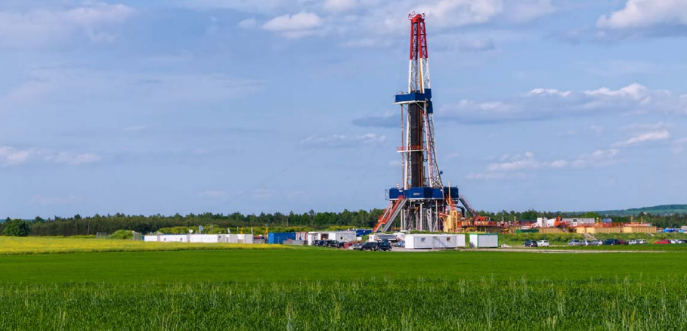
Fracking equipment in a field at daytime.
Goal 3: Achieve near-zero water impact for new thermoelectric power plants, and significantly lower freshwater use intensity within the existing fleet
BACKGROUND – Thermoelectric power plants utilize large volumes of freshwater for cooling operations. This water use accounts for about 40% of water withdrawals in the United States. Effluent water from thermoelectric power plants that is returned to its source can affect aquatic ecosystems if altering natural water temperatures and flows. Water that evaporates and is not returned to its source is considered consumed; this accounts for about 3% of U.S. water consumption.
CHALLENGE – The thermoelectric power sector’s reliance on water poses a risk in light of anticipated warming ambient temperatures, increased water stress, and more frequent extreme events like droughts. If improperly managed, the water demand of the thermoelectric power sector may limit water available to other uses, limiting economic growth of surrounding communities.
OBJECTIVE – The Water Security Grand Challenge aims to accelerate research, development and deployment of new technologies that lead to near-zero water impacts for newly built thermoelectric power plants along with significantly lower freshwater use intensity for existing thermoelectric power plants. 
Current and Recent Opportunities:
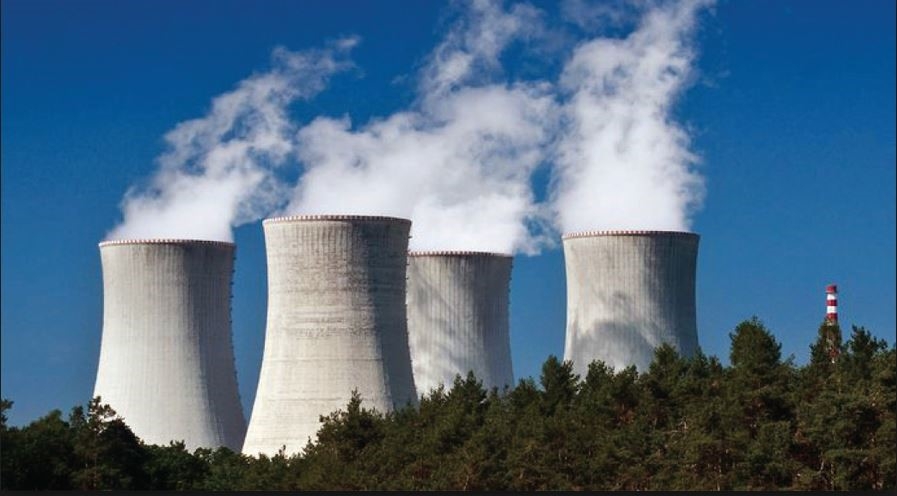
Steam emerges from three powerplant stacks.
Goal 4: Double resource recovery from municipal wastewater
BACKGROUND – Wastewater treatment plants purchase about $2 billion of electricity each year and face more than $200 billion in future capital investment needs to meet water quality objectives. This can constrain municipal budgets. For example, energy consumption at wastewater treatment plants can account for a third or more of municipal energy bills. Wastewater treatment plants can address these challenges by recovering critical resources and turning them into marketable products. This can create new revenue streams for upgrading water treatment infrastructure, particularly in rural communities, prevent nutrient pollution, and provide new sources of alternative water supplies. Recovered resources include energy that can be used on-site or sold, nutrients, such as phosphorous and nitrogen that can be used as fertilizer, and clean water that can be reused for agricultural, industrial, and potable purposes.
CHALLENGE – Energy costs are expected to increase over time and affect affordability of water for businesses and consumers. Disposal of residual biosolids from water treatment is another significant cost for municipalities.
OBJECTIVE – The Water Security Grand Challenge aims to pursue research, development, deployment and other opportunities to increase resource recovery. 
Current and Recent Opportunities:
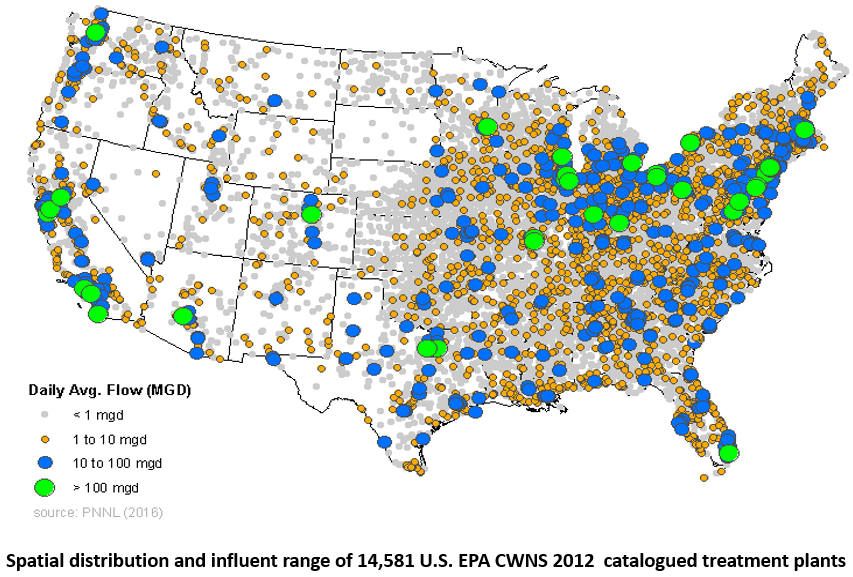
U.S. map showing dots that indicate spatial and influent ranges of catalogued treatment plants.
Goal 5: Develop small, modular energy-water systems for urban, rural, tribal, national security, and disaster response settings
BACKGROUND – Small, modular energy and water systems have the potential to cost-effectively serve areas where energy and clean water are expensive and challenging to produce. Small, decentralized energy-water systems can also play an important role in serving the more than one billion people worldwide that currently lack access to reliable sources of electricity and water.
CHALLENGE – The ability to cost-effectively produce clean water for urban settings where population growth is occurring but central energy or water systems are nearing maximum capacity; for rural communities, including tribal regions where population levels cannot accommodate the economies of scale needed to make large systems viable; for military sites in remote areas without access to central electricity and water systems; and in areas impacted by disaster when storms and other events have knocked existing energy and water systems offline.
OBJECTIVE – The Water Security Grand Challenge aims to spur innovation needed to improve the cost-effectiveness of small, modular linked energy-water systems and test their performance for a range of applications.
Current and Recent Opportunities:

Wednesday, May 23, 2018

Advanced Manufacturing Office (AMO)


AMO Supports $2 Million for 12 Small Business Research and Development Projects

AMO (Advanced Manufacturing Office) supports R&D projects, R&D consortia, and early-stage technical partnerships with national laboratories, companies (for-profit and not-for profit), state and local governments, and universities through competitive, merit reviewed funding opportunities designed to investigate new manufacturing technologies.

Recently, Secretary of Energy Rick Perry announced $34 million to support small businesses in advancing scientific discoveries and develop and commercialize manufacturing solutions. The Office of Energy Efficiency and Renewable Energy’s (EERE’s) Advanced Manufacturing Office (AMO) will provide funding support to twelve new projects across eleven states, totaling nearly $2 million in funding.
U.S. Department of Energy (DOE) offices award Phase I grants to small businesses that demonstrate technical feasibility for innovations during the first phase of their research. Most Phase I awards are for $150,000 for less than one year.
AMO projects were selected from two of 32 collaborative topics among multiple programs in DOE’s Office of Science. Eleven projects were selected under the Advanced Manufacturing topic, which included four subtopics:
  • Intelligent Systems for Materials Design and Discovery
  • Novel Energy-Efficient Dewatering Methods for Cellulosic Nanomaterials
  • Thermal Process Intensification for Productivity Improvements
  • Technology Transfer Opportunity: Process for the Synthesis of Precision Nanoparticles
The projects listed below will receive $150,000 under this topic award.
3D Array Technology LLC – Storrs, Connecticut
This Small Business Innovation Research (SBIR) Phase I project will result in a low-cost and high-efficiency microwave-irradiation intensified scalable manufacturing of nano-structured functional devices for environmental and energy applications. The obtained strategy will enable the industrial-relevant practical application of the novel nano-array based catalysts for automotive emission.

AccuStrata Inc – Rockville, Maryland
Catalysts are imperative to the efficiency and economy of the United States by making energy production, manufacturing and transportation more efficient and ecofriendly. This project seeks to provide a technology that will rapidly improve catalysts and keep the United States on the forefront of technological innovation.

BienaTech – Akron, Ohio
Discovery of high-efficiency catalysis frameworks vital to national advanced manufacturing goals is a challenging materials science problem. Using big data and machine learning approaches, the discovery of nanocatalysts will be accelerated.

Boston Electrometallurgical Corporation – Woburn, Massachusetts
Vanadium is a critical constituent of the high-strength steels that make cars lighter, safer, and more efficient. Boston Electromet will apply new manufacturing technology to supply the American steel industry with vanadium alloys of higher quality at a lower cost, all while saving energy in producing these alloys.

Christian Schafmeister - Merion Station, Pennsylvania
Computers are underutilized to design materials and molecules. Christian Schafmeister will develop software and “Molecular Lego” for designing materials and large molecules that purify other molecules, act as new medicines, sense other molecules, and assemble other molecules.

Compact Membrane Systems, Inc – Newport, Delaware
The proposed technology will significantly reduce capital and energy costs for converting shale gas based ethane into value added ethylene.

Faraday Technology – Englewood, Ohio
In order to enable cellulosic nanomaterials as a competitive renewable feedstock, technology must be developed to collect them from their growth medium at minimum cost. Solids processing technologies will be evaluated for effectiveness when used together for harvesting of cellulosic nanomaterials.

Physical Optics Corporation – Torrance, California
Nanocellulose is a natural and renewable polymer (paper), which has been used from ancient times but is currently finding modern applications in composite materials. The proposed technology allows dewatering the nanosized cellulose without compromising its nanoscaling.

Sep-All LLC – Ames, Iowa
Sep-All unique technology is a platform based on chemo-mechanical stresses and interface metastability at the microscale to drive a controlled separation of mixed sources into high-value micro- and nano-materials of purified compounds (e.g. oxides, acetates), without the need to operate at high temperatures.

TDA Research, Inc. – Wheat Ridge, Colorado
Cellulosic nanomaterials are a new bio-based material that requires an energy-intensive, multi-step process to manufacture. TDA Research proposes a new dewatering system will reduce energy consumption and production costs of these new bio-materials that can be used in a wide range of new products in packaging, consumer electronics and pharmaceuticals.

Voxtel, Inc – Beaverton, Oregon
Technology Transfer Opportunity with Idaho National Lab‐developed nanoparticle‐synthesis methods that will be used to advance the performance of microwave radome systems for antenna improvement in the communication space.

AMO will also fund one project under the Atomically Precise Manufacturing II topic that included a subtopic on Molecular Machine Advances. The project below will receive $225,000 under this topic award.
Covalent, Inc. - Las Vegas, Nevada
Novel, atomically-precise nanomaterials and nanomembranes made by mimicking nature’s construction techniques are being developed to provide ultra-low energy, low cost, high purity water from sources as diverse as seawater, wastewater, and water contaminated from nature, agriculture, industry and other sources.

For a full list of EERE-funded projects, view the EERE SBIR-STTR Project Spreadsheet. EERE-specific SBIR information is available on the EERE website.
Small businesses play a major role in spurring innovation and creating jobs in the U.S. economy. Congress created the SBIR and STTR programs to leverage small businesses to advance innovation at federal agencies.  DOE developed Technology Transfer Opportunity subtopics as a way for small businesses to partner with national laboratories on research and development needed to speed commercialization of national laboratory inventions.
EERE's Advanced Manufacturing Office (AMO) supports early-stage research to advance innovation in U.S. manufacturing and promote American economic growth and energy security.

Overview
Advanced Manufacturing Offce
The Advanced Manufacturing Offce is the only technology development offce within the U.S. Government that is dedicated to improving the energy and material effciency, productivity, and competitiveness of manufacturers across the industrial sector.


AMO brings together manufacturers, not-for-proft entities, research organizations, and institutions of higher education to identify challenges; catalyze innovations; and develop cutting-edge material, process, and information technologies needed for an effcient and competitive domestic manufacturing sector. By targeting effcient manufacturing technologies, AMO seeks to drive energy productivity improvements in the U.S. manufacturing sector, effciently utilize abundant and available domestic energy resources, and support the manufacture of clean energy products with benefts extending across the economy.
VISION: U.S. global leadership in sustainable and effcient manufacturing for a growing and competitive economy.
MISSION: Catalyze research, development and adoption of energy-related advanced manufacturing technologies and practices to drive U.S. economic competitiveness and energy productivity.

AMO Strategic Goals
• Improve the productivity and energy effciency of U.S. manufacturing
• Reduce lifecycle energy and resource impacts of manufactured goods
• Leverage diverse domestic energy resources in U.S. manufacturing, while strengthening environmental stewardship
• Transition DOE supported innovative technologies and practices into U.S. manufacturing capabilities
• Strengthen and advance the U.S. manufacturing workforce

Offce Structure
Organizationally, AMO pursues its goals through the following three subprogram approaches:
R&D PROJECTS: Bridging the innovation gap
The Advanced Manufacturing R&D Projects subprogram supports innovative advanced manufacturing applied R&D projects that focus on specifc high- impact manufacturing technology and process challenges. The subprogram invests in foundational energy-related advanced manufacturing technologies that impact areas relevant to manufacturing processes and broadly applicable platform technologies.
R&D CONSORTIA: Public-Private consortia model
The Advanced Manufacturing R&D Consortia subprogram helps the United States position itself as a world leader in strategic areas of manufacturing by bringing together manufacturers, suppliers, companies, institutions of higher education, national laboratories, and state and local governments in public- private R&D consortia. These partnerships create an innovation ecosystem that accelerates technology development and facilitates the transition of innovative advanced manufacturing technologies to industry.
TECHNICAL PARTNERSHIPS: Direct engagement with Industry
The Technical Partnerships subprogram provides critical support to the adop- tion of advanced energy effciency technologies and practices. The subprogram supports the adoption of cost-effective combined heat and power (CHP) technologies; provides resources to assist manufacturers in reducing their energy use intensity; promotes the adoption of energy management programs, provides targeted energy effciency, productivity, and waste/water use reduction practices to small- and medium-sized manufacturers.

Leadership
Dr. Rob Ivester, Director Robert.Ivester@ee.doe.gov
Valri Lightner, Acting Deputy Director Valri.Lightner@ee.doe.gov
Isaac Chan, Program Manager R&D Projects Isaac.Chan@ee.doe.gov
Mike Mckittrick, Program Lead R&D Consortia Michael.Mckittrick@ee.doe.gov
Jay Wrobel, Program Manager Technical Partnerships Jay.Wrobel@ee.doe.gov
U.S. Department of Energy – Advanced Manufacturing Offce Room 5F-065, MS EE-5A 1000 Independence Ave, SW Washington, DC 20585 Phone: (202) 586-9488
A variety of funding opportunities are available to manufacturers from the Advanced Manufacturing Office (AMO) and other organizations.

Without generous private donations the CROATIAN CENTER of RENEWABLE ENERGY SOURCES would be unable to continue the valuable work it does in bringing objective information to an often overheated debate.


Making a donation is simple: a cheque payable to CROATIAN CENTER of RENEWABLE ENERGY SOURCES can be posted to the following address:


CROATIAN CENTER of RENEWABLE ENERGY SOURCES

Medarska 24,

10 000 ,Zagreb,

CROATIA


or on


CROATIAN CENTER of RENEWABLE ENERGY SOURCES

BANK ACCOUNT 2484008-1105745975

IBAN HR0324840081105745975

SWIFT RZBHHR2X
Zeljko Serdar, Croatian Center of Renewable Energy Sources (CCRES)