
Global climate change is about more than just greenhouse gas emissions — among the many complex systems that impact Earth’s climate, one of the most important is how much sunlight is reflected back into space by bright surfaces such as snow, ice, and clouds. Clouds play a particularly powerful role in the climate system since they can change rapidly and have a strong effect on Earth’s reflectivity. That’s why researchers with the UW Marine Cloud Brightening Program, an international scientific initiative, are working to better understand clouds, and how both inadvertent and possibly intentional changes to atmospheric particles affect clouds.
“Atmospheric particles, also called aerosols, can have a strong effect on sunlight reflection by clouds,” said Sarah Doherty, program director of the Marine Cloud Brightening Program and a senior research scientist with the UW Cooperative Institute for Climate, Ocean and Ecosystem Studies. “As humans make changes to aerosol emissions, we need a stronger scientific understanding of these effects in order to better understand the potential risks and benefits, and to limit unintended effects.”
The role of clouds and aerosols
When tiny aerosol particles are released into the atmosphere from both natural sources (such as biological emissions and sea spray) and human activities (such as from burning fossil fuels, wood and vegetation) they mix into clouds and can cause them to brighten and reflect more sunlight back into space. This has a cooling effect on the Earth’s climate.
The idea to better understand the role of clouds in climate — and humans’ effect on it — came about when scientists observed that clouds were being made more reflective, or “brighter,” in regions where they were influenced by air pollution.
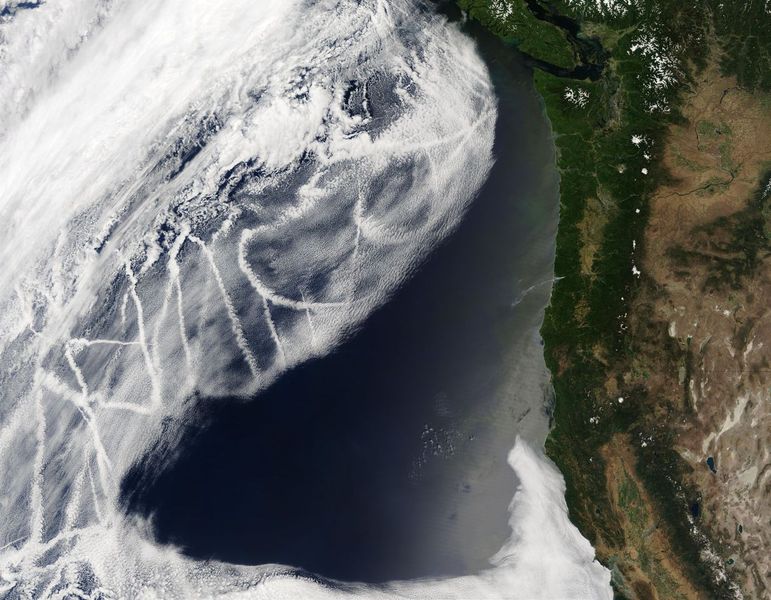
A particularly striking version of this is seen in “ship tracks,” the trails of brightened clouds along the routes of ships caused by the small aerosol particles their engines emit. The tracks are bright enough and big enough to be observed from space. In order to reduce this pollution and improve global air quality, recent regulations have significantly reduced shipping and other emissions — but in doing so, they have also reduced the reflectivity of clouds, which could be accelerating global warming.
“There’s now strong evidence that reductions in ship emissions starting in 2020 contributed in part to the anomalously warm waters recently observed in the north Atlantic Ocean,” said Robert Wood, professor of atmospheric sciences and lead investigator of the Marine Cloud Brightening Program. “This really speaks to the remarkably strong influence these tiny particles in the atmosphere can exert on clouds and the absorption of sunlight by the Earth. But the truth is that we still don’t have a very good handle on how big of an effect aerosol changes can have globally because cloud responses to aerosols can vary enormously depending on the type of cloud and on meteorology.”
As scientists investigate these questions, they have also identified new questions: if ship emissions could cause clouds to brighten and reflect sunlight back into space, could a non-polluting version of that phenomenon be used to help cool the planet? And if so, should it?
These are complex topics, and as climate change becomes an everyday reality for people around the world, scientists and governments have recognized the importance of investigating them by recommending further research. In studying the ways that aerosols and clouds interact, the Marine Cloud Brightening Program seeks to inform future decisions by helping humanity understand not just the technical challenges of this kind of climate intervention, but the suite of potential benefits and risks that come along with it.
Understanding marine cloud brightening
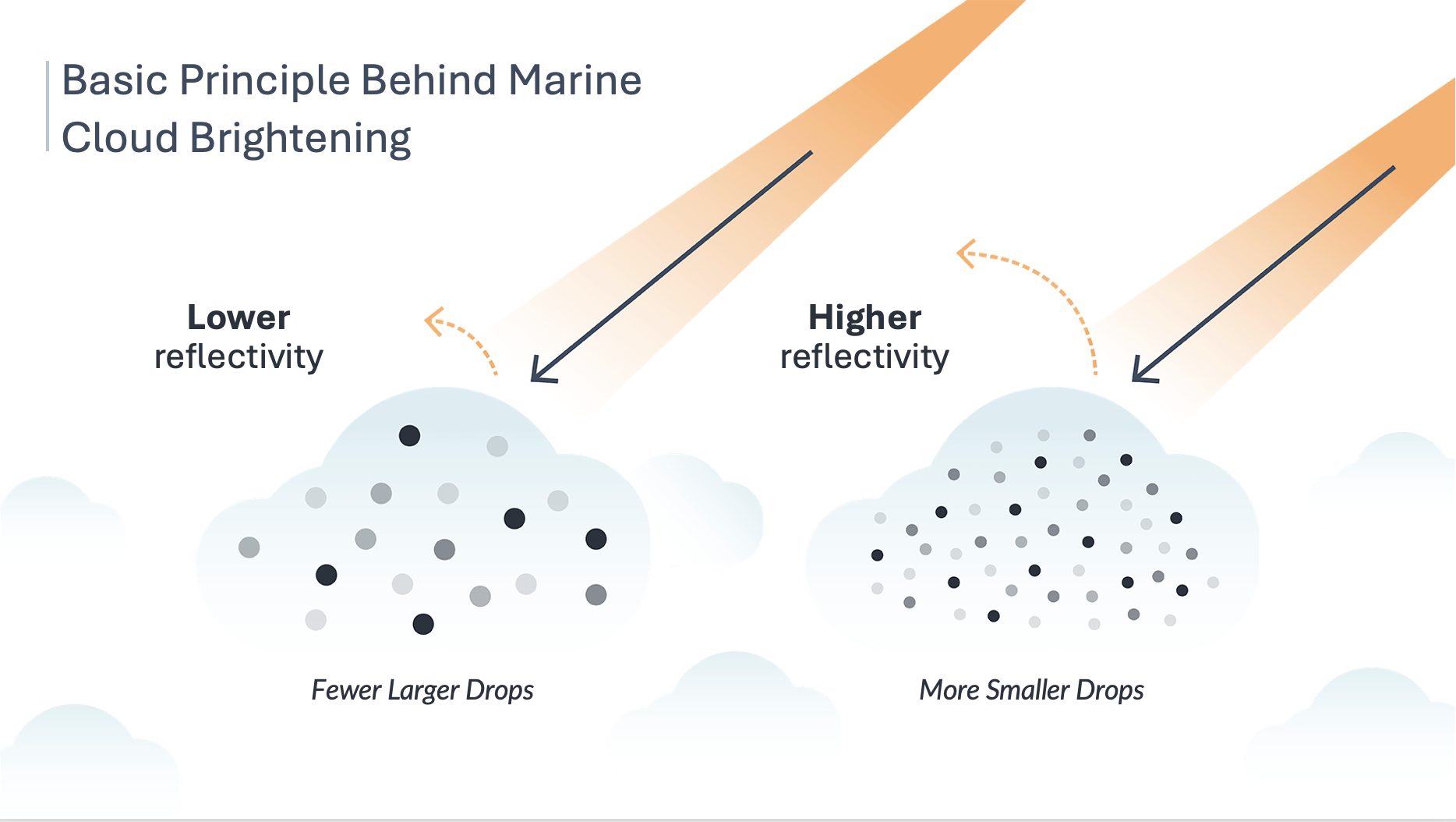
Marine cloud brightening (MCB) is one of several proposed climate interventions collectively known as solar radiation modification, or SRM. In this approach, tiny sea salt particles generated from ocean water would be sprayed from ships into areas of low-lying clouds. Once emitted, the particles would remain in the atmosphere for only a few days, brightening clouds over parts of the ocean in order to reduce climate warming.
But before any intervention like this can be considered, it is crucial to fully understand how it will affect the climate system, our oceans and our terrestrial ecosystems.
“The goal of the MCB Program is to understand whether it might even be possible to predictably and reliably brighten low marine clouds, and if so, how doing this in different regions of the globe would affect temperatures, precipitation and climate both globally and locally — as well as any other possible side effects,” said Doherty. “As atmospheric scientists, we think it’s critically important that society has the answers to these questions before making any decisions about whether or not to actually use marine cloud brightening in an effort to reduce climate risks.”
In order to better understand how aerosol particles interact with clouds, and how intentionally brightened clouds would interact with our global climate system, the Marine Cloud Brightening Program researchers are taking a multi-pronged approach.
Computer simulations
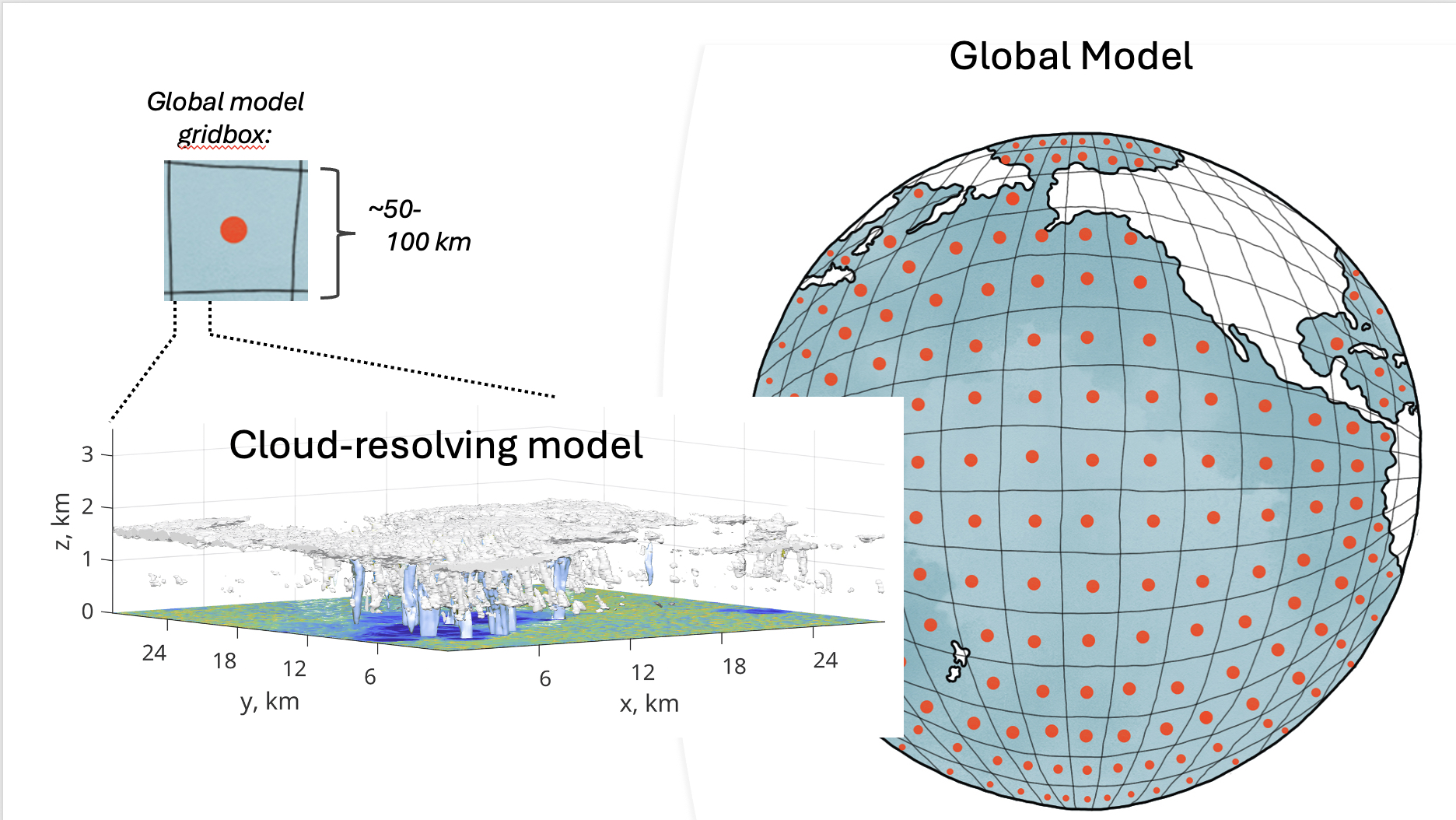
The first phases of research have focused on computer modeling. The team is working with models at the global scale to study how aerosol-cloud interactions affect climate, testing the accuracy of their simulations against observations in the field and using them to understand how different MCB implementations would affect future climate. The team is also working with smaller-scale models that simulate the details of clouds to better understand how their reflectivity and other properties are affected by aerosol changes.
“But as with any computer simulations, we need to validate these detailed models against observations because the real world always introduces variables you weren’t expecting,” Doherty said.
Small-scale field studies
To validate the models and measure real-world cloud responses, the team has developed a new approach for controlled studies of aerosol-cloud interactions. That’s where CARI — the cloud aerosol research instrument — comes in.
“In the past when we’ve tried to study how clouds are affected by aerosols, we’ve had to just observe clouds in polluted regions, where it’s difficult to distinguish between changes in the clouds due to aerosols versus other meteorological factors,” said Wood. “Being able to add known quantities of sea salt particles to clouds and compare clouds with different concentrations of aerosols, but that are otherwise the same, will be a powerful new research capability.”
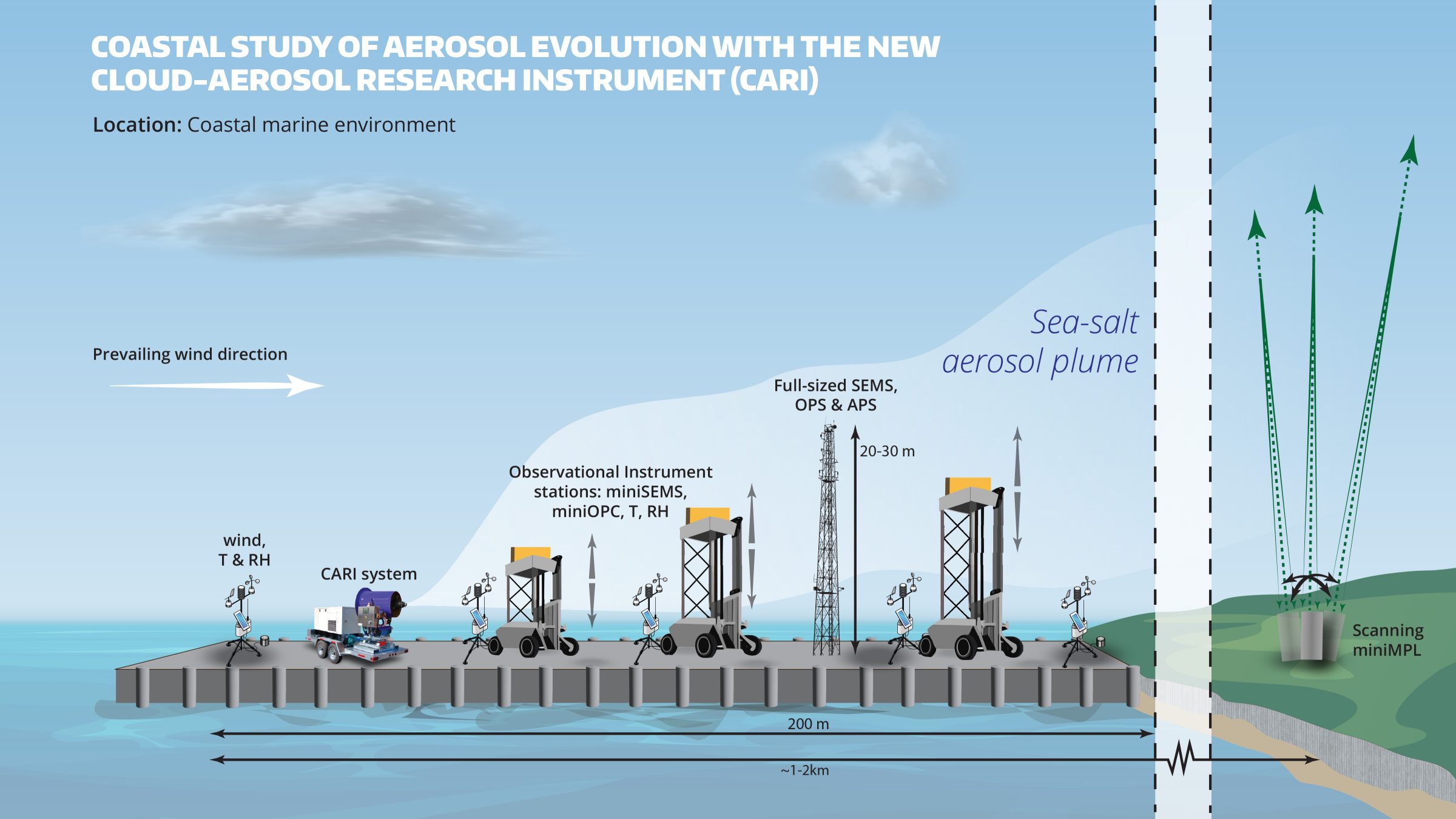
This spring, the Marine Cloud Brightening Program researchers are putting CARI to the test at a new research facility they’ve established onboard the USS Hornet Sea, Air and Space Museum — a Smithsonian affiliate — in Alameda, CA. There they have begun a series of small-scale studies in which CARI generates a sea salt plume, then measures the generated aerosol at multiple points downwind to compare with simulations generated from high resolution models.
Importantly, these studies are not large enough to have any effect on local weather conditions — naturally occurring sea spray from crashing waves along the coast puts more sea salt mass into the air than CARI, which will also only be run for 30 minutes or less at a time. But the researchers’ sensitive instruments will still be able to gather important data from these experiments.
Partnering with the public and other scientists
In addition to revealing new insights about how aerosols interact with clouds, these early outdoor studies are an opportunity to engage with other stakeholders and members of the public.
To that end, the program has established the Coastal Atmospheric Aerosol Research and Engagement (CAARE) facility, also housed at the USS Hornet Sea, Air and Space Museum. Open to scientists, students, community members, government officials, global stakeholders and members of the public, the research site is also an exhibit.
“This research is of the utmost importance to society, so transparency is crucial,” said Maya Tolstoy, Maggie Walker Dean of the UW College of the Environment. “I’m grateful to our researchers and partners for prioritizing engagement with the public, the scientific community and regulators in line with the University of Washington’s commitment to the public good.”
What’s next for marine cloud brightening?
Whether intentional marine cloud brightening should ever be used to address climate risks is a question that requires extensive scientific research, assessment by scientific experts, and informed and equitable decision-making by a global community of stakeholders.
Beyond the scientific questions being addressed by the Marine Cloud Brightening Program, the effort will continue to expand its direct engagement with the public to help inform, educate and receive input on the research. A high degree of openness and engagement is a critical part of the work, given that both pollution aerosols and any human climate intervention have the potential for far-reaching impacts on people, the climate and wildlife.
The researchers are motivated by a stark reality: As climate change worsens, it becomes increasingly likely that society will look to climate interventions such as MCB to help avoid the worst impacts of climate change. The Marine Cloud Brightening Program aims to provide the information needed to understand their potential benefits and risks.
“Improving our understanding of the influence of aerosols on clouds and climate is essential to understanding near-term climate risks, and whether and how marine cloud brightening could help reduce them,” said Doherty. “If we don’t improve our knowledge now, we’ll be flying blind. The international community needs the best information it can get in order to chart a responsible course into a future with a rapidly changing climate.”


