Showing posts with label Europe 2020. Show all posts

Sunday, June 10, 2018

Europe 2020 indicators - Croatia

The energy sector in Croatia

Croatia has around 4.28 million inhabitants and rich potential for renewable energy and energy efficiency. In 2016 the country produced 57.3 percent of its total primary energy supply, including around 20 percent of the oil it consumes, and around two thirds of natural gas. Unlike most of its Western Balkan neighbours it no longer has its own coal reserves.
Croatia produces only about half of its own electricity, depending on hydrological conditions. Most of the electricity generation capacity is owned by Hrvatska Elektroprivreda, the state-owned electricity group. In 2015, 57% of domestically generated electricity came from hydropower, 20% from coal, 12.4% from oil/gas, 7% from wind, 2.3% from biomass and 0.5% from solar. In other words, non-hydropower renewables accounted for just under 10% of generation. Krsko nuclear power plant in Slovenia, of which HEP owns 50 percent, also contributes to Croatia’s electricity supply but is counted under imports in the statistics.
Electricity generation in Croatia, 2015, GWh
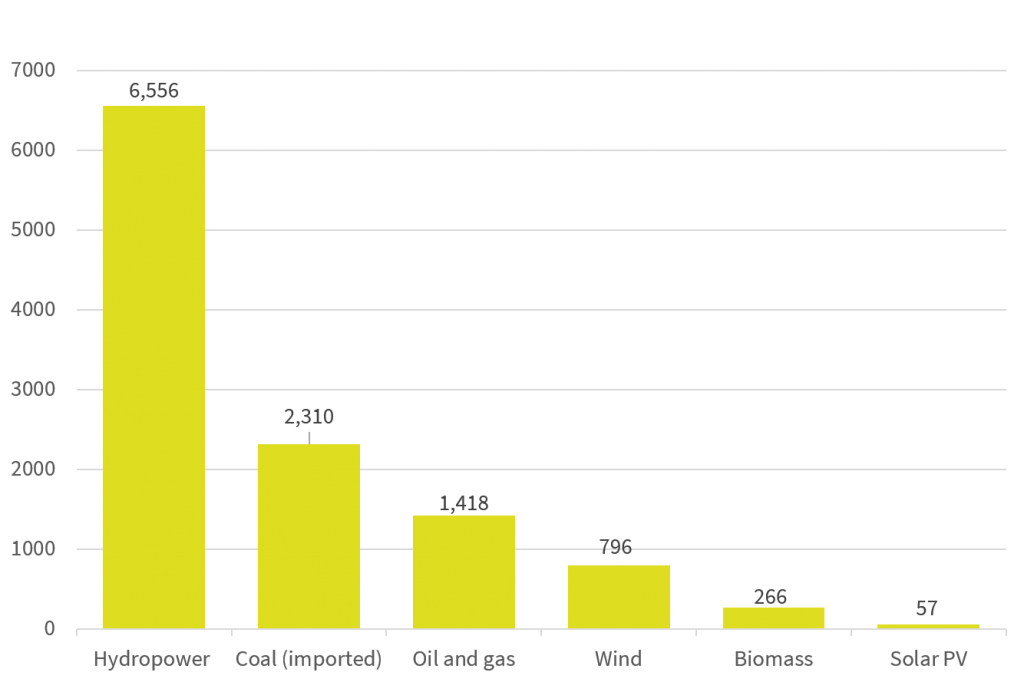
Although Croatia has made some progress in using its wind and solar PV potential in recent years, this there is still much more potential that has not been exploited. Solar thermal is also underused compared to the obvious potential in this very sunny country.
SourceSolar PVWind
IRENA
Cost-competitive potential
3173 MW
4309 GWh
14384 MW
28317 GWh
SEERMAP
Decarbonisation scenario (2050 minus 2016)
1839 MW
1837 GWh
3857 MW
7215 GWh
SEE-SEP
The EU Road scenario
6950 MW
11830 GWh
3200 MW
8450 GWh
Renewables and energy efficiency development has been held back by a lack of political will resulting in small quotas for support for wind and especially solar. Croatia has not developed a new energy strategy since the over-ambitious and outdated 2009 one, so there has been no systematic debate about the country’s energy direction in recent years. In line with EU state aid rules, Croatia has now switched to auctioning and feed-in premiums rather than feed-in tariffs, but as of May 2018 had not approved the supporting legislation that would enable the system to function, this braking further development until this is resolved.
Much time and resources have also been lost on pushing outdated projects such as the 500 MW Plomin C coal power plant, to be run on imported coal, the 450 MW Peruća gas power plant, and large-scale hydropower projects in sensitive locations such as Ombla and Kosinj. The first three of these projects have now been cancelled after civil society campaigns highlighted their weaknesses. However a floating LNG terminal on the island of Krk is still planned, with support from the EU.
Croatia still has plenty of potential for energy efficiency improvements. Its energy intensity of total primary energy supply was 21.9 percent above the EU average in 2016. There is still plenty of work to be done to improve efficiency in the residential sector.

Sources:
  1. Energy Community Implementation Report 2017 
  2. BIH State Regulatory Commission for Electrical Energy – 2016 annual report 
  3. IEA energy statistics
  4. EIHP: Energy in Croatia 2016 

BONUS

The winners of the EU Sustainable Energy Awards 2018 were announced at an Awards Ceremony with the European Commissioner for Climate Action and Energy, Miguel Arias Cañete, in Brussels.


12 projects across 4 categories made it onto the Awards shortlist this year.

CONSUMERS: Bio.Energy.Parc

In 2008, the 7,200 inhabitants of Saerbeck decided to become self-sufficient in renewable energy by 2030 implementing over 150 actions based on an approach to link people and profits and transforming an old army munitions site into a sustainable energy park.
“We are proud to have received this award. It’s a big ‘yes’ to continue our way. We have been working on this project for the past 10 years and we are not at the end yet. This prize gives us the motivation to continue,” on behalf of Bio.Energy.Parc.Saerbeck Guido Wallraven said.

PUBLIC SECTOR: PEACE Alps

Project supports Alpine authorities in making the transition to a low-carbon area. Involving more than 200 municipalities across 6 countries, PEACE_Alps focuses on energy management, building renovation and public lighting. It also helps authorities overcome barriers in implementing their strategic action plans.
“Have a good project that is a good idea, with a good team behind it. We have been lucky at PEACE_Alps with such a team. It’s about the spirit of the people and believing in the change and transition,” Silvio De Nigris accepting the award on behalf of PEACE_Alps said.

BUSINESSES: WiseGRID

Funded by the EU’s Horizon 2020 programme, WiseGRID has developed a set of 9 solutions to improve the electricity grid and empower customers, by making the grid smarter, open and more consumer orientated.
“It’s very exciting. We are very happy about both our awards – from the jury and especially the citizens’ Award – this means that it’s not just the technology which is ready to help the energy transition but society is also willing to embrace the energy transition,” said Antonio Marques accepting the award for WiseGRID.

YOUNG ENERGY LEADERS: Czech Sustainable Houses

What began as an online hub providing information on sustainability, developed into an annual architectural competition inspiring young architects to lead the way in energy transition with their innovative, energy-saving designs.
“This award is for all the people that worked on Czech Sustainable Houses project. We started this project four years ago and we’ve created the largest student architecture competition. We also created a new system for energy management and households. We’re just a little grassroots organisation, but we’re dynamic,” explained Pavel Podruh, Czech Sustainable Houses project on hearing that his project won.

Croatian Center of Renewable Energy Sources (CCRES)

Friday, April 13, 2012

Indirect land-use change (ILUC)


'Indirect land-use change' (ILUC) means that if you take a field of grain and switch the crop to biofuel, somebody somewhere will go hungry unless those missing tonnes of grain are grown elsewhere.
Economics often dictates that the crops to make up the shortfall come from tropical zones, and so encourage farmers to carve out new land from forests.
Burning forests to clear that land can pump vast quantities of climate-warming emissions into the atmosphere, enough in
theory to cancel out any of the benefits that biofuels were meant to bring.
The European Commission has run 15 studies on different biofuel crops, which on average conclude that over the next decade Europe's biofuels policies might have an indirect impact equal to 4.5 million hectares of land – an area the size of Denmark.
Some in the biofuels industry argue that the Commission's science is flawed and that the issue could be tackled by a major overhaul of agricultural strategy to improve productivity or by pressing abandoned farmland back into action. Waste products from biofuels production can also be fed to animals, they say, so reducing the pressure on land resources.

Conventional biofuels like biodiesel increase carbon dioxide emissions and are too expensive to consider as a long-term alternative fuel, a draft EU report says.


The study ‘EU Transport GHG [greenhouse gases]: Routes to 2050’ estimates that before indirect effects are counted, the abatement cost of reducing Europe’s emissions with biofuels is between €100-€300 per tonne of carbon.
At current market prices, this would make their CO2 reduction potential up to 49 times more expensive than buying carbon credits on the open market at €6.14 a tonne.   
But the EU’s authors conclude that it “it is not possible (and useful) to determine cost effectiveness figures for [conventional] biofuels” because their indirect effect - measured in cleared forests and grasslands (‘ILUC’) - make it a CO2-emitting technology.
The latest report will feed a growing unease about the reasons for the EU's original biofuels policy - justified in environmental terms - and the way it has developed since.
“The truth is that policy makers inside and outside Europe are doing biofuels for other reasons than environmental ones,” said David Laborde, a leading agricultural scientist and author of key biofuels reports for the European Commission.
“It’s a new and easy way to give subsidies to farmers, and it’s also linked to industrial lobbies that produce these biodiesels, and also what they will call energy security,” he told EurActiv.
“They want to diversify the energy supply, and keep their foreign currencies instead of buying oil from the Middle East. They prefer to keep it for something even if it is not efficient or even green,” he added.
The '10% target'
In 2007, the EU first set a 10% target for the use of blended biofuels in transport by 2020.
Although the target was re-sourced from ‘biofuels’ to ‘renewable energy’ in 2009, analysts say that 8.8% of the EU target will still be provided by biofuels, and up to 92% of that will come from conventional biofuels like biodiesel.
Industrial associations disagree, putting the EU’s ratio of sugar-based ethanol, one of the best-performing biofuels, to biodiesel, one of the worst, at 22%-78%.
But both the original announcement and the Renewable Energy Directive two years later conditioned biofuel use on subsequently neglected criteria of cost-efficiency, sustainability and, where available, the use of second generation fuels.  
“I don’t think we are there on cost-effectiveness,” said Géraldine Kutas, Brussels representative of the Brazilian Sugarcane Industry Association (UNICA).
“There are no monetary provisions to support this in the directive, and second generation biofuels are still a promise. They are not commercially available yet,” she said.
Even trying to address the issue of indirect sustainability criteria for biofuels had gummed up the EU's policy-making process, she acknowledged. 
French farmers
Research by EurActiv has uncovered evidence that the EU’s original biofuels target was set as much for industrial and political reasons, as environmental concerns.
Claude Turmes, the European Parliament’s rapporteur responsible for steering the Renewable Energy Directive into law, said that business lobbies had influenced his negotiations with the then-French Presidency of the European Council.
“There were two lobbies, the sugar farmers lobby and the German car industry who tried to prevent the EU’s CO2 and cars legislation,” Turmes (Greens/Luxembourg) told EurActiv.
“The origin of the 10% renewables in transport target was the fact that these two lobbies joined forces to impose it on the Commission.”
EU insiders spoken to by EurActiv agreed, saying that biofuels had been a quid-pro-quo demanded for the imposition of ‘greener’ measures in the directive that would encourage wind and solar energy, and cut emissions. 
European sugar farmers had suffered in the 2006 Common Agricultural Policy reform which reduced the guaranteed sugar price by 36% and opened up the European sugar market to global competition.
A guaranteed market for agrifuel made from sugar-based ethanol held out some prospect of compensation. And the strength of the French farmers lobby made removing the 10% target “an absolute no go area” for Paris, Turmes said.
“The farm industry was obviously interested in biofuels, biochemicals and the bio-economy more generally,” Kutas added.
But Europe’s sugar farmers profited far less from the EU’s biofuels policy than growers of feedstocks for biodiesel, better suited to the continent’s diesel-based auto fleet.  
Car industry
EU officials say that the car industry was also instrumental in pushing for the biofuels target to be included as a compromise to bridge the gap between the 130g of CO2 per km that the EU wanted as a target for 2012 and the 140g that the car industry was prepared to offer.
“It was no secret,” a source told EurActiv. “It was very clear what they were lobbying for and it went all the way up the Commission”.
As a result, officials in the EU’s energy directorate responsible for biofuels did not treat research which questioned the fuel’s environmental credentials in the same light as that which supported it, multiple sources confirm.  
The EU’s biggest error was “that we started to make a policy without knowing the effect it would have,” Laborde said.
“We are now discussing the land use effect after saying for ten years that we need biofuels to reduce emissions,” he went on. “It was a serious mistake.”
Indirect emissions proposal
Brussels is due to publish a proposal measuring the indirect emissions caused by biofuels later this year, distinguishing between low-emitting biofuels such as ethanol and high-emitting ones like biodiesel.
But the EU’s decision-making process has been paralysed by the ongoing dispute between its energy directorate – which does not want ILUC factors considered – and its climate directorate, which does. And there are other problems too.    
Both the Renewable Energy and Fuel Quality directives contain ‘grandfathering’ clauses exempting all existing biofuels installations as of 2014 from further legislation until 2017.
As the biofuels industry’s existing capacity is already on the cusp of meeting the 10% target, according to a new report by the environmental consultants Ecofys, this would create massive overcapacity.  
The Institute for European Environmental Policy has calculated that on current trends, land conversion of between 4.7 million and 7.9 million hectares would be needed to accommodate the extra biofuels production, an area roughly the size of Ireland. 
But the introduction of any ILUC factor would probably rule out high-emitting conventional biodiesels, the majority of Europe’s biofuels production.
That would create a political backlash in EU states such as France and Germany, and potentially tear up the compromise which allowed the Renewable Energy Directive to be passed in the first place.  
For now, the proposal remains stuck in the corridors of an EU that appears equally frightened of the political consequences of admitting a policy mistake and the environmental consequences of denying it.

CCRES special thanks to 
Brussels Network Office:
International Press Centre
Boulevard Charlemagne, 1 b1
B-1041 Brussels
CROATIAN CENTER of RENEWABLE ENERGY SOURCES (CCRES)

Wednesday, January 11, 2012

Energy efficiency talks


Financing aspects are dominating ongoing talks on the energy efficiency directive, but member states are keeping their hands firmly on their wallets, EurActiv has learned.
As negotiations over the energy efficiency directive reopen under the Danish EU Presidency, discussions are  focusing heavily on financing aspects.
However, several options floated by the European Parliament to break the deadlock already look like non-starters, EurActiv was told.
And opposition by some EU states is making a binding 20% energy efficiency target impossible, said Martin Lidegaard, Danish minister for climate, energy and building as he was speaking to a group of Brussels-based journalists in Copenhagen. 

Bendt Bendtsen, a Danish member of Parliament who is following the dossier for the European People's Party (EPP) told EurActiv that funding mechanisms currently contemplated by Parliament will be blocked by the EU Council of Ministers, which represents the EU's 27 member states.
“The provision on ear-marking of financing, such as national energy efficiency funds will not be part of the final piece of legislation,” Bendtsen said.
“It is generally quite difficult to convince member states to earmark funds," explained Bendtsen, adding that "this has even been the case before the crisis emerged”.
“I feel that the council has a hard job ahead, the ball is really on their table,” he said.
Danes revive talks
Both the European Commission and Parliament were forced to change their position on the proposed energy efficiency directive in order to accommodate the Council's views. Member sates first refused to sign up to binding targets on energy savings, which prompted the Commission to propose binding "measures" instead.
Now, the Council does not want binding measures either, Bendtsen said, “unless the targets are measured differently or there are opt-outs or something else”.
The Danish presidency was expected to meet the Council’s energy working group yesterday (10 January) for the first time since it took over the EU's rotating presidency on 1 January. The Danes are hoping to piggy-back on discussions over the EU's energy roadmap to 2050 in order to re-launch the stalled talks on the directive.
Funding to be discussed as part of the 2014-2020 EU budget
But financing issues are more likely to be addressed in wider talks over the EU budget for 2014-2020, the Multi-Annual Financial Framework (MFF), which covers areas such as research and regional funding.
The funding aspect of the directive “has to be seen in the full picture of the European Regional Development Fund and 'Horizon 2020' [research agenda], but should not necessarily be a part of the directive,” an EU official told EurActiv.
Member states are avoiding signing up to a specific wording on financing issues in the text of the directive, as they do not want to prejudge the ongoing negotiations over the EU’s budget for the 2014-2020 period, EurActiv understands.
The upcoming months will see “tough talks” on the proposed directive, with “a large majority of the European Parliament” wanting binding financial facilities in place to fund the energy efficiency measures and member states being reluctant to allocating further money.
The talks are "like a poker game" where governments keep their cards close to their chests, said Claude Turmes, a Green MEP from Luxembourg who is spearheading talks for the European Parliament.
Claire Roumet of Cecodhas, a federation promoting social housing in Europe, said financing issues were crucial as renovation work in homes help bring energy bills down for the poorest. “[The EED] is looking at more than just EU finance. Tapping money for energy efficiency is not touched fully by the MFF, because it does not take into consideration all alternative types of funding,” Roumet told EurActiv.
Roumet was also adamant that binding measures were necessary. ​“If there is an obligation without specific measures, it will never be complied with," she said.
March vote in Parliament
Meanwhile, the European Parliament's committee on industry, research and energy (ITRE), which has the lead on the dossier, has pushed back its vote on the draft text from 24 January to 28 February. A full parliamentary vote is expected to take place late March.
The delay can be explained by the huge number of amendments, with more than 1,800 changes proposed to the draft energy efficiency bill.
“The number of amendments shows just how important this directive is,” said Claude Turmes MEP. The industry committee aims to integrate all those into 60-70 compromise amendments for the final vote of the Parliament.
“We are entering the eye of the storm, we are trying to build alliances with friendly governments,” Turmes told EurActiv.
On financing aspects, he said he was optimistic: “We are very much still in the negotiations, it is still very probable that we will have a text on this issue of financing in the directive".
The Green MEP said that the Parliament's insistence on having financial facilities included in the text of the directive gives the Assembly “visibility” and allows it “to have a tough discussion on financing” with member states.
Targets to stimulate investment
And as financing aspects remain the most difficult part of the negotiation, some are trying to revive an old idea – making the EU's 20% energy efficiency target legally-binding on the member states.
Proponents say a binding target would make it harder for countries to argue against energy efficiency funds, because they would be compelled to allocate some money from the EU budget to meet that objective.
"A way of seeing it is the spine is the target and the flesh is the European budget to add meat to the bone," Sanjeev Kumar of environmental group E3G told EurActiv.
And even if the EU allocates some specific funds for energy efficiency, without targets investments might remain scarce, efficiency advocates argue.
The European Commission’s last report on how the 2007-2013 budget was spent says that "certain energy and environmental investments are not progressing  as expected" and this must be redressed by the member states and regions.
"The direction for 10-20 years is vital so that you can cast these investments over a longer time," Kumar said. "It gives people certainty that their efforts will not be reversed," he added.
Claude Turmes, the Green MEP, agrees. “The more binding the target , the less risky the investment,” he said. “A clear target gives a bigger incentive to kick start investment. More flexibility and joint targets would make the energy efficiency directive easier to be agreed on,” Roumet added.
The  Danish presidency, described as “ambitious, but realistic”, its aim to finalise the so-called 'trialogue’ talks between the European Commission, Council and Parliament on the energy efficiency directive during the first six months of 2012.

CROATIAN CENTER of RENEWABLE ENERGY SOURCES (CCRES)

Wednesday, December 14, 2011

EU RenewableTargets by 2020


Croatian Center of Renewable energy Sources

EU Targets by 2020


The Directive on renewable energy sets ambitious targets for all Member States, such that the EU will reach a 20% share of energy from renewable sources by 2020 and a 10% share of renewable energy specifically in the transport sector.

It also improves the legal framework for promoting renewable electricity, requires national action plans that establish pathways for the development of renewable energy sources including bioenergy, creates cooperation mechanisms to help achieve the targets cost effectively and establishes the sustainability criteria for biofuels.


Related documents can be found in the background documents and the first steps in implementation are indicated on the transparency platform, including the national renewable energy action plans .

National targets

National overall share and targets for the share of energy from renewable sources in gross final consumption of energy in 2020


Renewable energy %*

20052009 (prov.)2020 target
Austria23,329.234
Belgium2,23.813
Bulgaria9,411.516
Cyprus2,93.813
Czech Rep6,18.513
Denmark1719.730
Estonia1822.7 25
Finland28,529.838
France10,312.423
Germany5,89.718
Greece6,97.918
Hungary4,39.513
Ireland3,15.116
Italy5,27.817
Latvia 32,636.840
Lithuania1516.923
Luxembourg0,92.811
Malta00.710
Netherlands2,44.214
Poland7,29.415
Portugal20,525.731
Romania17,821.624
Slovak Rep6,71014
Slovenia1617.525
Spain 8,71320
Sweden 39,850.249
UK1,32.915
EU278,511.620


Summary of Member States' progress


It shows that the 2020 renewable energy policy goals are likely to be met and exceeded if Member States fully implement their national renewable energy action plans and if financing instruments are improved. It also stresses the need for further cooperation between Member States and a better integration of renewable energy into the single European market. Estimates indicate that such measures could lead to 10 billions Euros savings each year.

National Renewable Energy Action Plans

Article 4 of the renewable energy Directive (2009/28/EC) requires Member States to submit national renewable energy action plans by 30 June 2010. These plans, to be prepared in accordance with the template published by the Commission, provide detailed roadmaps of how each Member State expects to reach its legally binding 2020 target for the share of renewable energy in their final energy consumption.

Member States must set out the sectoral targets, the technology mix they expect to use, the trajectory they will follow and the measures and reforms they will undertake to overcome the barriers to developing renewable energy. The plans are published below upon receipt in the original language, allowing public scrutiny. The Commission will evaluate them, assessing their completeness and credibility. In parallel, the plans will be translated into English and added to this page. In addition, the Energy Research Centre of the Netherlands was contracted by the European Environment Agency to create an external database and quantitative report of the reports receivedso far.

Member State

Notice: In general, each of the reports has been submitted in the language of the respective Member State, which is the sole authentic version. Translations into the English language are being provided for information purposes only. The European Commission does not guarantee the accuracy of the data or information provided in these translations, nor does it accept responsibility for any use made thereof.

More info at CCRES site.

Croatian Center of Renewable Energy Sources (CCRES)