Thursday, May 23, 2024

Steže se obruč oko Anthonyja Faucija


Objavljen memorandum s dokazima koji teško inkriminiraju bliske suradnike dr. Faucija.

U Sjedinjenim Državama jučer je kongresni Committe on Oversight and Accountability objavio priopćenje za medije s dramatično teškim optužbama na račun jednog od najbližih suradnika dr. Anthonyja Faucija, a u kojem upozoravaju na važnost vlastitog memoranduma pod naslovom "Allegations of Wrongdoing and Illegal Activity by Dr. David Morens, Senior Advisor to National Institute of Allergy and Infectious Diseases former-Director, Dr. Anthony Fauci" (Optužbe o zlouporabi i nezakonitim radnjama dr. Davida Morensa, višeg savjetnika Nacionalnog instituta za alergije i zarazne bolesti, bivšeg ravnatelja, dr. Anthonyja Faucija). 

Dokumenti koje je objavio kongresni Committe on Oversight and Accountability, ključni i najvažniji istražni komitet Zastupničkog doma, a njihovi zaključci su doista spektakularni te dovode dr. Faucija u jako neugodnu situaciju.

To je drugi strahoviti udar na ionako nagriženu reputaciju američkog epidemiološkog cara Faucija u razmaku od samo nekoliko dana, koji je tijekom pandemije propagirao strogu epidemiološku politiku, ali i s gađenjem poricao svoje direktne ili indirektne veze s etički problematičnim istraživanjem opasnih virusa u kineskim laboratorijima. 

Prije samo nekoliko dana, naime, već je snažno odjeknulo suspendiranje financiranja američke neprofitne organizacije EcoHealth dr. Petera Diszeka, bliskog Faucijiu, koji je dobivao milijune dolara jer "nije uspio adekvatno nadzirati i izvješćivati ​​o rizičnim eksperimentima s virusima na Institutu za virologiju Wuhan, kršeći uvjete savezne potpore i zahtjeve za biosigurnošću".

image


"Dokazi putem e-pošte sugeriraju da je dr. Fauci koristio svoju osobnu e-poštu za obavljanje službenih poslova. Ovo postavlja ozbiljna pitanja o tome je li dr. Fauci sudjelovao u zavjeri među najvišim razinama NIH-a za skrivanje službenih zapisa povezanih s podrijetlom COVID-19."


To be continued


Wednesday, May 15, 2024

California's grid faces collapse


From Croatia's point of view, the "rush-to-green" policies of the Biden administration and congressional Democrats are based on a false premise that intermittent power generation can meet energy demand in the United States. 

This belief, and its forced reliance on China for the components necessary to implement the policy, is detrimental to Americans’ standard of living and safety. 

Most of my colleagues and I support renewable energy from wind, solar, geothermal, and, potentially, hydrogen. We also help clean, renewable energy that comes from one of the oldest sources of energy production — hydropower. 

The truth of the matter is that in many places we've seen how the US energy grid is already dangerously close to failing because we're not paying enough attention to sustaining the grid. This is going to result in blackouts. And we've already seen them. 

Currently, renewables cannot provide that always-on, always-available energy that USA requires. In its "rush-to-green," the administration forced certain energy generation, like coal and natural gas, to be taken offline or made it extremely difficult to operate.  

Renewables will be a part of energy matrix, but they must work in tandem with always-on baseload power generation. This is due to renewables’ ability to only generate power intermittently, not 24/7/365. From households to municipalities to manufacturing, Croatia like America relies upon always-on, always available electricity 24 hours a day, seven days a week, 365 days a year. 


Saturday, April 27, 2024

Smart and sustainable cities


Many EU cities are already struggling with environmental degradation, traffic congestion, inadequate urban infrastructure, and a lack of basic services, such as water supply, sanitation, and waste management. The ecological footprints of cities are quite alarming and can threaten the natural resources required to sustain economic development and poverty alleviation rates. Maintaining economic growth, while creating sustainable livable cities for all, is the biggest urban challenge facing Europe, Asia, and the Pacific today.

CCRES is promoting sustainable consumption and production practices across Europe, Asia, and the Pacific to address inefficient resource-use patterns, and cities are the centerpiece where such issues need to be addressed. Since 80 percent of the GDP comes from its urban areas, the quality and efficiency of European, Asian, and Pacific cities will determine the region’s long-term productivity and overall stability. However, inefficiencies, such as unmet demand for urban services (water, energy, and transport), and huge financing requirements hamper economic growth and impede inclusive development, trapping the poor in slums. City pollution—air pollution, ineffective wastewater treatment, and solid waste management—remains a constant problem. EU cities contribute enormously towards the emission of greenhouse gases. They are also highly vulnerable to the consequences of climate change, including flooding, landslides, heat waves, and drought. These urban challenges have very significant impacts on the national economies.

Cities generate over 80 percent of gross domestic product in many countries in Europe, Asia, and the Pacific and are engines of economic growth that have lifted millions from poverty. This economic growth is accelerating rural-to-urban migration. Asia’s cities will become home to another 1.1 billion people in the next two decades as the poor continue to be drawn to better opportunities. Today, approximately 700 million people live in urban slums.

The cities included in this report are those that reinvest the profits obtained from social services and policies into environmental actions to improve the quality of life of their inhabitants and that are taking a long path toward of sustainability. 

Oslo

Oslo tops the list of the world’s most sustainable cities because of its efforts to preserve its green spaces – a whopping 47% of Oslo is green. Additionally, the city’s use of mainly renewable energy means it’s on track to achieve almost zero emissions in 2030. Moreover, it places a concerted effort on sustainable plant-based and seasonal foods as well as social and ethical procurement.  

Stockholm

Stockholm’s efforts to become more sustainable actually began in the 80s when it started to experience environmental issues like water and air pollution. Today, Stockholm is considered the 2nd most sustainable city because of its expansive public transportation system, community of cyclists, energy efficient buildings, comprehensive waste management system, numerous green spaces, and last but not least, its target to become fossil fuel-free by the end of 2024.

Tokyo

Ranking 3rd overall, Tokyo is considered the most sustainable city in the APAC region. In fact, it’s the only Asian city in the top 25. This is largely in part because of Tokyo’s commitment to the planet and people's sustainability pillars. By 2050, the city seeks to achieve its net-zero carbon goal, and it ranks highly in terms of crime, connectivity, transportation, health, and work-life balance.  

Copenhagen

Some of the reasons why Copenhagen tops the list is because of the city’s many sustainability initiatives like achieving carbon neutrality by 2025, transitioning buses from diesel to electric, and devoting more roads to cycling. Moreover, a quarter of Copenhagen’s total food sales is organic and most of its electricity comes from wind and solar energy thanks to the world’s largest cleanest waste-to-energy power plant. 

Berlin

Berlin’s many parks, gardens, and trees located throughout the city make it one of the greenest cities in the EU. It aims to become climate neutral by 2045, which seems feasible considering it’s already but its CO2 emissions by a third since 1990.  

London

In 2018, London was actually considered the world’s #1 most sustainable city, revealing that since Brexit, the city has declined in terms of the 3Ps. However, the city ranks 6th on the 2022 list because of its sustainability initiatives such as the city’s bike schemes, accessible public transportation network, and improvements to air quality. 

Seattle

As the first most sustainable city in the US, Seattle is setting an example of through action. 80% of the city’s power is generated from clean, carbon-free hydroelectricity and it recently implemented the Clean Car Law which requires all vehicles sold to be zero-emission. However, efforts aren’t just planet-focused. Interweave is Seattle’s community-led sustainability accelerator which helps to create an equitable & sustainable economic region as well.

Beyond the top 7, however, there are many examples of cities innovating in unique ways. Cape Town, for example, is comparatively far down the rankings overall but is making strides in facilitating its citizens’ access to information and improving liveability. Santiago, meanwhile, has made significant progress on several green initiatives, reducing the number of days with poor air quality by 70% over the past decade. Measures taken by the Chilean capital include converting 30% of its bus fleet to electric.

Elsewhere, Melbourne, Australia is leading the way in biophilic urban design – integrating nature into the fabric of the city. Examples include the Data in the Park initiative, where interactions and behaviors in public spaces are analyzed to help improve green spaces' management, maintenance, and design. Cities are home to a growing majority of the world’s population, and so ensuring they thrive as sustainable, inclusive, and liveable hubs is an ongoing challenge. While each city will have its own path to improvement, many best practices can be identified. These include - prioritizing innovation to address changes, dealing with economic problems such as inflation and rising energy costs, finding a balance between economic growth, social justice, and sustainability, and in the end learning from each other.

Tuesday, April 9, 2024

The role of aerosols


Global climate change is about more than just greenhouse gas emissions — among the many complex systems that impact Earth’s climate, one of the most important is how much sunlight is reflected back into space by bright surfaces such as snow, ice, and clouds. Clouds play a particularly powerful role in the climate system since they can change rapidly and have a strong effect on Earth’s reflectivity. That’s why researchers with the UW Marine Cloud Brightening Program, an international scientific initiative, are working to better understand clouds, and how both inadvertent and possibly intentional changes to atmospheric particles affect clouds.

“Atmospheric particles, also called aerosols, can have a strong effect on sunlight reflection by clouds,” said Sarah Doherty, program director of the Marine Cloud Brightening Program and a senior research scientist with the UW Cooperative Institute for Climate, Ocean and Ecosystem Studies. “As humans make changes to aerosol emissions, we need a stronger scientific understanding of these effects in order to better understand the potential risks and benefits, and to limit unintended effects.”

The role of clouds and aerosols

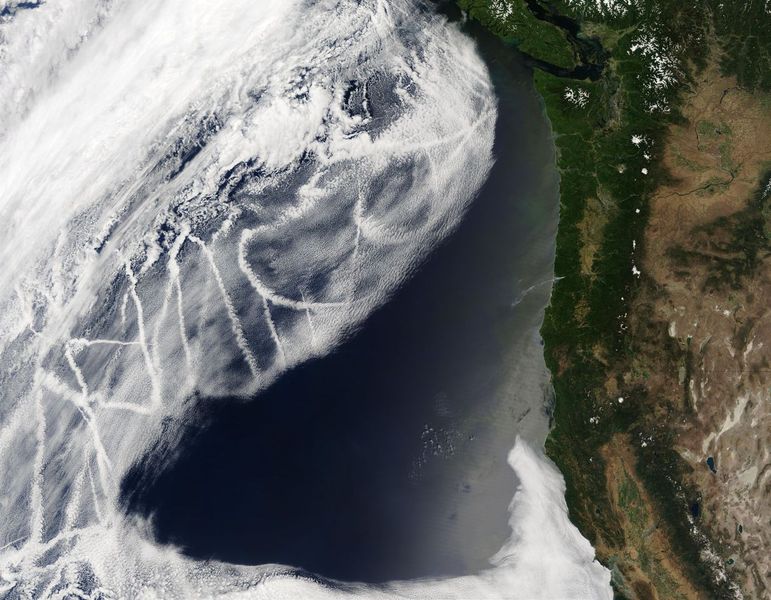
Bright tracks in clouds over the Pacific Ocean
Particulate emissions from ships produce bright tracks in clouds over the Pacific Ocean.

When tiny aerosol particles are released into the atmosphere from both natural sources (such as biological emissions and sea spray) and human activities (such as from burning fossil fuels, wood and vegetation) they mix into clouds and can cause them to brighten and reflect more sunlight back into space. This has a cooling effect on the Earth’s climate.

The idea to better understand the role of clouds in climate — and humans’ effect on it — came about when scientists observed that clouds were being made more reflective, or “brighter,” in regions where they were influenced by air pollution.

A particularly striking version of this is seen in “ship tracks,” the trails of brightened clouds along the routes of ships caused by the small aerosol particles their engines emit. The tracks are bright enough and big enough to be observed from space. In order to reduce this pollution and improve global air quality, recent regulations have significantly reduced shipping and other emissions — but in doing so, they have also reduced the reflectivity of clouds, which could be accelerating global warming.

“There’s now strong evidence that reductions in ship emissions starting in 2020 contributed in part to the anomalously warm waters recently observed in the north Atlantic Ocean,” said Robert Wood, professor of atmospheric sciences and lead investigator of the Marine Cloud Brightening Program. “This really speaks to the remarkably strong influence these tiny particles in the atmosphere can exert on clouds and the absorption of sunlight by the Earth. But the truth is that we still don’t have a very good handle on how big of an effect aerosol changes can have globally because cloud responses to aerosols can vary enormously depending on the type of cloud and on meteorology.”

As scientists investigate these questions, they have also identified new questions: if ship emissions could cause clouds to brighten and reflect sunlight back into space, could a non-polluting version of that phenomenon be used to help cool the planet? And if so, should it?

These are complex topics, and as climate change becomes an everyday reality for people around the world, scientists and governments have recognized the importance of investigating them by recommending further research. In studying the ways that aerosols and clouds interact, the Marine Cloud Brightening Program seeks to inform future decisions by helping humanity understand not just the technical challenges of this kind of climate intervention, but the suite of potential benefits and risks that come along with it.

Understanding marine cloud brightening

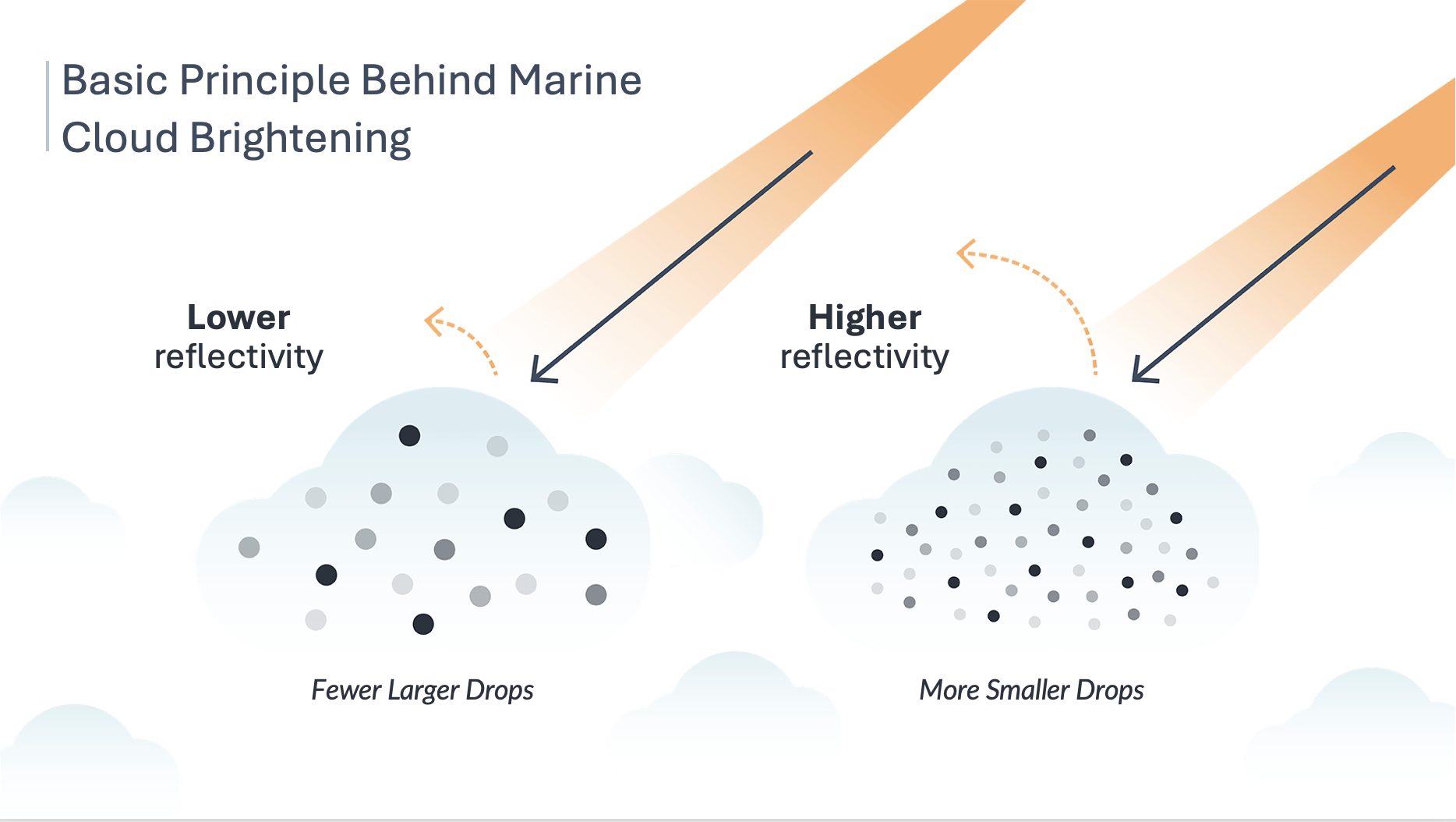
Diagram depicting how droplet sizes and numbers affect cloud reflectivity
Changes to the size and number of droplets in clouds can change how much sunlight those clouds reflect back into space.

Marine cloud brightening (MCB) is one of several proposed climate interventions collectively known as solar radiation modification, or SRM. In this approach, tiny sea salt particles generated from ocean water would be sprayed from ships into areas of low-lying clouds. Once emitted, the particles would remain in the atmosphere for only a few days, brightening clouds over parts of the ocean in order to reduce climate warming.

But before any intervention like this can be considered, it is crucial to fully understand how it will affect the climate system, our oceans and our terrestrial ecosystems.

“The goal of the MCB Program is to understand whether it might even be possible to predictably and reliably brighten low marine clouds, and if so, how doing this in different regions of the globe would affect temperatures, precipitation and climate both globally and locally — as well as any other possible side effects,” said Doherty. “As atmospheric scientists, we think it’s critically important that society has the answers to these questions before making any decisions about whether or not to actually use marine cloud brightening in an effort to reduce climate risks.”

In order to better understand how aerosol particles interact with clouds, and how intentionally brightened clouds would interact with our global climate system, the Marine Cloud Brightening Program researchers are taking a multi-pronged approach.

Computer simulations

Diagram of the Pacific Ocean broken into square segments for simulating cloud dynamics.
Researchers use computer models to simulate how clouds respond to aerosols locally to inform projections of the effects on climate globally.

The first phases of research have focused on computer modeling. The team is working with models at the global scale to study how aerosol-cloud interactions affect climate, testing the accuracy of their simulations against observations in the field and using them to understand how different MCB implementations would affect future climate. The team is also working with smaller-scale models that simulate the details of clouds to better understand how their reflectivity and other properties are affected by aerosol changes.

“But as with any computer simulations, we need to validate these detailed models against observations because the real world always introduces variables you weren’t expecting,” Doherty said.

Small-scale field studies

To validate the models and measure real-world cloud responses, the team has developed a new approach for controlled studies of aerosol-cloud interactions. That’s where CARI — the cloud aerosol research instrument — comes in.

“In the past when we’ve tried to study how clouds are affected by aerosols, we’ve had to just observe clouds in polluted regions, where it’s difficult to distinguish between changes in the clouds due to aerosols versus other meteorological factors,” said Wood. “Being able to add known quantities of sea salt particles to clouds and compare clouds with different concentrations of aerosols, but that are otherwise the same, will be a powerful new research capability.”

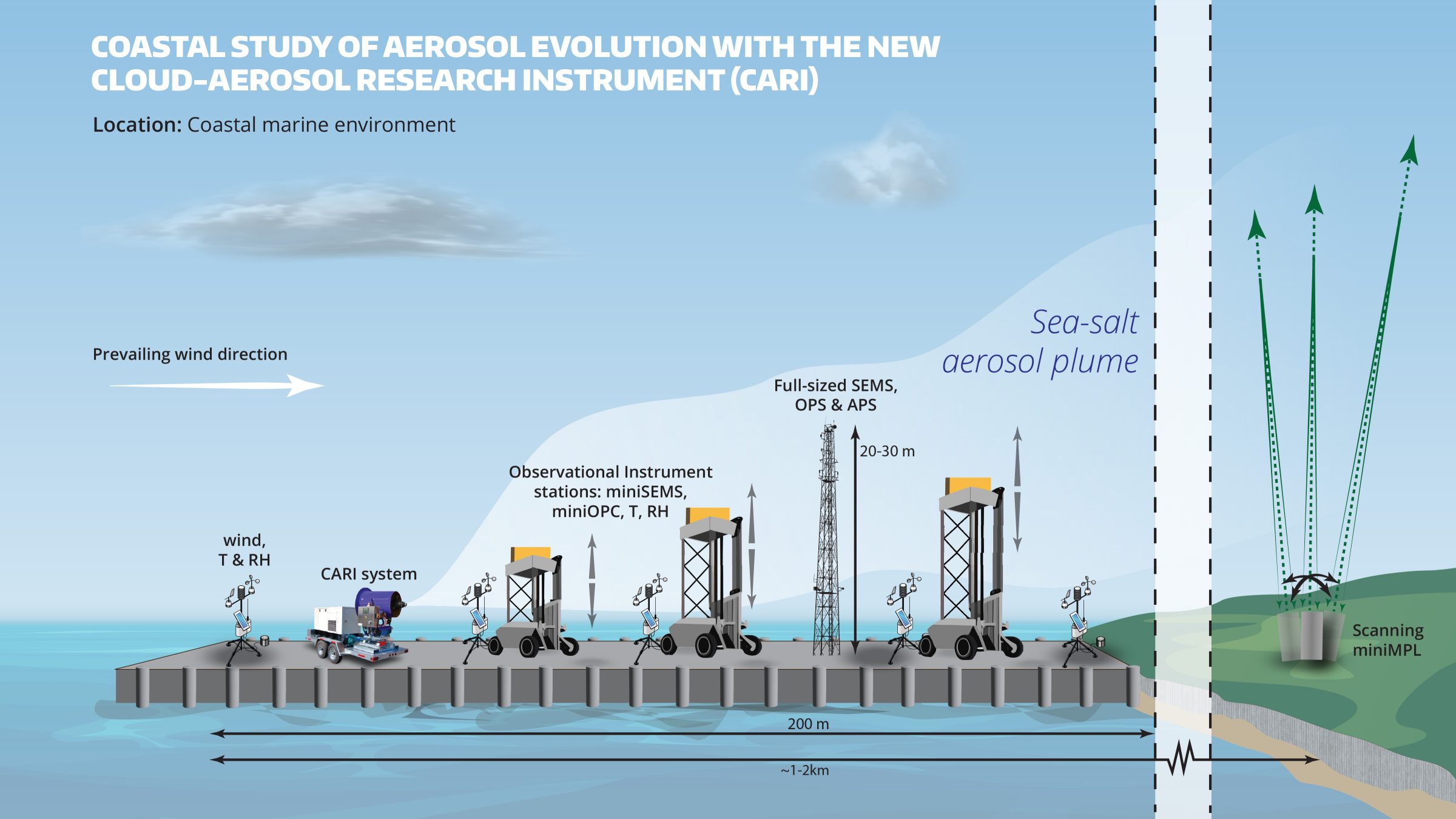
Diagram of a coastal marine cloud brightening study.
The Cloud-Aerosol Research Instrument (CARI) generates a sea salt plume, then measures the generated aerosol downwind to compare with computer simulations.

This spring, the Marine Cloud Brightening Program researchers are putting CARI to the test at a new research facility they’ve established onboard the USS Hornet Sea, Air and Space Museum — a Smithsonian affiliate — in Alameda, CA. There they have begun a series of small-scale studies in which CARI generates a sea salt plume, then measures the generated aerosol at multiple points downwind to compare with simulations generated from high resolution models.

Importantly, these studies are not large enough to have any effect on local weather conditions — naturally occurring sea spray from crashing waves along the coast puts more sea salt mass into the air than CARI, which will also only be run for 30 minutes or less at a time. But the researchers’ sensitive instruments will still be able to gather important data from these experiments.

Partnering with the public and other scientists

In addition to revealing new insights about how aerosols interact with clouds, these early outdoor studies are an opportunity to engage with other stakeholders and members of the public.

To that end, the program has established the Coastal Atmospheric Aerosol Research and Engagement (CAARE) facility, also housed at the USS Hornet Sea, Air and Space Museum. Open to scientists, students, community members, government officials, global stakeholders and members of the public, the research site is also an exhibit.

“This research is of the utmost importance to society, so transparency is crucial,” said Maya Tolstoy, Maggie Walker Dean of the UW College of the Environment. “I’m grateful to our researchers and partners for prioritizing engagement with the public, the scientific community and regulators in line with the University of Washington’s commitment to the public good.”

What’s next for marine cloud brightening?

Whether intentional marine cloud brightening should ever be used to address climate risks is a question that requires extensive scientific research, assessment by scientific experts, and informed and equitable decision-making by a global community of stakeholders.

Beyond the scientific questions being addressed by the Marine Cloud Brightening Program, the effort will continue to expand its direct engagement with the public to help inform, educate and receive input on the research. A high degree of openness and engagement is a critical part of the work, given that both pollution aerosols and any human climate intervention have the potential for far-reaching impacts on people, the climate and wildlife.

The researchers are motivated by a stark reality: As climate change worsens, it becomes increasingly likely that society will look to climate interventions such as MCB to help avoid the worst impacts of climate change. The Marine Cloud Brightening Program aims to provide the information needed to understand their potential benefits and risks.

“Improving our understanding of the influence of aerosols on clouds and climate is essential to understanding near-term climate risks, and whether and how marine cloud brightening could help reduce them,” said Doherty. “If we don’t improve our knowledge now, we’ll be flying blind. The international community needs the best information it can get in order to chart a responsible course into a future with a rapidly changing climate.”

Friday, March 29, 2024

Clean Energy Transition - Net Zero by 2050


China has the largest carbon market in the world and Hong Kong can help connect it globally by establishing an Asia-focused carbon standard and developing a futures market. As a major carbon emitter, the power sector plays a crucial role in realizing the goal of carbon peaking and carbon neutrality. Although there has been a local expansion of wind and solar projects, this is limited due to the environment. It is possible that Hong Kong could create more opportunities for clean energy transition by buying energy from clean sources and supporting renewable energy businesses.  Over the last 7 days, the Renewable Energy industry has dropped 1.3%, driven by a pullback from China Power International Development of 3.6%. The industry has fallen 5.1% in the last year. As for the next few years, earnings are expected to grow by 18% per annum.


What are the most urgent challenges for the sector over the next three years?

1. Cost of Transition


High capital costs associated with clean energy transition are a challenge to the oil and gas industry in Asia, particularly among smaller and emerging markets. Even in developed economies such as South Korea, cost can be a challenge slowing the pace of change.

2. Ongoing demand for fossil fuels


There is an ongoing and – especially in the case of China for example – a growing demand for fossil fuels in Asia. It was unlikely that the majority of local businesses would be able to accommodate a fall in the use of oil and gas in the next few years.

3. Lack of renewables infrastructure


Infrastructure transformation poses challenges in dealing with legacy liabilities as well as significant investment in ensuring electricity grids can store and transmit electricity generated from renewable resources.

Governments around the world have set targets for reducing carbon dioxide emissions. As economies make the move towards sustainable development, small and medium-sized enterprises (SMEs), the backbone of the world economy, are adjusting their supply chain strategies to help them embark on the road to zero carbon with a measurable carbon footprint.

Burning fossil fuels to feed our energy systems accounts for 75% of the world’s total greenhouse gas emissions. The transport and processing of oil and gas alone resulted in 5.1 billion tonnes of emissions in 2022, accounting for just under 15% of the total produced by the global energy sector.

Interestingly, in the year that the US goes to the polls to elect a new president, geopolitics could be a factor that potentially slows clean energy transition in the next few years. 

Asia accounts for a large part of this, with China alone acting as the largest producer and consumer of energy in the world. Although coal accounts for the greatest share of the total energy supply in Asia (48%), oil is second with 23% and natural gas 11.6%. In terms of oil refining, Asia accounts for 38% of the global share.


However, in addition to being a big producer and consumer of fossil fuels, Asia also generates a significant amount of electricity from renewable resources. In 2021, the International Energy Agency (IEA) calculated that 23.5% of the region’s electricity was generated by hydro (13.7%), wind (5.6%) and solar (4.2%). This compares to just 11.8% of electricity generation by oil and gas combined.


China is a key player in many clean energy supply chains and both Japan and Korea have devised plans for decarbonisation.


Of course, Asia is a large continent with different needs, strengths, and drivers across markets, and different perceptions of challenges and opportunities. For example, when we asked our underwriters whether geopolitical issues might impact the transition to clean energy in the local oil and gas industries, our specialists in China said “probably, yes”, whereas in Thailand, Hong Kong, Taiwan, Japan, and Korea the response was, “not so much”.


The oil and gas industry could not shift to clean energy in the short term due to high costs and supply issues. The fact is, it is hard to build a business case for consuming more expensive electric energy from renewables if cheaper oil and gas are on tap.


More than 80% of Taiwan's electricity came from fossil fuels in 2022, making the country’s official pledge to achieve Net Zero by 2050 a big challenge. While there is still significant demand for oil, natural gas, and coal, the industry is increasingly facing pressure from the growth of renewable energy sources, as well as concerns over climate change and environmental impacts, with many companies and governments investing in carbon capture and storage technologies, as well as exploring alternative sources of energy.


Geographical issues do influence which energy sources are most commonly used by different countries in the region. For example, Japan's primary energy source is oil, amounting to about 36% of the country’s overall energy fuel mix, followed by coal (25%) and natural gas (21%). There is a local high dependency on fossil fuels, but this is partly due to the suspension of nuclear power plants since the earthquake in 2011. Domestic demand for oil is getting weaker due to a decreasing population and the growth in alternative energy sources. Meantime, the greenhouse gas emission target is 46% compared to the 2013 level, revised from 26% in April 2021.


What are the greatest opportunities for the sector over the next three years?

1. Growing demand for sustainability


Consumer demand for environmental sustainability presents a good opportunity for long-term growth for industry players who invest in diversification.  What’s more fossil fuels are a finite resource, which means diversification into renewables and other income streams is vital for business sustainability.

2. Repositioning role as energy companies


Some large oil and gas companies are set to make a switch to energy companies that supply a diverse range of energy services, particularly electricity.

3. Improved brand image


Oil and gas companies that pivot towards clean energy transition may benefit from an improved brand image and may be more likely to attract public and private capital from investors, especially those seeking to promote and support greater environmental and social responsibility.


Sunday, March 10, 2024

European banks in Russia


A banker is a professional who is responsible for managing the financial transactions of clients. Bankers provide financial advice to clients and help them with investments, loans, and other financial services. Bankers should have a good understanding of financial markets, banking regulations, and accounting principles. A few short weeks from now, we will be asked to place our trust in politicians at the ballot box. Sadly, this does not reflect a sudden surge in the popularity of the political parties. It has more to do with the fact that even those with the most sensitive political antennae are struggling to predict the outcome. As a result, people will believe that their vote is more likely to make a difference and, so the logic goes, be more eager to put their cross in the box. 

Bankers, like politicians, too often lose sight of their purpose. The crash exposed some ugly truths about the way some big banks and bankers gained an overweening sense of entitlement and, over many years, systematically and cynically abused their position and customers. The covenant of trust between banks and their customers was broken. Hubris had indeed led to nemesis.

EU banks still operating in Russia are squirming to show they're abandoning their ever-more toxic client — but actions speak louder than words. Some banks pulled out of Russia a long time ago, but a lot of people didn't and now they've been caught with their pants down. Austria's top lender, Raiffeisen Bank International (RBI), made €1.8bn in pre-tax profit in Russia last year. Following earlier briefings with German lenders, the US has threatened Austria's top bank with sanctions for doing business in Russia.

RBI is one of eight leading EU banks still in Russia. The others are Dutch lender ING, Germany's Commerzbank and Deutsche Bank, Hungary's OTP Bank, Italy's Intesa Sanpaolo and UniCredit, and Sweden's SEB. The US Treasury warned Austria's Raiffeisen Bank International (RBI) that it risked "being cut off from the US financial system" if it was helping to fund Russia's military.

OTP Bank, which used to be on Ukraine's Sponsors of War list, posted a 125 percent increase in its Russia profit in 2023, pocketing €242m. It has 82 retail branches in Russia and employs 2,018 people there. The US Treasury didn't reply if Morris might come knocking on OTP Bank's door in Budapest in the future. 

But US Treasury officials have also briefed German financiers on the new sanctions threat. Commerzbank does corporate banking for mostly German companies active in Russia. It doesn't disclose its Russian profit and employs about 130 people there. ING also does corporate banking in Russia, where its Moscow office employs some 270 people and manages €1.3bn of loans. The Dutch bank said it didn't feel at risk because it "complies with all international sanctions laws including UN, EU, and OFAC".

We trust people who are clear and open with us, with nothing to hide. In a similar vein, we trust people we can rely on, who dependably do what they say they will. We trust people who show they trust and respect us, and those prepared to act against their own self- or short-term interests on our behalf. Lastly, we respond to those whose values we share, who live by those values and don’t contradict them. Some are hoping that if they can keep their head down, the whole thing will blow over and they can have good business in Russia afterwards. Some are afraid of violating any Putin decree because they don’t want personal cases opened up against them. Some are just paralyzed by fear. These are not people who ever imagined, despite all the warnings, that they would be in the middle of this murderous war where they could get killed in the crossfire.


Thursday, February 15, 2024

Illegal immigration and mechanics of democratic government


This year, the US has an agenda that includes some of the upcoming elections in Croatia too. Immigration experts are raising the alarm about how the increasing flow of migrants illegally crossing into the U.S. may significantly impact states' representation in the House of Representatives and Electoral College.


Overall, according to the Federation for American Immigration Reform, there are an estimated 16.8 million illegal immigrants living in the U.S. as of June 2023. Therefore, because every House seat represents 761,168 residents on average, the total number of illegal immigrants accounts for roughly 22 seats in the House.

The US presidential election takes place on 5 November. But it's possible the candidate with the most votes won't be the winner. This is because the president is not chosen directly by the voters, but by what's known as the electoral college. When Americans go to the polls in presidential elections they're actually voting for a group of officials who make up the electoral college.

The word "college" here simply refers to a group of people with a shared task. These people are electors and their job is to choose the president and vice-president. The electoral college meets every four years, a few weeks after election day, to carry out that task. The number of electors from each state is roughly in line with the size of its population. Each state gets as many electors as it has lawmakers in the US Congress (the House and Senate).

California has the most electors - 54 - while a handful of sparsely populated states like Wyoming, Alaska, and North Dakota (and Washington DC) have a minimum of three.


There are 538 electors in total. Each elector represents one electoral vote and a candidate needs to gain a majority of the votes - 270 or more - to win the presidency. Generally, states award all their electoral college votes to whoever won the poll of ordinary voters in the state. For example, if a candidate wins 50.1% of the vote in Texas, they are awarded all of the state's 40 electoral votes. Alternatively, a candidate could win by a landslide and still pick up the same number of electoral votes. It's therefore possible for a candidate to become president by winning a number of tight races in certain states, despite having fewer votes across the country.

There are only two states (Maine and Nebraska) that divide up their electoral college votes according to the proportion of votes each candidate receives. Most states consistently vote for the same party each election. This is why presidential candidates target specific "swing states" - states where the vote could go either way - rather than trying to win over as many voters as possible across the country. Every state they win gets them closer to the 270 electoral college votes they need.

It is possible for candidates to be the most popular candidate among voters nationally, but still fail to win enough states to gain 270 electoral votes. In 2016, Donald Trump had almost three million fewer votes than Hillary Clinton but won the presidency because the Electoral College gave him a majority. In 2000, George W Bush won with 271 electoral votes, although Democrat candidate Al Gore won the popular vote by more than half a million. Only three other presidents have been elected without winning the popular vote, all of them in the 19th Century: John Quincy Adams, Rutherford B Hayes, and Benjamin Harrison.

When the US Constitution was being drawn up in 1787, a national popular vote to elect a president was practically impossible (country size and tricky communications). So, the framers of the Constitution created the Electoral College, with each state choosing electors. Smaller states favored the system as it gave them more of a voice than a nationwide popular vote to decide the president.

The electoral college was also favored by southern states, where slaves made up a large portion of the population. Even though slaves didn't vote, they were counted in the US Census (as three-fifths of a person). Since the number of electoral votes was determined by the size of a state's population, southern states had more influence in electing a president than a direct public vote would have given them.

In some states, electors could vote for whichever candidate they prefer, regardless of who voters backed. But in practice, electors almost always vote for the candidate who wins the most votes in their state. If an elector votes against their state's presidential pick, they are termed "faithless". In 2016, seven Electoral College votes were cast this way, but no result has been changed by faithless electors. In some states, "faithless" electors can be liable for fines or prosecuted for their votes or abstaining.

In 2020, US voters became familiar with the concept of "fake electors" after pro-Trump Republicans in seven US states created their electors in a bid to overturn the election's results. In some cases, they created and signed official-looking documents or arrived at state capitals on 14 December - when electors across the country met to officially cast their votes. Some of those involved have faced prosecution and investigations are still ongoing. Federal prosecutors later described the effort as a "corrupt plan to subvert the federal government function by stopping Biden electors' votes from being counted and certified".

Shortly after taking office in January 2021, President Biden signed an executive order requiring the U.S. Census Bureau to factor in all residents, including noncitizens, as part of its decennial calculation of the U.S. population. As a result, the apportionment of House seats and, therefore, electoral votes for presidential elections, could be swayed as migrants continue to pour over the southern border.

Illegal immigration has all kinds of effects and among them is that it distorts the mechanics of democratic government, so their inclusion in the census count for purposes of apportionment is outrageous.

Saturday, February 10, 2024

Super Bowl Stadium Powered by Renewable Energy


Nevada gets 23% of its energy from solar and 37% of its energy from all renewable sources combined, according to the US Energy Information Administration. Rapidly shifting from fossil fuels to renewable sources is one key step in avoiding the worst effects of human-caused climate change.

Who doesn't love a good rematch? Sunday brings us a matchup of the NFL's most consistently dominant teams over the past five seasons, each of whom has something to accomplish with a victory.

When the Kansas City Chiefs and the San Francisco 49ers face off in Las Vegas this Sunday, they'll be doing so under lights powered by renewable energy. This year's Super Bowl host, Allegiant Stadium gets 100% of its power from renewable sources.

Allegiant Stadium is a domed multi-purpose stadium located in Paradise, Nevada, southwest of adjacent Las Vegas. Opened in 2020, it is the home field of the Las Vegas Raiders of the National Football League (NFL) and the University of Nevada, Las Vegas (UNLV) Rebels college football team. The stadium also hosts the Vegas Kickoff Classic in early September and the Las Vegas Bowl in December. The stadium will host Super Bowl LVIII.

The stadium has a roll-in natural Bermuda grass field similar to the one at State Farm Stadium in Glendale, Arizona, which is primarily used for NFL games. The main advantages of such a configuration is that it allows the natural playing surface to be exposed to natural sunlight when not in use and allows other events to be held at the facility without any risk of damage to the grass. Unlike the Arizona facility (which does not have a varsity tenant) Allegiant Stadium also has an artificial turf field, which is primarily used for college football games. This design was chosen because UNLV prefers to play on an artificial turf surface, and also due to concerns that the use of the grass field by two teams would cause excessive wear to the playing surface. The artificial turf is placed directly on the stadium's concrete floor and is rolled up and stored under the stadium when the tray is rolled in. 

There are 2,700 parking spots surrounding the stadium and 6,000 in proximity to it. More than 35,000 parking spaces are located within a mile of Allegiant Stadium.


According to a press release from the Las Vegas Raiders, the stadium's main tenant, the stadium achieved that milestone in October. The team and the stadium's website don't spell out what renewable sources helped them achieve that goal, but more recent reporting says a big chunk of it comes from a Nevada-based solar installation. The Las Vegas Raiders have agreed to purchase power from the solar farm for 25 years, CBS reported.

Big-time sporting events at major stadiums are energy-hungry affairs. A stadium can require 5-10 megawatts of electricity during an event like an NFL game, enough to power around 5,000 homes. Covering that demand is certainly a step in the direction of sustainability.

But an event like the Super Bowl has a footprint that expands beyond the stadium's walls. While electric power generated from fossil fuels is the second largest source of greenhouse gas emissions, transportation is the largest and accounts for 28% of US emissions, according to the Environmental Protection Agency. Air travel to and from the game is part of an aviation industry that accounts for 2% of global energy-related carbon dioxide emissions, according to the International Energy Agency.

A win for the Chiefs would confirm them as a dynasty. The list of teams to win three Super Bowls in five years isn't long. the mid-1970s "Steel Curtain" Steelers, the mid-1990s Cowboys built by Jimmy Johnson, the Patriots with Tom Brady and Bill Belichick managed to pull it off twice in two different decades. That's it. A victory would put the Chiefs among the greatest five-year runs in league history, full stop.

The 49ers might believe they would be the dynasty if a few things had broken their way. They led the Chiefs by 10 points with seven minutes to go in the fourth quarter of Super Bowl LIV, only for Patrick Mahomes to carry Kansas City back. In the 2021 NFC title game, the Niners had a 10-point lead on the Rams to start the fourth quarter, but Jaquiski Tartt dropped an arm punt and the offense went cold at the wrong time. In the 2022 NFC title game, down to their third-string quarterback in rookie sensation Brock Purdy, the 49ers went into Philadelphia and lost Purdy to a serious elbow injury in the first quarter, which led to a 31-7 rout.

Five months ago, the season began with a Chiefs loss. Will it end with one? Who doesn't love a good rematch? 


Thursday, February 1, 2024

Digresija o mentalnom zdravlju moje nacije


Prošlo je 180 godina od povijesnog govora Ivana Kukuljevića Sakcinskog na hrvatskom jeziku. Hrvatski političar, povjesničar i književnik bio je jedan od nositelja ilirskog pokreta, hrvatskog nacionalnog preporoda. Zalagao se za uvođenje hrvatskoga jezika umjesto latinskog kao službenoga te je bio prvi zastupnik koji je na materinskom jeziku progovorio u Hrvatskom saboru 2. svibnja 1843. godine. 


Mentalna higijena polazi od pretpostavke kako socijalna sredina utječe na mentalno zdravlje. Mentalna higijena (psihohigijena), granično je područje kliničke psihologije koje se bavi sprječavanjem psihičkih poremećaja i očuvanjem duševnoga zdravlja. Proučava čimbenike koji održavaju mentalno zdravlje i mjere kojima se ono poboljšava, potiče dobro osjećanje i volja za životom, te otklanjaju i izbjegavaju čimbenici koji dovode do psihičkih bolesti ili pogoršavaju duševnu kvalitetu života.


180 godina kasnije, prema podacima sa stranica hrvatskog Sabora, protiv zakona kojim se potvrđuje da je hrvatski jezik službeni jezik u Hrvatskoj i jedan od službenih jezika Europske unije, kao i to da je u svojoj ukupnosti i cjelovitosti temeljna sastavnica hrvatskog identiteta i hrvatske kulture. glasali su zastupnici Mirela Ahmetović, Barbara Antolić Vupora, Boška Ban Vlahek, Arsen Bauk, Erik Fabijanić, Sabina Glasovac, Peđa Grbin, Branko Grčić, Siniša Hajdaš Dončić, Mišel Jakšić, Boris Lalovac, Andreja Marić, Anka Mrak-Taritaš, Dalija Orešković, Katarina Peović, Marijana Puljak i Martina Vlašić Iljkić. Suzdržani su bili Domagoj Hajduković, Marin Lerotić, Vesna Nađ, Željko Pavić, Ivana Posavec Krivec, Sanja Udović, Davorko Vidović, Franko Vidović i Nikšta Vukas. Za provedbu zakona glasalo je 95 zastupnika, uz ovih 17 protiv, bilo je tu i 10 suzdržanih.

Mentalna higijena usmjerena je na uklanjanje patogenih čimbenika koji štete duševnomu zdravlju pojedinca i zajednice, te na poboljšanje zdravlja, u čem nalazi veze sa životom i praksom, povezujući se s kulturnim utjecajima, prosvjetom, ekonomijom, zdravstvom, urbanizacijom, a ulazi i u područje ekologije te, u širem smislu, antropologije. To je povezivanje interdisciplinarno, proizlazi iz shvaćanja da je zdravlje stanje fizičkoga i emocionalnoga dobrog osjećanja i da stvaranje uvjeta za dobro osjećanje poboljšava mentalno zdravlje. 

Primjer 1. 

Ivan Kukuljević Sakcinski Hrvatskom saboru 2. svibnja 1843.


Preuzvišeni Gospodine Grofe i Bane, Presvetli Velmože! Slavni stališi i redovi!

Kao što svaki pravi Harvat i Slavonac, tako sam i ja s velikom zaisto radostju i unutrašnjim uzhitjenjem razumio, da slavni stališi i redovi ovih kraljevinah žele: podignutje katedrah za narodni naš jezik i literaturu, (kako ja mislim) ne samo u Akademii nego u celom Distriktu Akademie Zagrebačke čim bez dvojbe to steći žele, da svi izobraženii stanovnici kraljevinah naših svoj maternji jezik dobro i izvarstno nauče. Nu, pitam ja s poniznim dopuštenjem: na kakovu će korist i svarhu biti učenje našega jezika kakovim uspehom kakovom posledicom kakovim trudom učit će ga stanovnici domovine naše, ako sa znanjem njegovim nikada nikakovo dobro skopčano nebude; ako po njem nitko ništa zaslužiti si nebude mogao; i ako mi nikad niti pomisliti nećemo, da ga u javni život uvedemo Zaisto će on bez toga, kao i do sada ostati u tmini, šnjim će se zabavljati samo oni, koji baš za to vremena imali budu, u ostalom neće ga opet veća strana naroda znati, a oni, koji se javnim životom bave, i koji su u javnih službah stavljeni sasvim će ga zanemariti kao i do sada; podignutje pako naših katedrah i učionah neće na drugo služiti, nego na zasleplenje domorodacah i tudjinah.


Znam ja, da mi kako smo ovde sakupljeni s veće strani naš jezik dobro neznamo, i da se u celoj našoj domovini osobe obadvojeg spola, koje u svom maternjim jeziku dobro govoriti, čitati i pisati znadu, lahko na parste prebrojiti bi mogle; a šta je tomu uzrok nego to: da ga mi u javnom životu i poslovih nigde neupotrebljavamo, i š njim se samo tako zabavljamo, kao gizdavi gospodar svojim plaćenim slugom.


Još nezna veća strana naroda našega, kakova je to višnja slast i milina svojim prirodjenim materinskim jezikom govoriti moći i smeti, to samo on iskreno ćutiti može, koj je duže vremena medju tudjemi narodi u tudjih daržavah stanovati i živiti morao. Mi naš jezik čuvamo još uvek samo za družinu i za naše kmetove. U občinski život i u poslove uveli smo u onih još barbarskih vremenah, kad su na celom svetu jedini jezik latinski za izobraženi i izdelani daržali, taj jezik; u družtveni život i familiu našu uvuko se je s vremenom jezik nemački i promenio našu prirodjenu narav i način mišljenja otacah naših; u Primorju pako učinio je isto jezik talianski. Šta smo mi stigli po tom, nego to: da smo se odtudjili sami sebi, da smo se odcepili od susedne jednorodne bratje naše, i da mnogi od naroda našega niti neznaju od kojega su naroda i koji puci po rodu, po karvi, i po jeziku k nama spadaju!!!


Mi gledamo svaki dan, kako domovina naša sve dublje i dublje propada, kao imanje one detce, koja pod više tutorah stoje, svaki od ovih tutorah stavi si nešta u žep, svaki si nešta prisvoji, najposle neće ostati detci ništa.


Mi smo malo Latini, malo Nemci, malo Taliani malo Magjari i malo Slavjani a ukupno (iskreno govoreći) nismo baš ništa! Martvi jezik rimski, a živi magjarski, nemački i latinski –  to su naši tutori, živi nam groze, martvi darži nas za garlo, duši nas, i nemoćne nas vodi i predaje živima u ruke. Sada imamo još toliko sile u nami suprotstaviti se martvomu, za mala nećemo moći nadvladati žive, ako se čvarsto na naše noge ne stavimo, to jest, ako naš jezik u domovini neutvardimo i njega vladajućim neučinimo. Susedi naši, osobito Magjari, neće već odstupljivati od svojega jezika, i iz priateljstva i uljudnosti prema nas ili iz drugoga kakvoga uzroka, neće ga zaista zamenjivati s ikojim drugim najmanje martvim, nu to i potrebovati hoteti od njih, bi značilo toliko: kao orlu hoteti svezati krila, da k nebu nepoleti; njihova stalnost i jedinost u jeziku nadvladati će zaisto našu nestalnost, neslogu i mešariu.


Tko može jednomu narodu zabraniti, da svojim prirodjenim jezikom govori...


Čuli smo mi jučer preuzvišenu gospodu Bana i Biskupa pred sakupljenimi slavnimi stališi i redovi ovih kraljevinah izjaviti se, da ćedu oni u velikom saboru ugarskom i magjarski govoriti, ako time stvari i domovini našoj hasniti budu mogli, mi se nismo protivili tomu, niti se protiviti želimo; nama je drago da su i preuzvišena ta gospoda toga mnenja, da Harvati i Slavonci u javnom životu nemoraju uvek kod jezika latinskog ostati, i njihova misao veseli nas zaisto tim više, budući da se ufati i nadati možemo, da oni s vremenom u Harvatskoj i Slavonii k Harvatom i Slavoncem harvatskoslavonski će govoriti, ako bude jedanput naš jezik u javni život uveden. 


Nu čitam ja u očiuh od mnogih ovde nazočnih tu misao: da mi to dopuštenje, da se naš materinski jezik u javni život i u poslove uvede, nikad i nikad zadobiti nećemo! A ja pitam slobodnim duhom: tko može celomu jednomu narodu, ako je taj i Bog zna, kako malen, nu ako istinitu i krepku volju ima, zabraniti, da svojim prirodjenim jezikom govori, da ga na parvo mesto stavi, i po tom narodnost svoju digne, tko može i srne slobodnomu narodu, kao što su konštitucialni Harvati i Slavonci, to zaprečiti. Ima li sile na svetu, koja ono, što Bog komu poda, uze ti sme ili pako, kojoj stvari drugo opredeljenje podati, nego joj ga Bog poda, a na što su jezici narodah odlučeni, to će svaki izmedju nas znati, ja mislim na taj cilj najviše, da se š njima narodi od drugih odlikuju, da se š njima služe, i da svaki narod svoj jezik nad svimi drugimi štuje, ljubi i uzvisuje. Vodimo dakle i mi već naš jezik k njegovomu cilju, i daržimo se u tom primera ostalih narodah europejskih koji svi martvi jezik s živimi zameniše, i po tom k narodnomu svo¬jemu razvitju najviše doprinesoše; pogledajmo samo na susedne puke, koji s nama pod jednim žezlom austrianskim stoje, svaki od njih Nemac, Talian i Magjar postavio je svoj jezik na parvo mesto, samo mi ponizni i krotki Slavjani, kojih u Carstvu 17 milionah ima, samo mi plašljivi Harvati i Slavonci, koji u domovini našoj s nikakvimi drugimi puci smešani nismo, bo¬jimo se našega jezika, volimo služit tudjemu, tudjoj volji, i činimo samo ono, što se drugim lepo i krasno vidi, i što je drugim hasnovito.


Ili je možebiti jezik slavnih predjah naših od providnosti nebeske, ili od kakvog prokletstva na to osudjen da uvek u robstvu i kod prostog puka prebiva da uvek u blatu kopa i da nikad u visinu poletiti nesme. Kuda toliki drugi jezici od našega manje mili i sladki, manje bogati i izdelani, manje krepki i silni, kroz toliko vekovah već lete i uzdaržavaju se. Pitam ja sve izkrene Harvate i Slavonce: što im na to sarce veli. Je da li je naš jezik, jezik najprostranii i najdalje razšireni u celom svetu, za večnu tminu, ili za jasnu bistru svetlinu stvoren ako je za parvo odhitimo ga onda, što hitrie za na veke u vekoviti grob! zaboravimo ga sasvime, nepodižimo nikakovih učionah i katedrah za njega, nego ogarlimo sa svom silom parvi živi, koj nam se nudi, bio taj aziatski ili europejski; možebiti da ćemo šnjime barem u tudjem kipu sretnii postati ali ako je za svetlost stvoren, a tko bi o tom i dvojio, moramo ga čistiti od svake tmine, koja ga sad još krije, moramo se samo za njega skarbiti, samo š njim najviše zabavljati se, i kao majka dete svoje nad svimi drugimi stvari ljubiti ga! On nam mora biti parvi sarcu našemu, on mora biti parvi i duhu našemu! Š njim i po njem moramo nesretnu našu domovinu i nesretni naš narod sretnimi učiniti! U njem neka nam se zakon daje i razglašuje, on neka bude trublja od buduće naše sreće i slave!


Mi smo potomci onih predjah koji su u staro vreme maternji svoj jezik na toliko ljubili, da su ga već u 9. stoletju izpovednici tako vere katoličke kao i garčke u istu carkvu uveli i njega time u svetu s najstariim garčkim i latinskim usporedili, a u domovini svojoj nad njimi ga uzvisili; mnogo ih je to truda stalo, nu oni su stalnostju svojom sve teškoće nadvladali, i još sada se velika strana našega naroda s njime u carkvi služi! Mi smo sini majke slave, koja je svojom detcom sav svet oplodila i koja samo zato tako duboko u tmini i potlačena leže, jer im je jezik potlačen; pokažimo dakle da smo vredni biti potomcima takovih predjah, da smo vredni sinovi takove majke, i da ono, što nas i jezik naš tlači, razdrobiti želimo, hoćemo, i možemo!!!


Ko svoj može biti, tudj neka ne bude...


Naš narod proslavio se je mnogo putah u Istorii junačtvom, smionstvom i postojanstvom, pomislimo samo na vremena Alexandra velikoga maćedonskoga, na slavne domaće naše vladare Ograna, Dušana i Krešimira, na branitelje od Metulja i Siska, na boj Grobnički, na rat sedmoi tridesetoletni, te na najnovii francuzki; u sva ta bojna vremena proslavio se je naš narod telesnom silom, i nadvladao puke kopjem u ruci, ali sada je nastalo 19. izobraženo stoletje, u kojem se puci duhom i umom medju sobom bore, trebalo bi dakle, da ih i time nadvladamo ili barem da se s njimi usporedimo, nu kako ćemo to učiniti, kad je duh naroda našeg, narodni naš jezik, u lancih, i kad se potlačen svagde tudjemu klanjati mora; radimo dakle složno i krepko, da se barem u domovini njemu drugi već jedared klanjali budu. 


Nemojmo se u tom obziru strašiti svake sene, koja nam grozi; nemojmo se bojati, da ćemo po tom ustav naš ili konštituciu našu i municipalna prava naša izgubiti, ona će time samo bolje ustanoviti i utvarditi se; nesvadjajmo se u domovini našoj kao bratja radi jedne stvari, koja nam svim jednako draga, jednako sveta biti mora, nego čuvajmo hrabro i bratski ono do zadnje kaplje karvi, što je naše; samo tako možemo u Harvatskoj i Slavonskoj ostati Harvati i Slavonci, a u svetu slobodni, nezavisni narod. Nemislimo, da jezik naš nije jošte prikladan zato, da ga u javne poslove uvedemo: ta on je bio prie 800 godinah jezik diplomatički harvatskih i sarbskih kraljevah, a kasnie i turskoga carstva, on je tako bogat, tako izdelan, tako blagozvučan, kao što je malo samo jezikah na svetu; on poseduje u ostalih slavjanskih narečjih neizcarpivo blago: zašto bi dakle bojali se i oklevali uvesti ga u javni život; zašto bi se bojali reći, da mi želimo, da nam se zakoni i zapovedi pišu u krasnom našem materinskom jeziku, kad se to nisu plašili učiniti drugi narodi, ko jim je jezik mnogo surovii i siromašnii "Ko svoj može biti, tudj neka ne bude!" 


Carni oblaci puni dažda i grada vise nad nami i domovinom našom, silne velike vode obkoljivaju nas od svih stranah, i groze nam strašnom poplavicom, kako se možemo mi od nje osloboditi, nego ako jame i kanale kopali budemo, po kojih se vode odcede, i ako tvardi most sagradili budemo, po kojem ćemo na suhom preko njih projti i od svake pogibelji izbaviti se; taj most je naš materinski jezik! Ako smo ga doma ustanovili, utvardili i podigli, neimamo se već strašiti ništa od nijedne strane od njedne stvari!!!


Na koncu činim pozorne stališe i redove tih kraljevinah, da nisam od one u galop tarčeće stranke, koja odmah i taki sve i sva steći želi; poznam ja dobro one velike predsude, onaj mali obškurantizam, i onu neizmemu nemarnost, koja u domovini našoj vladaju, i koja čine, da se sve tudje domaćemu i svaki tudji jezik materinskomu predpostavlja, zato sam ja samo toga mnenja, da bi slavni stališi i redovi na to jedankrat već misliti počeli, kako da svoj jezik tudjemu predpostave, i njega u javni život uvedu, i da se u molbi za podignutje katedrah narodnoga jezika ta klauzula prida, da mi te katedre zato molimo; budući da mislimo svremenom naš jezik polag primera drugih europejskih narodah u javni život i u poslove uvesti, i martvi živim zameniti; jer ako mi na to nikada niti pomisliti nećemo ostat ćemo kao i do sada ne narod nego sena naroda, a u Europi medju narodi, koji se svi živimi jezici služe, kao zapušteni mali otok na moru, i umreti ćemo zaista prie ili posle s martvim jezikom i mi, i to umreti kao onaj čovek, koi u celom svojem živlenju za uzdaržanje svog života baš ništa radio nije!!!


Ivan Kukuljević Sakcinski (1816.-1848.)

Primjer 2. 

Na početku Domovinskoga rata, 30. kolovoza 1991., Vlado Gotovac održao je govor pred tadašnjim Zapovjedništvom 5. vojne oblasti u Zagrebu. Obratio se u tom trenutku generalima JNA koji su se još nalazili u zgradi Zapovjedništva, majkama koje su se okupile sa zahtjevom da se njihovi sinovi, koji su u jugoslavensku vojsku otišli služiti vojni rok prije početka rata, puste svojim kućama i, naposljetku, obratio se hrvatskomu narodu – kako onda, tako i danas:


»Oni imaju obraza da, zaposjevši sve naše svete građevine, naše zadužbine, govore o svom posjedu u Hrvatskoj! Oni nam prijete da će na odlasku sve uzeti, sve odnijeti. Oni nam kažu da će iza sebe ostaviti samo pustoš. Pa mi znamo da će otići jedino s onim što će ukrasti jer nikada ništa drugo nisu ni imali. (…) Oni će, prijete, uzeti sve. A pitam ja tu gospodu: gdje su i čime su stekli pravo na bogatstvo koje je Hrvatska stjecala tisuću godina? Koji su njihovi gradovi? Koji su njihovi dvorci? Koje su njihove palače? Neka slobodno uzmu sve što je njihovo. A mi dobro znamo da oni ništa nemaju! Oni se ne boje uništavanja jer se njima nema što uništiti! (…) Mi imamo svoje gradove, mi imamo svoju kulturu, mi imamo svoju domovinu, svoju naciju. Neka nas puste na miru!«

Vladimir "Vlado" Gotovac (Imotski, 18. rujna 1930. – Rim, 7. prosinca 2000.), hrvatski pjesnik, esejist, filozof, disident i političar.

Taj Gotovčev govor smatra se biserom u povijesti hrvatskoga govorništva i bilo bi ga poželjno promatrati i analizirati u kontekstu trenutka u kojem je izgovoren. Stoga je neshvatljivo i civilizacijski poražavajuće kada jedan takav govor nakon više od 30 godina od svoga nastanka i nakon više od četvrt stoljeća od završetka Domovinskoga rata može tako precizno i tako jasno opisivati sadašnji trenutak u kojem ni Jugoslavije, ni Komande, ni generala u njoj više nema, ali je zato ostala ta, očito, vječna potreba posezanja za onim što pripada drugomu. 

Za kraj, obveznici službene uporabe hrvatskoga jezika su tijela državne vlasti, tijela državne uprave, tijela jedinica lokalne i područne (regionalne) samouprave i pravne osobe koje imaju javne ovlasti, odnosno sva javnopravna tijela u Hrvatskoj. Zakon o hrvatskom jeziku važan je korak u isticanju vrijednosti i očuvanju bogatstva hrvatskog jezika u njegovoj punini i raznovrsnosti, bilo da je riječ o hrvatskom standardnom jeziku ili o hrvatskim narječjima (čakavsko, kajkavsko i štokavsko). Hrvatski je jezik u svojoj ukupnosti jedna od temeljnih sastavnica hrvatskog nacionalnog identiteta i hrvatske kulture. On je nematerijalno kulturno dobro i dragocjeno naslijeđe koje pripada svima nama. Stoga se o njemu hrvatska država dužna skrbiti onako kako to rade najbolje uređene države koje drže do svoje kulture. Ovo je bilo malo poduža digresija. Toliko i hvala. 

Sunday, January 28, 2024

John Titor's scary vision for the US future


"Greetings," Titor wrote in November of 2000 on an obscure site called the Time Travel Institute Forum. "I am a time traveler from the year 2036." Over the next four months, Titor described life in 2036. Gave us a glimpse into our future. The most immediate of Titor's predictions foretold a civil war in the United States having to do with "order and rights". As a result, the United States would split into five regions based on a variety of factors, including differing military objectives. That story is the kind of piece that can take you down an Internet wormhole that you emerge from and say "Did I really just spend two days on that?"


Now multiply that by 10 and back to 2024. Large groups of concerned Americans are traveling toward the southern border to demand action from the Biden administration to fix the "wide open" flood of illegal migrants. A clash between Texas and the Biden administration over who controls the Texas-Mexico border continues to escalate this week as federal officials once again demanded the state give Border Patrol agents access to a park that is a popular corridor for migrants to enter the United States illegally.


"We the People are resolute to stand to send a peaceful, lawful, and clear message to all city, state, and federal politicians and immigration enforcement officials who are enabling tens of thousands of illegal entrants, criminals, and known terrorists from over 160 countries worldwide to cross daily into our country along our southern border!" the press release said. 


The current stand-off has sparked fears among right-wing circles that President Joe Biden could try to federalize the National Guard, and the troops could be forced to choose between loyalty to the state and their country. The Texas National Guard is technically part of the US military, which ultimately reports to the president, but they take orders from the state governors except in exceptional circumstances.


The Supreme Court this week sided with the administration when it granted an emergency appeal to allow agents to keep cutting border wire set up by Texas after a lower court had blocked such moves. However, Border Patrol currently has "no plans" to remove the wire unless in an emergency. Gov. Greg Abbott says ten other states have sent the National Guard to the Texas border, and others will follow. Abbott says he is “prepared” for a conflict with federal authorities.


Rep. Marjorie Taylor Greene called for a "national divorce" between red and blue states amid the escalating standoff over migration at the Texas border. Twenty-five Republican governors released a joint statement in support of Abbott on Thursday, praising him for "stepping up to protect American citizens from historic levels of illegal immigrants, deadly drugs like fentanyl, and terrorists entering our country." The dispute has inflamed loose talk of civil war and resistance from conservative media and politicians. 


The clause of the Constitution that Abbott references provides that “no State shall ... engage in War, unless actually invaded, or in such imminent Danger as will not admit of delay.” One thing that immediately stands out after reading this language is that it does not authorize any state to do anything. Rather, this clause is a prohibition on certain state actions; it forbids states from waging “War” except in limited circumstances. It is very odd to read a provision of the Constitution that limits state power as giving a state the power to violate federal law. Texas’ border stance challenges the federal government’s authority and goes against historical precedent. It is essential to ensure that the Constitution’s principles are upheld and that the rule of law is respected as the situation unfolds. 

John Titor, so far, withstands the test of time.