Sunday, January 28, 2024

John Titor's scary vision for the US future


"Greetings," Titor wrote in November of 2000 on an obscure site called the Time Travel Institute Forum. "I am a time traveler from the year 2036." Over the next four months, Titor described life in 2036. Gave us a glimpse into our future. The most immediate of Titor's predictions foretold a civil war in the United States having to do with "order and rights". As a result, the United States would split into five regions based on a variety of factors, including differing military objectives. That story is the kind of piece that can take you down an Internet wormhole that you emerge from and say "Did I really just spend two days on that?"


Now multiply that by 10 and back to 2024. Large groups of concerned Americans are traveling toward the southern border to demand action from the Biden administration to fix the "wide open" flood of illegal migrants. A clash between Texas and the Biden administration over who controls the Texas-Mexico border continues to escalate this week as federal officials once again demanded the state give Border Patrol agents access to a park that is a popular corridor for migrants to enter the United States illegally.


"We the People are resolute to stand to send a peaceful, lawful, and clear message to all city, state, and federal politicians and immigration enforcement officials who are enabling tens of thousands of illegal entrants, criminals, and known terrorists from over 160 countries worldwide to cross daily into our country along our southern border!" the press release said. 


The current stand-off has sparked fears among right-wing circles that President Joe Biden could try to federalize the National Guard, and the troops could be forced to choose between loyalty to the state and their country. The Texas National Guard is technically part of the US military, which ultimately reports to the president, but they take orders from the state governors except in exceptional circumstances.


The Supreme Court this week sided with the administration when it granted an emergency appeal to allow agents to keep cutting border wire set up by Texas after a lower court had blocked such moves. However, Border Patrol currently has "no plans" to remove the wire unless in an emergency. Gov. Greg Abbott says ten other states have sent the National Guard to the Texas border, and others will follow. Abbott says he is “prepared” for a conflict with federal authorities.


Rep. Marjorie Taylor Greene called for a "national divorce" between red and blue states amid the escalating standoff over migration at the Texas border. Twenty-five Republican governors released a joint statement in support of Abbott on Thursday, praising him for "stepping up to protect American citizens from historic levels of illegal immigrants, deadly drugs like fentanyl, and terrorists entering our country." The dispute has inflamed loose talk of civil war and resistance from conservative media and politicians. 


The clause of the Constitution that Abbott references provides that “no State shall ... engage in War, unless actually invaded, or in such imminent Danger as will not admit of delay.” One thing that immediately stands out after reading this language is that it does not authorize any state to do anything. Rather, this clause is a prohibition on certain state actions; it forbids states from waging “War” except in limited circumstances. It is very odd to read a provision of the Constitution that limits state power as giving a state the power to violate federal law. Texas’ border stance challenges the federal government’s authority and goes against historical precedent. It is essential to ensure that the Constitution’s principles are upheld and that the rule of law is respected as the situation unfolds. 

John Titor, so far, withstands the test of time. 

Monday, January 15, 2024

US Building Energy Codes Program


The Building Technologies Office (BTO) supports the development and implementation of residential and commercial building energy codes by engaging with government and industry stakeholders, and by providing technical assistance for code development, adoption, and compliance. Through advancing building codes, we aim to improve building energy efficiency and to help states achieve maximum savings. For more information, visit energycodes.gov.

A few months ago, we discussed what building energy codes are, and more recently we looked at how they are developed and what role the U.S. Department of Energy (DOE) plays in that process. Today, we are going to take a look into the next step—how codes are adopted.


The Building Energy Codes Program

Assesses the savings impacts of model energy codes, calculating energy, cost, and carbon savings

Coordinates with key stakeholders to improve model energy codes, including architects, engineers, builders, code officials, and a variety of other energy professionals

Reviews published codes to ensure increased energy savings, such as the International Energy Conservation Code (IECC) and Standard 90.1

Tracks the status of energy code adoption across the U.S. and provides technical assistance to states implementing updated codes

Provides a variety of educational and training resources and assists states working to measure and improve code compliance

Administers a Help Desk to assist individual code users with questions about energy codes.


First, here are a few key points:

Building codes are state laws. The U.S. does not have a national building code or energy code; instead, states or local governments can choose to adopt one of the national model energy codes, a modified version of the model code, or their own state-specific code.

Energy codes are just one of many building codes, such as fire, electrical, structural, or plumbing.


Energy codes are different than appliance and equipment standards. Energy codes cover the building itself—for example, the walls/floors/ceiling insulation, windows, air leakage, and duct leakage. Appliance and equipment standards cover the things that go into the buildings. However, there is some overlap, particularly in lighting.

Now, here are the three key primary components of the energy codes process and DOE’s role within them. It’s important to know that DOE’s Building Energy Codes Program is statutorily directed to participate in each of these phases.


1. CODE DEVELOPMENT

How it works: National model energy codes are developed by two private organizations, ASHRAE and the International Codes Council. ASHRAE develops the model commercial energy code, known as 90.1. The International Code Council developed the International Energy Conservation Code (IECC), which contains chapters for both residential and commercial buildings. Any interested party can participate in the development processes by submitting proposals to change the code and commenting on others’ proposals. The code cycle is continuous, with new codes being developed every three years. Final versions of each new edition are determined by a vote of the 90.1 committee members for ASHRAE and by the International Code Council membership for the IECC.


DOE’s role: DOE participates in both the ASHRAE and ICC development processes, but has no special status. DOE develops and submits code change proposals that strive to make cost-effective, energy-efficient upgrades to current model codes. After each new model code is published, DOE also must determine if the new version saves energy relative to the old version.


2. CODE ADOPTION

How it works: Most codes are adopted at the state level, though, in about 10 states they are adopted by cities. State adoption can occur directly by legislative action, or through regulatory agencies authorized by the legislature. Cities adopt codes through their mayors, councils, or committees depending on their form of government. Once adopted, the code becomes law within a particular state or local jurisdiction.


DOE’s role: DOE provides technical assistance to state and local governments to support their adoption processes. DOE responds to state and local requests and it also develops customized reports for every state detailing the benefits of upgrading to the current model codes. To ensure that its information is used effectively, DOE works with the Regional Energy Efficiency Organizations (REEOs) and the National Association of State Energy Officials (NASEO) who have connections in almost every state and often participate directly in the adoption processes. DOE support also includes tracking state adoption status, coordinating activities among stakeholders, and technical analysis.


3. CODE COMPLIANCE

How it works: The key to realizing the full savings potential of building energy codes is by ensuring that builders are complying with them. Design and construction professionals are most likely to comply with the code when they are given education and training, particularly after a new code is adopted. Enforcement is almost always done by building permit office staff at the local (city) level who typically review plans first to ensure they are compliant and then conduct field inspections to verify that the plans are being followed during construction.


DOE’s role: DOE develops and regularly updates software (REScheck and COMcheck) to simplify and clarify compliance with model energy codes and standards, as well as a number of state-specific energy codes. DOE also develops education and training materials that are available free and used by governments, organizations, and trainers across the country.


DOE has also developed an affordable methodology for states and cities to determine energy and dollar savings opportunities associated with increased energy code compliance in single-family homes. Field studies based on the methodology have already been implemented in nine states with more underway. The data that comes from these studies helps focus education and training programs and provides a basis for utilities and states to determine whether such programs will be cost-effective. DOE is currently developing a parallel methodology for the commercial sector.

Building energy codes set minimum energy efficiency levels, but those savings are never realized unless states and localities actually adopt them. State adoption usually occurs through either legislative action or through regulatory agency actions. In some states, codes are adopted by local governments (“home rule”), generally through an action of the city or county. In all cases, once the code is adopted, it becomes law within the adopting jurisdiction. While adoption procedures are set by individual states, federal statute provides specific timelines for states to review and/or update their energy codes (based on the model codes), and to submit code adoption certifications to DOE. 

There are almost as many ways to adopt a code as there are states, but the following sections describe processes most commonly used around the country.


FEDERAL GUIDANCE

How it Works: Federal statute directs DOE to review each newly published edition of the model energy codes and to issue a determination as to whether the updated codes would result in increased energy efficiency in residential and commercial buildings. When a code results in increased energy efficiency (based on DOE’s review), the statute then requires states to review and/or update their building energy codes based on the new model codes. States are given two years to accomplish this process and certify their new code based on the updated model code. 

STATE GOVERNMENTS

Legislative Actions: A legislature can adopt a new energy code by title (e.g. the 2015 International Energy Conservation Code) or, more commonly, by directing either a one-time administrative action (“the Building Codes Department will adopt a new energy code by December 31”) or by putting in place an ongoing process. In Maryland, for example, there is a permanent law that requires the state to adopt each new version of the national model code within 18 months of when it is published. In Washington, however, a state law passed in 2009 that requires that energy codes reduce building energy use by 70% by 2031. Like all legislation, there is a process of hearings, public commentary, and revisions followed by a formal vote, and ending with an approved bill being signed into law by the governor.

Regulatory Action: Each state that adopts statewide building codes has an agency charged with administering them. To begin the adoption of a new code, the state agency typically releases a public notice of its intent, which includes the name of the code being considered, and often convenes a selected group of representative stakeholder interests. In almost all cases, the public then has the opportunity to review the proposed code and formally submit proposals to modify it. These proposals are heard by and voted on by either agency staff or a committee composed of representative stakeholders (such as builders, tradespeople, architects and engineers, product manufacturers, and efficiency advocates) selected by the agency, the legislature or the governor. This phase largely mimics the national code development process (described in our previous post). The results of this process are then incorporated into a revised code that the agency staff or committee votes to formally adopt. The adoption process may require a variety of approvals from other state agencies, the legislature, or the executive branch to become official. Overall, the regulatory process is lengthier than legislative action but may allow greater opportunity for local citizen participation.

LOCAL GOVERNMENTS

Home-rule states vary in the authority given to local governments. The range of options are:

No statewide code is adopted and the local government can select any code (e.g. Colorado, Arizona, and Wyoming).
Statewide code is adopted and local government may adopt that code as-is or may make only strengthening amendments (e.g. Maryland, Texas, the Washington state commercial code).
Regardless of how it is done, the actual process mirrors the just-described regulatory process with the city council or mayor’s office either convening a committee or directing the local building department to adopt a new code. In all of the above cases – legislative, regulatory, or local – the adoption process stipulates an effective date for the new code, usually one to six months after the adoption date, which is the point at which newly permitted buildings need to comply with the requirements of the new code. The time between the adoption date and the effective date allows building officials and design and construction professionals to become familiar with the new requirements.

DOE’S ROLE: TECHNICAL ASSISTANCE

How it works: The DOE’s Building Energy Codes Program is directed by statute to help states adopt the most recent version of the national model energy codes. DOE does not typically participate directly in state and local code adoption processes; instead, it provides technical assistance to states and local governments to aid their processes. This includes a variety of useful services, such as:

Analysis of code improvements and amendments, associated energy and cost savings, and economic and environmental benefits of upgrading to new codes.
Coordination with affected national, state, and local interests to encourage code adoption, including an annual energy codes conference to promote the sharing of information and dissemination of resources across states and other stakeholders.
Free compliance tools to assist with code implementation – REScheck™ and COMcheck™ – based on the most recent editions of the model codes. These programs are widely used by builders and code officials to check compliance and are explicitly referenced by some state codes.
Code Review and Analysis:  DOE reviews newly published model codes and issues guidance as to whether they will increase energy efficiency. Following this, DOE conducts a variety of energy and cost analyses to assess the savings associated with codes.  DOE also assists states in evaluating their codes, helping adapt the model codes to their individual needs, providing state-level savings analysis, and other forms of support to ensure codes are well-understood and cost-effective to home and business owners.  In addition, DOE receives and tracks state certifications indicating that they’ve reviewed and/or updated their codes based on the model energy codes, as directed by federal statute.

Tracking Energy Code Adoption: The DOE tracks energy code adoption and implementation across the United States and reports the status by state for both residential and commercial codes. This provides transparency and a better understanding of what is happening across the U.S. in building energy codes. Individual profiles include the impact codes within each state, the current code version and any state modifications, as well as information on the responsible government agencies and primary contacts for a particular area. 


For more information on DOE’s support for building energy codes and code adoption, visit the Building Energy Codes Program website at www.energycodes.gov. 
Zeljko Serdar, CCRES Team

Tuesday, January 2, 2024

New Year’s Resolutions - Energy


As the confetti from New Year’s Eve celebrations settles, it is only fitting that we prepare our 2024 New Year’s Resolutions. Our resolutions are often about a change we wish to see in ourselves, but what about making them around the change we wish to see in our homes and our world? Making energy efficiency and sustainability part of your New Year’s resolutions opens a pathway to savings, community resilience, and a safer, healthier Earth for future generations to call home. 


Consumption of oil, gas, and coal has been growing, and all three fuels hit new record highs in 2023. But, at the same time, renewable energy has been booming. Production from wind and solar power worldwide in 2023 was about 55% higher than in 2020.  

Nonetheless, it's worth noting that despite the recession fears that marked much of the last year, a U.S. recession hasn't materialized so far. Oil demand in the U.S. and globally has been quite good too. I want to point out that the oil prices aren't meager compared to the pre-pandemic years. Natural gas may be low and many U.S. gas-focused producers are generating negative cash flow, but many oil investments remain profitable. I wrote a lot throughout the year about the performance differentiators, but even in the onshore services space factors such as gas vs. oilier basin exposure, the proportion of private vs. public clients or fleets contracted long-term vs. participating in the spot market would matter a lot.


Turning to 2024, I will first lay out my macro expectations.

A solar slowdown, relief for OPEC+, the rise of blue hydrogen, and other trends to watch out for in the year ahead. Even though total global solar capacity will continue to grow rapidly over the coming decade, the pace of growth in annual installations will start to slow in 2024 compared to the rates seen in recent years. If our forecast for 2023 holds, the average annual growth in capacity installations over 2019-23 was 28%, including 56% growth in 2023. By contrast, annual average growth from 2024-28 will be about zero, including a few years with contractions. Growth in the global solar market is following a typical S-curve. Over the last few years, growth has climbed rapidly up the steepest part of the curve. Starting in 2024, the industry will be past the inflection point, characterized by a slower growth pattern. The global solar market is still many times larger than it was even a few years ago, but it’s natural for an industry to follow this growth path as it matures. 


Not every region is currently in the same place along the S-curve. Africa and the Middle East, for example, have a long way to go before they hit their growth inflection points. But two major markets are driving this global growth pattern: Asia Pacific, dominated by China, and Europe. 

No U.S. recession or at best a very modest one.

Continued deceleration in inflation but not down to the coveted 2%; probably down to 3% with some upside risk in 2024 H2;

The Fed and other central banks cut a bit, though, pushing up commodities.

Weaker dollar/stronger emerging markets. In the conclusions of the first Global Stocktake at COP28, countries acknowledged that the remaining global carbon budget is shrinking rapidly, with a risk of overshooting the 1.5 °C goal. That means hundreds of billion tonnes of carbon dioxide will need to be removed or captured and stored to get the world back on course for no more than 1.5 °C of warming by 2100. 


Geoengineering techniques can be used to enhance the carbon absorption capacity of the planet, and to reflect sunlight back into space, helping to keep the earth cool. For example, aerosols or other chemicals can be released a few kilometers up into the atmosphere, thus reflecting more sunlight away from the planet’s surface. I believe that in 2024, governments and scientific institutions will come together to study this fascinating subject more deeply and discuss the pros and cons of pursuing it. 

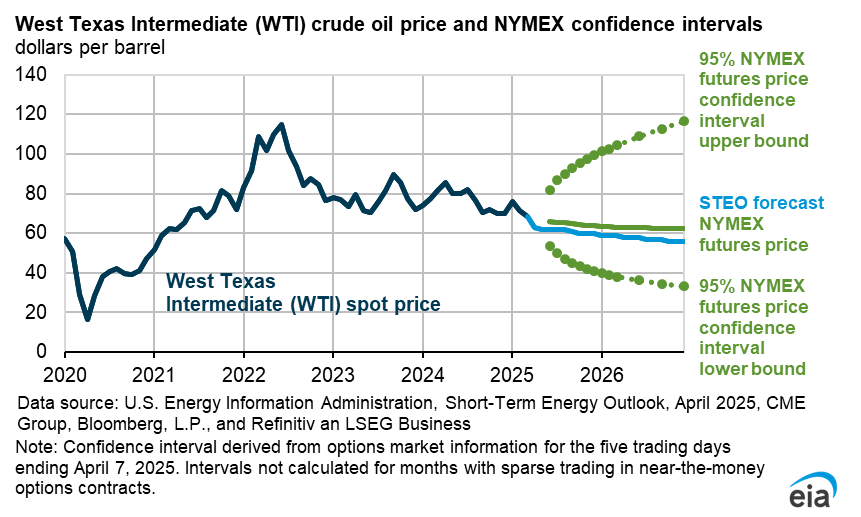
In the energy space, I expect an average of $70-$80 crude oil (OIL). Some push-pull between geopolitical risks and OPEC's spare capacity while U.S. shale production growth moderates. The ambitions for low-carbon hydrogen around the world, reflected in government policies and corporate project development, are quite remarkable. As is a 108 - mtpa global project pipeline that skews 80% to green hydrogen, made from electrolyzing water. However, the rate of project maturation for electrolyzer hydrogen will remain slow as developers struggle to overcome key obstacles. 


Two of the most important challenges that green hydrogen projects will face are achieving competitive costs and securing firm commitments from off-takers. Projects with credible counterparties and those targeting hydrogen as a feedstock in existing applications are most likely to move ahead. Those targeting new applications will struggle to achieve costs that compete with traditional fossil fuels. Blue hydrogen projects will also move slowly through the project development cycle, but more will achieve FID as they benefit from competitive economics and scaling more quickly.  

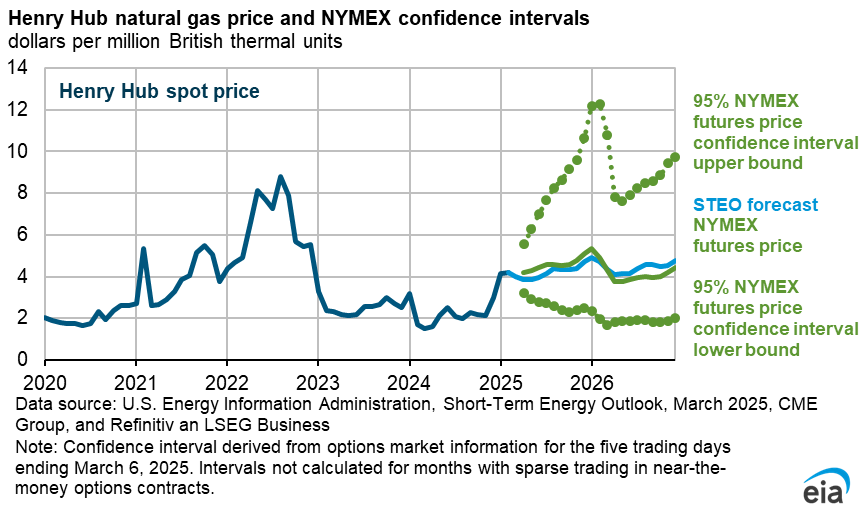
More downside for U.S. natural gas in 2024 H1 as we are already halfway through the winter with no major events so far.

Sustained international and offshore capex, with flat U.S. activity and single-digit growth in Canada. A quote often misattributed to Albert Einstein is that nuclear power is "one hell of a way to boil water". It was actually coined in 1980, after the Three Mile Island reactor accident that helped to turn the tide of public opinion against atomic energy. In 2024, however, nuclear power is set to win widespread support as a key solution to the world's energy crisis, for the first time in over half a century. Nuclear power has faced and still faces, challenges of public acceptability and economic competitiveness against renewables and fossil fuel generation. But it is the only reliable, dispatchable, small physical-and-material footprint, plug-and-play zero-carbon solution for power generation. 


That is all from me and the rest of the Croatian Center of Renewable Energy Sources (CCRES) team for 2023. Many thanks to all of you for reading last year. Have a great holiday, and we will be back again and again in 2024. Happy working and trading in the new year, and feel free to share in the comments where you see the most upside going into 2024. Zeljko Serdar

Monday, December 18, 2023

Merry Christmas to all.


People blame God for everything but do nothing to do what He says. They get lost in their own worlds of work, home life, entertainment, etc, and when a bad thing happens … they blame God for it. Nobody reads The Book anymore, nobody has a clue what He requires of us. We abandoned God long ago, so why would He suddenly help us? By the way, these things have to happen, the prophecy speaks about it in the Bible. WORST times are yet to come. We are sinners and a punishment is upon us. So go ahead blame God.


In December of 1946, Strand Magazine published “A Christmas Sermon for Pagans” by C. S. Lewis. Anyone who has read Lewis extensively will recognize many of the themes within this short essay, primarily that the journey to Christianity for a post-Christian may quite possibly include a short passage through paganism (paganism as it really is, not as we sometimes foolishly imagine it). From the essay: “If the modern post-Christian view is wrong—and every day I find it harder to think it right—then there are three kinds of people in the world. (1) Those who are sick and don’t know it (the post-Christians). (2) Those who are sick and know it (Pagans). (3) Those who have found the cure. And if you start in the first class you must go through the second to reach the third. For (in a sense) all that Christianity adds to Paganism is the cure. It confirms the old belief that in this universe we are up against Living Power: that there is a real Right and that we have failed to obey it: that existence is beautiful and terrifying. It adds a wonder of which Paganism had not distinctly heard—that the Mighty One has come down to help us, to remove our guilt, to reconcile us”

To date, this piece has not been included in any published collection of Lewis essays. It was only discovered several years ago. I have a copy and thought all Lewisians would enjoy seeing the essay and reading a transcription (included below).

Merry Christmas to all. Thanks be to God that because of King Jesus, we need never lament that it is always winter and never Christmas. Rather, it is always Christmas, always Immanuel, always God-with-us, no matter what the weather.

“A Christmas Sermon for Pagans” by C. S. Lewis

Strand magazine, Vol. 112, Issue 672, December 1946 

Writing religion for sceptics has made C. S. Lewis a best-seller. His books on Christianity—chief among them “The Screwtape Letters”—sell better, and read more easily, than most crime stories. This sermon is a characteristic piece of writing by the Oxford don who has become the most entertaining missionary of our time.

//

When I was asked to write a Christmas sermon for Pagans I accepted the job lightheartedly enough: but now that I sit down to tackle it I discover a difficulty. Are there any Pagans in England for me to write to?

I know that people keep on telling us that this country is relapsing into Paganism. But they only mean it is ceasing to be Christian. And is that at all the same thing? Let us remember what a Pagan or Heathen (I use the words interchangeably) really was.

A “Heathen” meant a man who lived out on the heath, out in the wilds. A “Pagan” meant a man who lived in a Pagus or small village. Both words, in fact, meant a “rustic” or “yokel.” They date from the time when the larger towns of the Roman Empire were already Christianised, but the old Nature religions still lingered in the country. Pagans or Heathens were the backward people in the remote districts who had not yet been converted, who were still pre-Christian.

To say that modern people who have drifted away from Christianity are Pagans is to suggest that a post-Christian man is the same as a pre-Christian man. And that is like thinking that a woman who has lost her husband is the same sort of person as an unmarried girl: or that a street where the houses have been knocked down is the same as a field where no house has yet been built. The ruined street and the unbuilt field are alike in one respect: namely that neither will keep you dry if it rains. But they are different in every other respect. Rubble, dust, broken bottles, old bedsteads and stray cats are very different from grass, thyme, clover, buttercups and a lark singing overhead.

Now the real Pagan differed from the post-Christian in the following ways. Firstly, he was religious. From the Christian point of view he was indeed too religious by half. He was full of reverence. To him the earth was holy, the woods and waters were alive. His agriculture was a ritual as well as a technique. And secondly, he believed in what we now call an “Objective” Right or Wrong. That is, he thought the distinction between pious and impious acts was something which existed independently of human opinions: something like the multiplication table which Man had not invented but had found to be true and which (like the multiplication table) he had better take notice of. The gods would punish him if he did not.

To be sure, by Christian standards, his list of “Right” or “Wrong” acts was rather a muddled one. He thought (and the Christians agreed) that the gods would punish him for setting the dogs on a beggar who came to his door or for striking his father: but he also thought they would punish him for turning his face to the wrong point of the compass when he began ploughing. But though his code included some fantastic sins and duties, it got in most of the real ones.

And this leads us to the third great difference between a Pagan and a post-Christian man. Believing in a real Right and Wrong means finding out that you are not very good. The Pagan code may have been on some points a low one: but it was too high for the Pagan to live up to. Hence a Pagan, though in many ways merrier than a modern, had a deep sadness. When he asked himself what was wrong with the world he did not immediately reply, “the social system,” or “our allies,” or “education.” It occurred to him that he himself might be one of the things that was wrong with the world. He knew he had sinned. And the terrible thing was that he thought the gods made no difference between voluntary and involuntary sins. You might get into their bad books by mere accident, and once in, it was very hard to get out of them. And the Pagan dealt with this situation in a rather silly way. His religion was a mass of ceremonies (sacrifices, purifications, etc.) which were supposed to take away guilt. But they never quite succeeded. His conscience was not at ease.

Now the post-Christian view which is gradually coming into existence—it is complete already in some people and still incomplete in others—is quite different. According to it Nature is not a live thing to be reverenced: it is a kind of machine for us to exploit. There is no objective Right or Wrong: each race or class can invent its own code or “ideology” just as it pleases. And whatever may be amiss with the world, it is certainly not we, not the ordinary people; it is up to God (if, after all, He should happen to exist), or to Government or to Education, to give us what we want. They are the shop, we are the customers: and “the customer is always right.”

Now if the post-Christian view is the correct one, then we have indeed waked from a nightmare. The old fear, the old reverence, the old restraints—how delightful to have waked up into freedom, to be responsible to no one, to be utterly and absolutely our own masters! We have, of course, lost some fun. A universe of colourless electrons (which is presently going to run down and annihilate all organic life everywhere and forever) is, perhaps, a little dreary compared with the earth-mother and the sky-father, the wood nymphs and the water nymphs, chaste Diana riding the night sky and homely Vesta flickering on the hearth. But one can’t have everything, and there are always the flicks and the radio: if the new view is correct, it has very solid advantages. 

But is it? And if so, why are things not going better? What do you make of the present threat of world famine? We know now that it is not entirely due to the war. From country after country comes the same story of failing harvests: even the whales have less oil. Can it be that Nature (or something behind Nature) is not simply a machine that we can do what we like with?—that she is hitting back?

Waive that point. Suppose she is only a machine and that we are free to master her at our pleasure. Have you not begun to see that Man’s conquest of Nature is really Man’s conquest of Man? That every power wrested from Nature is used by some men over other men? Men are the victims, not the conquerors in this struggle: each new victory “over Nature” yields new means of propaganda to enslave them, new weapons to kill them, new power for the State and new weakness for the citizen, new contraceptives to keep men from being born at all.

As for the ideologies, the new invented Wrongs and Rights, does no one see the catch? If there is no real Wrong and Right, nothing good or bad in itself, none of these ideologies can be better or worse than another. For a better moral code can only mean one which comes nearer to some real or absolute code. One map of New York can be better than another only if there is a real New York for it to be truer to. If there is no objective standard, then our choice between one ideology and another becomes a matter of arbitrary taste. Our battle for democratic ideals against Nazi ideals has been a waste of time, because the one is no better than the other. Nor can there ever be any real improvement or deterioration: if there is no real goal you can’t get either nearer to it or farther from it. In fact, there is no real reason for doing anything at all.

It looks to me, neighbours, as though we shall have to set about becoming true Pagans if only as a preliminary to becoming Christians. I don’t mean that we should begin leaving little bits of bread under the tree at the end of the garden as an offering to the Dryad. I don’t mean that we should dance to Dionysus across Hampstead Heath (though perhaps a little more solemn or ecstatic gaiety and a little less commercialised “amusement” might make our holidays better than they now are). I don’t even mean (though I do very much wish) that we should recover that sympathy with nature, that religious attitude to the family, and that appetite for beauty which the better Pagans had. Perhaps what I do mean is best put like this.

If the modern post-Christian view is wrong—and every day I find it harder to think it right—then there are three kinds of people in the world. (1) Those who are sick and don’t know it (the post-Christians). (2) Those who are sick and know it (Pagans). (3) Those who have found the cure. And if you start in the first class you must go through the second to reach the third. For (in a sense) all that Christianity adds to Paganism is the cure. It confirms the old belief that in this universe we are up against Living Power: that there is a real Right and that we have failed to obey it: that existence is beautiful and terrifying. It adds a wonder of which Paganism had not distinctly heard—that the Mighty One has come down to help us, to remove our guilt, to reconcile us.

All of the world men and women will meet on December 25th to do what is a very old-fashioned and, if you like, a very Pagan thing—to sing and feast because a God has been born. You are uncertain whether it is more than a myth. Well if it is, then our last hope is gone. But is the opposite explanation not worth trying?

Who knows but that here, and here alone, lies your way back not only to Heaven, but to Earth too, and to the great human family whose oldest hopes are confirmed by this story that does not die?

Merry Christmas.

Wednesday, December 13, 2023

Inflation Reduction Act provisions related to renewable energy


U.S. wind and solar power generators are projected to produce more electricity than coal next year for the first time, according to a new outlook released by the U.S. Energy Information Administration on Tuesday. Solar additions are expected to reach 23 gigawatts this year and 37 gigawatts in 2024, leading to a 15 percent increase in generation in 2023 and a projected 39 percent increase next year, according to EIA. The solar industry has projected it could see a jump of 32 gigawatts, or more than 50 percent in year-over-year growth, in new installations thanks to incentives from the Inflation Reduction Act. That output from the two renewable sources will surpass the production of coal-fired power in 2024 by nearly 90 billion kilowatt hours as a wave of new solar and wind projects come online.


The Inflation Reduction Act of 2022 is the most significant climate legislation in U.S. history, offering funding, programs, and incentives to accelerate the transition to a clean energy economy and will likely drive significant deployment of new clean electricity resources. Most provisions of the Inflation Reduction Act of 2022 became effective 1/1/2023.


The Inflation Reduction Act incentives reduce renewable energy costs for organizations like Green Power Partners – businesses, nonprofits, educational institutions, and state, local, and tribal organizations. Taking advantage of Inflation Reduction Act incentives, such as tax credits, is key to lowering GHG emission footprints and accelerating the clean energy transition.’


Here’s how the Inflation Reduction Act's new direct pay and transfer options allow more organizations to utilize clean energy tax credits for equipment placed in service on or after January 1, 2023, and through December 31, 2032:


The direct pay option allows certain non-taxable entities to directly monetize certain tax credits for entities such as state, local, and tribal governments, rural electric cooperatives, the Tennessee Valley Authority, and others to directly monetize specific tax credits including many renewable energy credits such as the ITC ) and the PTC. Applicable entities may elect to treat these tax credits as refundable payments of tax. Such entities are eligible to receive a direct payment from the IRS for any amount paid more than their tax liability for credits.

The Inflation Reduction Act also allows eligible taxpayers who are not tax-exempt entities to transfer all or a portion of certain tax credits, including the ITC and PTC, to an unrelated party.

The US Inflation Reduction Act (IRA), which marked its first anniversary in August, is driving investment in clean energy with a broad range of tax incentives.


A total of 280 clean energy projects have been announced across 44 US states in the IRA’s first year, representing $282 billion of investment.


Companies discussing the IRA along with hydrogen fuel and infrastructure on earnings calls indicated a strong potential to invest, with 70% of mentions including a target or project numbers.


When the Biden administration marked the first anniversary of the Inflation Reduction Act (IRA) in mid-August this year, it rolled out some big numbers to demonstrate the impact of the legislation. In response to the act’s clean-energy and climate provisions, companies had announced more than $110 billion in new clean-energy manufacturing investments since the IRA became law, according to the White House. That includes over $70 billion in the electric vehicle (EV) supply chain and about $10 billion in solar manufacturing.   


The IRA has been surrounded by big claims—and intense criticism—from the start. When he signed the bill into law in 2022, President Biden hailed it as “the biggest step forward on climate ever.” To spur investment, the IRA relies on a package of tax incentives intended to accelerate the deployment of clean energy as well as clean vehicles, buildings, and manufacturing. These include tax credits for investment in renewable energy projects and facilities that generate clean electricity. The law provides tax breaks for the manufacturing of components for solar and wind energy, inverters, battery components, and critical minerals. It also sets out production tax credits for renewable and clean electricity as well as power from qualified nuclear facilities.   


Republicans have leveled a wide range of criticisms at the law, which passed both houses of Congress in party-line votes. Senate Republican Leader Mitch McConnell, for example, has called the IRA a “reckless taxing and spending spree” that will have “no meaningful impact on the world's climate.” Other critics charge that the IRA benefits foreign companies in countries such as China. In particular, the law's incentives for the purchase of EVs have faced pushback, and not just from Republicans. Sen. Joe Manchin, a Democrat who co-sponsored the IRA but has criticized the administration's implementation of the law, said he would oppose a rush to mass adoption of EVs while China controls the supply of critical minerals required for their production.   


One year after the launch of the IRA, we drilled down into the data to understand the investment response underlying the official optimism. What we found was that—so far at least—the reality is living up to or even exceeding expectations. Analysis based on public announcements tracked by the American Clean Power Association (ACP), Climate Power, and E2 show that 280 clean energy projects were announced across 44 US states in the IRA’s first year. These projects represent $282 billion in investment and are expected to create nearly 175,000 jobs. 


To find out which companies are talking about the IRA and what future projects they may be considering, we also examined earnings calls using Natural Language Processing. Solar energy was the clean-energy topic most often mentioned in combination with the IRA on these calls, followed by carbon capture and storage, and batteries and energy storage.   The evidence of the IRA’s impact is mounting, but if the law is to achieve the goals set out by its supporters, challenges will have to be overcome. These include delays in connecting renewable energy projects to the grid and the potential for rising project costs, which could in turn push up the IRA's final price tag. 


Estimating the total bill for the IRA is difficult because most of the spending under the law comes in the form of uncapped tax breaks, meaning the cost will increase as more companies and households take advantage of the incentives. Initial cost estimates tended to range between $370 billion, a figure cited regularly by the White House,11 to $391 billion, calculated by the Congressional Budget Office.  


The IRA’s potential to boost US development and production of clean-energy technology critical to the sustainable energy transition has been widely touted since its inception. The law provides the most supportive regulatory environment in clean-tech history, potentially driving results including the first large-scale deployment of green hydrogen and carbon capture, according to Goldman Sachs Global Investment Research (GIR). The IRA’s incentives could potentially help the US gain a larger share of the global clean-tech market, where China now dominates the manufacturing and trade of most technologies. 

Saturday, November 25, 2023

How is the mix of fuels used to produce electricity in the United States changing?


Forecast Overview

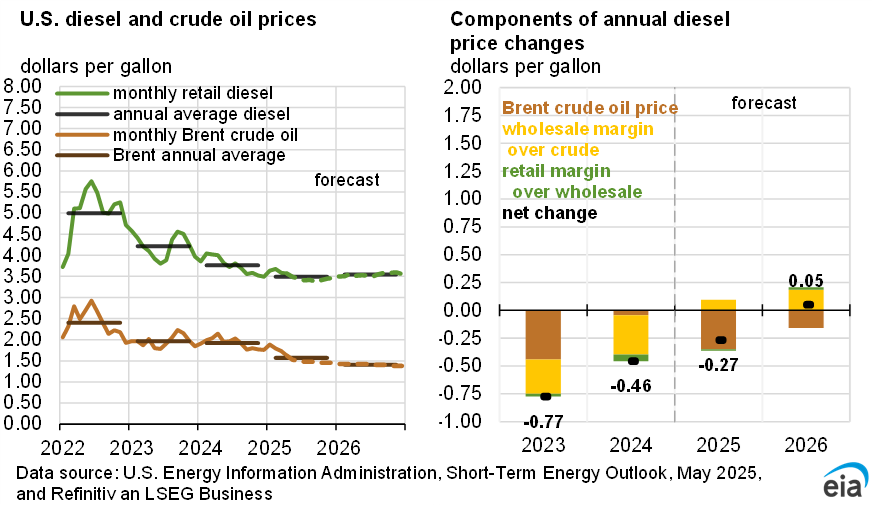
  • Global oil supply. We forecast global liquid fuels production will increase by 1.0 million barrels per day (b/d) in 2024. Ongoing OPEC+ production cuts will offset production growth from non-OPEC countries and help maintain a relatively balanced global oil market next year. Although the conflict between Israel and Hamas has not affected the physical oil supply at this point, uncertainties surrounding the conflict and other global oil supply conditions could put upward pressure on crude oil prices in the coming months. We forecast the Brent crude oil price will increase from an average of $90 per barrel (b) in the fourth quarter of 2023 to an average of $93/b in 2024.
  • U.S. gasoline consumption. U.S. gasoline consumption declined by 1% in 2024 in our forecast, which would result in the lowest per capita gasoline consumption in two decades. An increase in remote work in the United States, improvements in the fuel efficiency of the U.S. vehicle fleet, high gasoline prices, and persistently high inflation have reduced per capita gasoline demand.
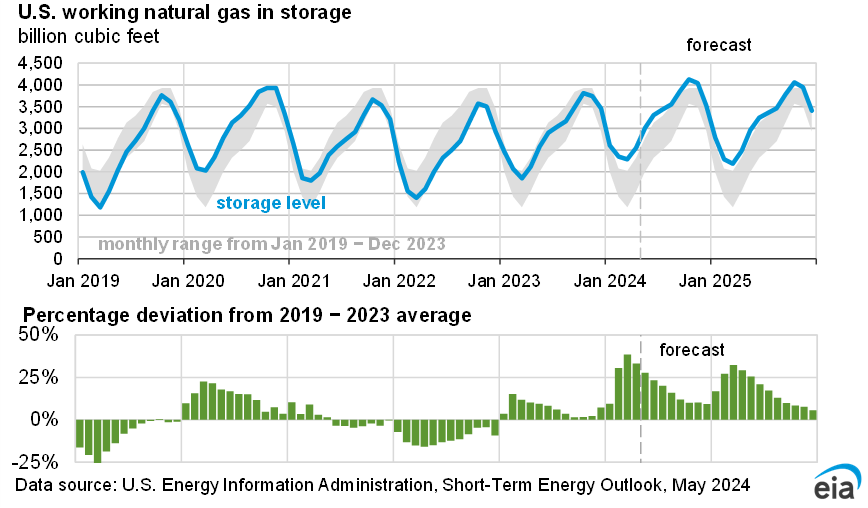
  • Natural gas inventories. We estimate that U.S. natural gas inventories totaled 3,835 billion cubic (Bcf) feet at the end of October, 6% more than the five-year (2018–2022) average. We forecast U.S. natural gas inventories will end the winter heating season (November–March) 21% above the five-year average with almost 2,000 Bcf in storage. Inventories are full because of high natural gas production and warmer-than-average winter weather, which reduces demand for space heating in the commercial and residential sectors. We forecast the Henry Hub spot price to average near $3.20 per million British thermal units (MMBtu) in November, down from a price of almost $5.50/MMBtu a year earlier.
  • Coal markets. U.S. coal exports have returned to pre-pandemic levels, driven by record-high global coal demand stemming primarily from Europe and Asia. We forecast that exports will rise to 97 million short tons (MMst) in 2023, because of increases in both steam and metallurgical coal exports. We expect steam coal exports to rise by 6 MMst compared with 2022 to 45 MMst in 2023 and metallurgical coal exports to increase by 6 MMst to reach 52 MMst over the same period. Despite this increase in coal exports, we expect U.S. production to fall by more than 100 MMst in 2024 due to reduced demand from the electric power sector. The decline in electricity generation from coal will be offset by an increase in electricity generation from renewable resources.
  • OPEC production capacity. Despite rising OPEC spare production capacity in 2023 and in 2024, we lowered our estimate of Iraq’s spare capacity by about 0.4 million b/d compared with last month’s STEO. We removed Iraq’s total production capacity assets in northern Iraq that relied on the northern Iraq-to-Türkiye pipeline for access to global markets. The pipeline has been out of commission since March 2023.


Notable Forecast Changes20232024

The current STEO forecast was released on November 7.
The previous STEO forecast was released on October 11.

OPEC surplus crude oil production capacity (current forecast) (million barrels per day)3.74.3
Previous forecast4.14.9
Percentage change-10.0%-12.0%
U.S. coal power demand (current forecast) (million short tons)384356
Previous forecast473342
Percentage change3.1%4.0%
U.S. coal production (current forecast) (million short tons)585480
Previous forecast581465
Percentage change0.7%3.2%

You can find more information in the detailed table of forecast changes.


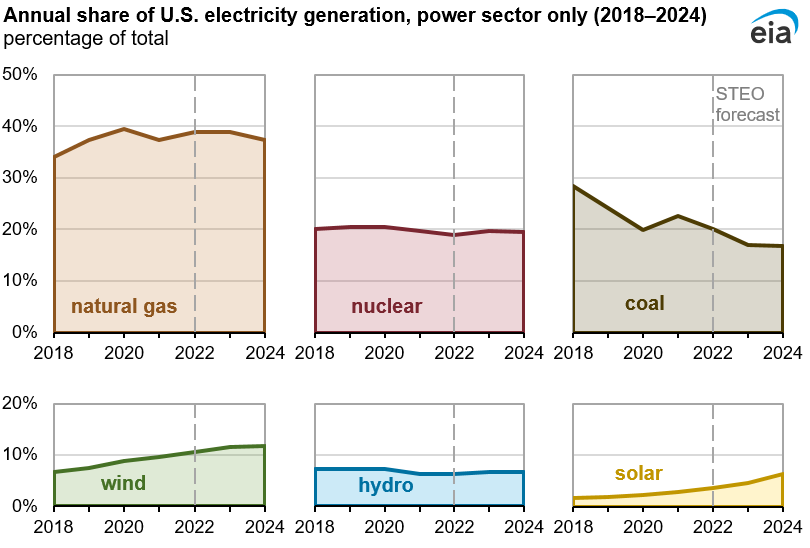
data visualization of the top six energy sources used for U.S. electricity generation
Data source: U.S. Energy Information Administration, Short-Term Energy Outlook, February 2023
Data values: U.S. electricity generation
Note: The six energy sources shown accounted for at least 98% of annual electricity generation from the electric power sector during this time period.

We expect that new renewables capacity—mostly wind and solar—will reduce electricity generation from both coal-fired and natural gas-fired power plants in 2023 and 2024. Renewable generation capacity additions in our STEO are less uncertain than other forecasts because we survey this information monthly. However, the electricity actually generated from both renewable and nonrenewable sources varies based on weather conditions and market dynamics. It’s this aspect of our STEO electricity generation forecast where most of the uncertainty lies.

Wind and solar accounted for 14% of U.S. electricity generation in 2022. In our February Short-Term Energy Outlook, we forecast that wind and solar will rise slightly, accounting for 16% of total generation in 2023 and 18% in 2024. Electricity generation from coal falls from 20% in 2022 to 17% in both 2023 and 2024. Natural gas accounted for 39% of electric power sector electricity generation last year, and we forecast its share to be similar in 2023 and then fall to 37% in 2024.

Electricity generation from renewable energy sources has been growing steadily in the United States over the past decade. Last year, electric power generation from all types of renewables accounted for nearly one-quarter of total generation by the U.S. electric power sector.

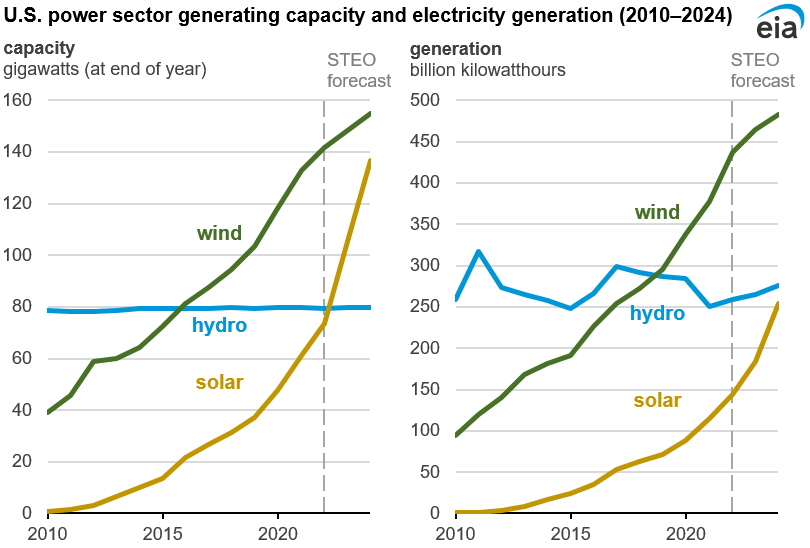
Renewables' output tends to follow capacity additions

two-panel data visualization showing the relationship between generating capacity and electricity generation from wind, hydro, and solar
Data source: U.S. Energy Information Administration, Short-Term Energy Outlook, February 2023
Data values: U.S. generating capacityU.S. electricity generation

The increase in renewables generation is being driven primarily by investment in new solar and wind generating capacity. The U.S. electric power sector operated about 73 gigawatts (GW) of solar photovoltaic (PV) capacity at the end of 2022. Power generators are reporting plans to expand solar capacity by 43% (32 GW) in 2023, which would be the largest percentage increase in solar capacity since 2016. Solar capacity will increase an additional 30% (31 GW) in 2024.

We expect U.S. wind capacity to increase 5% in each of the next two years, 6 GW in 2023 and 7 GW in 2024. Many solar and wind projects tend to come online in December, so these capacity additions tend to have the most impact on generation in the following year.

We compile information about existing and future capacity on our Preliminary Monthly Electric Generator Inventory, which is based on our monthly survey. When companies report plans for future capacity on these surveys, the projects are generally already in the development process. Although projects may experience delays, the majority of projects reported as future builds eventually come online.

We forecast coal generation to decline this year because the power sector is starting out in 2023 with about 5% (11 GW) less coal-fired capacity than at the beginning of 2022. U.S. natural gas-fired capacity rose by 3 GW over the past year, but that represents a less than 1% increase. Unlike electricity generation from renewable sources, generation from natural gas and coal are more affected by relative fuel costs.

Sources of uncertainty: weather and fuel costs

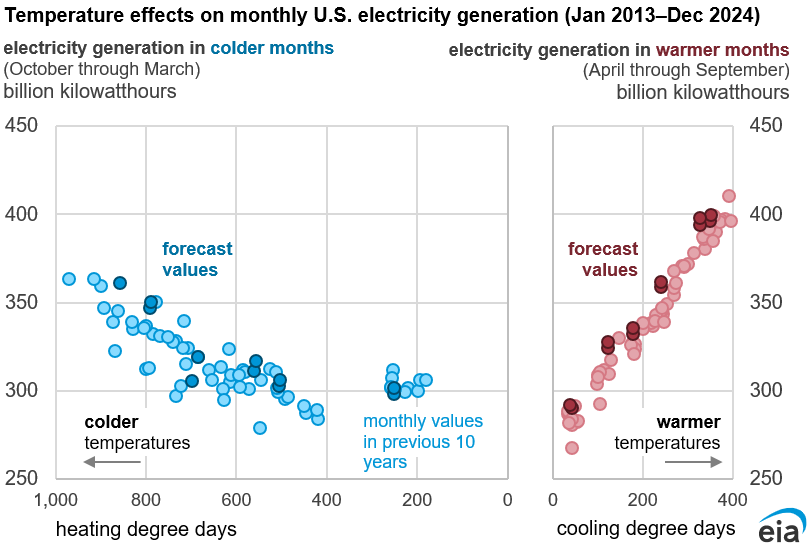
Two leading factors that make our electricity forecasts especially uncertain are future weather and fuel costs. Our forecast uses temperature outlooks from the National Oceanic and Atmospheric Administration. Temperatures directly affect overall electricity demand.

Electricity demand typically peaks in the summer when homes and businesses use air conditioning. Over the last 10 years, July 2020 saw the most monthly population-weighted U.S. cooling degree days at 397 cooling degree days; the most heating degree days were in January 2014, at 971 heating degree days. Electricity demand increases less during winter months because about 40% of U.S. households use electricity for their primary space heating needs.

data visualization of the relationship between temperature and electricity demand
Data source: U.S. Energy Information Administration, Short-Term Energy Outlook, February 2023
Data values: U.S. electricity generationWeather data

Variability in weather also leads to uncertainty in renewable generation. Our forecast assumes historically typical operating conditions for wind and solar, but weather conditions can cause output from both sources to vary significantly. Similarly, variations in precipitation can lead to uncertainty in hydropower generation. In 2021, California’s drought caused the state’s hydropower output to fall 48% below the previous 10-year average. More recently, precipitation along the West Coast increased snowpack, which will likely lead to higher-than-normal hydroelectric generation in California this year.

Natural gas prices are one of the primary factors that determine generation levels from existing coal and natural gas-fired power plants. Natural gas prices have also been one of the most uncertain aspects of the STEO forecast. In the past two months, the daily spot price of Henry Hub natural gas ranged from $7.20 per million British thermal units (MMBtu) in mid-December to $2.65/MMBtu at the end of January.

In our current outlook, we forecast the Henry Hub price to rise slightly throughout 2023, from $3.05/MMBtu in February to $4.11/MMBtu in December. However, if natural gas prices are higher than we expect, natural gas-fired generation could decline and coal generation could remain relatively flat. 

The U.S. Energy Information Administration (EIA) collects, analyzes, and disseminates independent and impartial energy information to promote sound policymaking, efficient markets, and public understanding of energy and its interaction with the economy and the environment. 

The U.S. Energy Information Administration is committed to its free and open data by making it available through an Application Programming Interface (API) and its open data tools. EIA's API is multi-faceted and contains the following time-series data sets organized by the main energy categories.

U.S. Energy Information Administration
1000 Independence Ave., SW
Washington, DC 20585