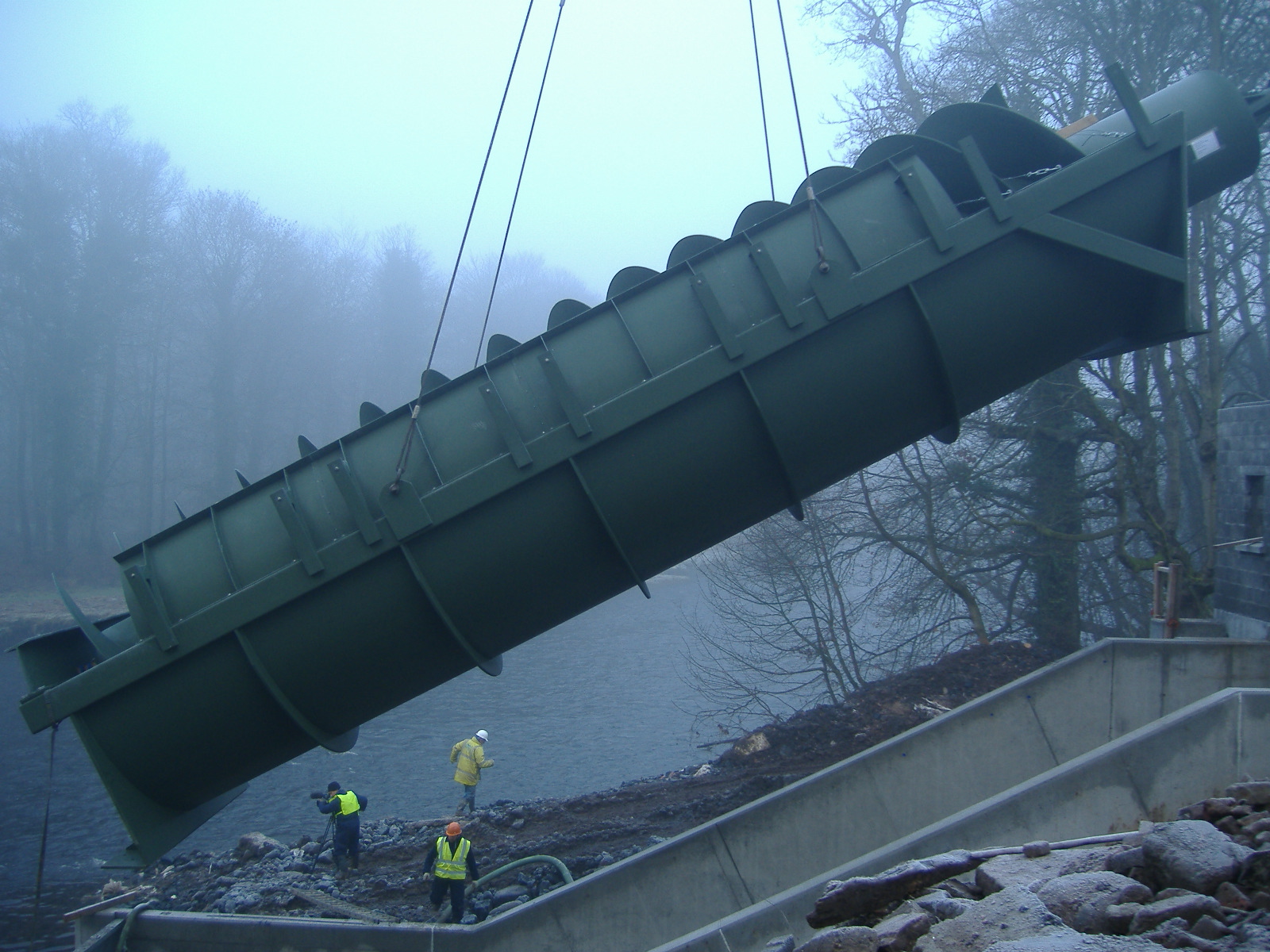
Sunday, February 5, 2012
How to power more than 260 houses
Sunday, July 3, 2011
3 RENEWABLE SOURCES by CCRES

CROATIAN CENTER of RENEWABLE ENERGY SOURCES
3 RENEWABLE SOURCES
1)
| WIND ENERGY |
| Energy from the Wind Wind is simply air in motion. It is caused by the uneven heating of the Earth's surface by the sun. Because the Earth's surface is made of very different types of land and water, it absorbs the sun's heat at different rates. One example of this uneven heating can be found in the daily wind cycle. The daily wind cycle During the day, the air above the land heats up more quickly than the air over water. The warm air over the land expands and rises, and the heavier, cooler air rushes in to take its place, creating wind. At night, the winds are reversed because the air cools more rapidly over land than over water. In the same way, the atmospheric winds that circle the earth are created because the land near the Earth's equator is heated more by the sun than the land near the North and South Poles. Wind Energy for Electricity Generation Today, wind energy is mainly used to generate electricity. Wind is a renewable energy source because the wind will blow as long as the sun shines. How Wind Turbines Work Like old fashioned windmills, today’s wind machines (also called wind turbines) use blades to collect the wind’s kinetic energy. The wind flows over the blades creating lift, like the effect on airplane wings, which causes them to turn. The blades are connected to a drive shaft that turns an electric generator to produce electricity. With the new wind machines, there is still the problem of what to do when the wind isn't blowing. At those times, other types of power plants must be used to make electricity. Wind Production In 2008, wind machines in the United States generated a total of 52 billion kilowatthours, about 1.3% of total U.S. electricity generation. Although this is a small fraction of the Nation's total electricity production, it was enough electricity to serve 4.6 million households or to power the entire State of Colorado. The amount of electricity generated from wind has been growing rapidly in recent years. Generation from wind in the United States nearly doubled between 2006 and 2008. New technologies have decreased the cost of producing electricity from wind, and growth in wind power has been encouraged by tax breaks for renewable energy and so called "green pricing programs". Many utilities around the country offer green pricing options that allow customers the choice to pay more for electricity that comes from renewable sources to support new technologies. Where Wind is harnessed Wind Power Plants Require Careful Planning Operating a wind power plant is not as simple as just building a windmill in a windy place. Wind plant owners must carefully plan where to locate their machines. It is important to consider how fast and how much the wind blows at the site. As a rule, wind speed increases with altitude and over open areas that have no windbreaks. Good sites for wind plants are the tops of smooth, rounded hills, open plains or shorelines, and mountain gaps that produce wind funnelling. Wind Speed is not the same across any country Wind speed varies throughout any country. It also varies from season to season. In Tehachapi, California, the wind blows more from April through October than it does in the winter. This is because of the extreme heating of the Mojave Desert during the summer months. The hot air over the desert rises, and the cooler, denser air above the Pacific Ocean rushes through the Tehachapi mountain pass to take its place. In a state like Montana, on the other hand, the wind blows more during the winter. Fortunately, these seasonal variations are a good match for the electricity demands of the regions. In California, people use more electricity during the summer for air conditioners. In Montana, people use more electricity during the winter. Major wind power locations Most of the wind power plants in the world are located in Europe and in the United States where government programs have helped support wind power development. As of 2008, the United States ranks first in the world in wind power capacity, followed by Germany, Spain, and China. Denmark ranks ninth in the world in wind power capacity, but generates about 20% of its electricity from wind. Large wind turbines (sometimes called wind machines) generated electricity in 34 different States in 2008. The top five wind power producing States with the most wind production were Texas, California, Minnesota, Iowa, and Washington. Offshore Wind Power Conditions are well suited along much of the coasts of the United Kingdom to use wind energy. However, there are people who oppose putting turbines just offshore, near the coastlines, because they think the wind turbines will spoil the view of the ocean. There is a plan to build an offshore wind plant off the coast of Cape Cod, Massachusetts, USA. Wind is a renewable energy source that does not pollute, so some people see it as a good alternative to fossil fuels. Types of Wind Turbines There are two types of wind machines (turbines) used today, based on the direction of the rotating shaft (axis): horizontal-axis wind machines and vertical-axis wind machines. The size of wind machines varies widely. Small turbines used to power a single home or business may have a capacity of less than 100 kilowatts. Some large commercial-sized turbines may have a capacity of 5 million watts, or 5 megawatts. Larger turbines are often grouped together into wind farms that provide power to the electrical grid. Horizontal-axis Turbines Look Like Windmills Most wind machines being used today are the horizontal-axis type. Horizontal-axis wind machines have blades like airplane propellers. A typical horizontal wind machine stands as tall as a 20-story building and has three blades that span 200 feet across. The largest wind machines in the world have blades longer than a football field. Wind machines stand tall and wide to capture more wind. Vertical-axis Turbines Look Like Egg Beaters Vertical-axis wind machines have blades that go from top to bottom. The most common type — the Darrieus wind turbine, named after the French engineer Georges Darrieus who patented the design in 1931 — looks like a giant, two-bladed egg beater. This type of vertical wind machine typically stands 100 feet tall and 50 feet wide. Vertical-axis wind machines make up only a very small share of the wind machines used today. Wind Power Plants Produce Electricity Wind power plants, or wind farms, as they are sometimes called, are clusters of wind machines used to produce electricity. A wind farm usually has dozens of wind machines scattered over a large area. The world's largest wind farm, the Horse Hollow Wind Energy Centre in Texas, has 421 wind turbines that generate enough electricity to power 220,000 homes per year. Many wind plants are not owned by public utility companies. Instead, they are owned and operated by business people who sell the electricity produced on the wind farm to electric utilities. These private companies are known as Independent Power Producers. History of Wind Power The Oldest Windmills Were in Ancient Persia Since early recorded history, people have been harnessing the energy of the wind. Wind energy propelled boats along the Nile River as early as 5000 B.C. By 200 B.C., simple windmills in China were pumping water, while vertical-axis windmills with woven reed sails were grinding grain in Persia and the Middle East. New ways of using the energy of the wind eventually spread around the world. By the 11th century, people in the Middle East were using windmills extensively for food production; returning merchants and crusaders carried this idea back to Europe. The Dutch refined the windmill and adapted it for draining lakes and marshes in the Rhine River Delta. When settlers took this technology to the New World in the late 19th century, they began using windmills to pump water for farms and ranches, and later, to generate electricity for homes and industry. American colonists used windmills to grind wheat and corn, to pump water, and to cut wood at sawmills. As late as the 1920s, Americans used small windmills to generate electricity in rural areas without electric service. When power lines began to transport electricity to rural areas in the 1930s, local windmills were used less and less, though they can still be seen on some Western ranches. Windmills Make a Comeback in the Wake of Oil Shortages The oil shortages of the 1970s changed the energy picture for the Country and the world. It created an interest in alternative energy sources, paving the way for the re-entry of the windmill to generate electricity. In the early 1980s, wind energy really took off in California, partly because of State policies that encouraged renewable energy sources. Wind Energy & the Environment In the 1970s, oil shortages pushed the development of alternative energy sources. In the 1990s, the push came from a renewed concern for the environment in response to scientific studies indicating potential changes to the global climate if the use of fossil fuels continues to increase. Wind energy is an economical power resource in many areas of the country. Wind is a clean fuel; wind power plants (also called wind farms) produce no air or water pollution because no fuel is burned to generate electricity. Growing concern about emissions from fossil fuel generation, increased government support, and higher costs for fossil fuels (especially natural gas and coal) have helped wind power capacity in the United States grow substantially over the past 10 years. Drawbacks of Wind Machines The most serious environmental drawbacks to wind machines may be their negative effect on wild bird populations and the visual impact on the landscape. To some, the glistening blades of windmills on the horizon are an eyesore; to others, they're a beautiful alternative to conventional power plants. More info at: solarserdar@gmail.com |
2)
| WATER ENERGY |
| Energy from Water Hydropower Generates Electricity Hydropower is the renewable energy source that produces the most electricity in the United States. It accounted for 6% of total U.S. electricity generation and 67% of generation from renewable in 2008. Hydropower relies on the Water Cycle Understanding the water cycle is important to understanding hydropower. In the water cycle:
Mechanical Energy is harnessed from moving water The amount of available energy in moving water is determined by its flow or fall. Swiftly flowing water in a big river, like the Columbia River in the United States that forms the border between Oregon and Washington, carries a great deal of energy in its flow. Water descending rapidly from a very high point, like Niagara Falls in New York, also has lots of energy in its flow. In either instance, the water flows through a pipe, or penstock, then pushes against and turns blades in a turbine to spin a generator to produce electricity. In a run-of-the-river system, the force of the current applies the needed pressure, while in a storage system, water is accumulated in reservoirs created by dams, then released as needed to generate electricity. History of Hydropower Early uses of waterpower date back to Mesopotamia and ancient Egypt, where irrigation has been used since the 6th millennium BC and water clocks had been used since the early 2nd millennium BC. Other early examples of water power include the Qanat system in ancient Persia and the Turpan water system in ancient China. Hydropower has been used for hundreds of years. In India, water wheels and watermills were built; in Imperial Rome, water powered mills produced flour from grain, and were also used for sawing timber and stone; in China, watermills were widely used since the Han Dynasty. The power of a wave of water released from a tank was used for extraction of metal ores in a method known as hushing. The method was first used at the Dolaucothi gold mine in Wales from 75 AD onwards, but had been developed in Spain at such mines as Las Medulas. Hushing was also widely used in Britain in the Medieval and later periods to extract lead and tin ores. It later evolved into hydraulic mining when used during the California gold rush. In China and the rest of the Far East, hydraulically operated "vigina wheel" pumps raised water into irrigation canals. At the beginning of the Industrial revolution in Britain, water was the main source of power for new inventions such as Richard Arkwright's water frame. Although the use of water power gave way to steam power in many of the larger mills and factories, it was still used during the 18th and 19th centuries for many smaller operations, such as driving the bellows in small blast furnaces and gristmills, such as those built at Saint Anthony Falls, utilizing the 50-foot (15 m) drop in the Mississippi River. In the 1830s, at the peak of the canal-building era, hydropower was used to transport barge traffic up and down steep hills using inclined plane railroads. Hydropower is one of the oldest sources of energy. It was used thousands of years ago to turn a paddle wheel for purposes such as grinding grain. U.S. first industrial use of hydropower to generate electricity occurred in 1880, when 16 brush-arc lamps were powered using a water turbine at the Wolverine Chair Factory in Grand Rapids, Michigan. The first U.S. hydroelectric power plant opened on the Fox River near Appleton, Wisconsin, on September 30, 1882. Because the source of hydroelectric power is water, hydroelectric power plants must be located on a water source. Therefore, it wasn't until the technology to transmit electricity over long distances was developed that hydropower became widely used. Where Hydropower is generated Hydroelectric power now supplies about 715,000 megawatts or 19% of world electricity. Large dams are still being designed. The world's largest is the Three Gorges Dam on the third longest river in the world, the Yangtze River. Apart from a few countries with an abundance of hydro power, this energy source is normally applied to peak load demand, because it is readily stopped and started. It also provides a high-capacity, low-cost means of energy storage, known as "pumped storage". Most dams were not built for power Only a small percentage of all dams in the world produce electricity. Most dams were constructed solely to provide irrigation and flood control. Small Scale hydropower Small scale hydro or micro-hydro power has been increasingly used as renewable energy source, especially in remote areas where other power sources are not viable. Small scale hydro power systems can be installed in small rivers or streams with little or no discernible environmental effect on things such as fish migration. Most small scale hydro power systems make no use of a dam or major water diversion, but rather use water wheels. Many areas of the North Eastern United States have locations along streams where water wheel driven mills once stood. Sites such as these can be renovated and used to generate electricity. Also, small scale hydro power plants can be combined with other energy sources as a supplement. For example a small scale hydro plant could be used along with a system of solar panels attached to a battery bank. While the solar panels may create more power during the day, when the majority of power is used, the hydro plant will create a smaller, constant flow of power, not dependent on the sunlight. There are some considerations in a micro-hydro system installation. The amount of water flow available on a consistent basis, since lack of rain can affect plant operation. Head, or the amount of drop between the intake and the exit. The more head, the more power that can be generated. There can be legal and regulatory issues, since most countries, cities, and states have regulations about water rights and easements. Micro-hydro power can be used directly as "shaft power" for many industrial applications. Alternatively, the preferred option for domestic energy supply is to generate electricity with a generator or a reversed electric motor which, while less efficient, is likely to be available locally and cheaply. Hydropower and the Environment Most dams in the world were built mainly for flood control and supply of water for cities and irrigation. A small number of dams were built specifically for hydropower generation. While hydropower (hydro-electric) generators do not directly produce emissions of air pollutants, hydropower dams, reservoirs, and the operation of generators can have environmental impacts A dam to create a reservoir may obstruct migration of fish to their upstream spawning areas. A reservoir and operation of the dam can also change the natural water temperatures, chemistry, flow characteristics, and silt loads, all of which can lead to significant changes in the ecology (living organisms and the environment) and rocks and land forms of the river upstream and downstream. These changes may have negative impacts on native plants and animals in and next to the river, and in the deltas that form where rivers empty into the ocean. Reservoirs may cover important natural areas, agricultural land, and archaeological sites, and cause the relocation of people. Greenhouse gases, carbon dioxide and methane, may also form in reservoirs and be emitted to the atmosphere. The exact amount of greenhouse gases produced from hydropower plant reservoirs is uncertain. The emissions from reservoirs in tropical and temperate regions may be equal to or greater than the greenhouse effect of the carbon dioxide emissions from an equivalent amount of electricity generated with fossil fuels. More info at: solarserdar@gmail.com3)
|
Sunday, May 15, 2011
Hydroelectric Inflow Dam System by CCRES
promotes
Hydroelectric Inflow Dam System
Field of Invention
This invention relates to a hydroelectric power generating dam system by channeling hydraulic flow from a water catchment area into a hollow inflow column to generate hydroelectric power.
This invention uses the basic principle of hydro electric production, as found principally in conventional dam constructions using Pelton turbines, Francis turbines and Kaplan turbines.
Background
Hydropower is a proven technology and is also the largest source of renewable green energy accounting for about 20% of all electricity produced globally. Hydro-electric power plants are large and usually involve huge capital investments. They also affect the local ecology once the associated dams are flooded.
Smaller Micro hydropower system, which generates less than 100kw will be cost effective to produce renewable energy in the rural areas which are near streams and rivers.
Comparative advantages of the Invention
The existing hydroelectric dam channels water into an intake pipe and converts static hydro energy into hundreds of MW of dynamic hydro energy by rotating the turbine and generators whilst the novelty of the inflow dam column is to channel water into each column and convert the dynamic hydro energy into electric power in the micro capacity of tens of kW.
Others advantages compared to conventional dam-based and tide-based hydro electric systems:
a. Flexibility: Flexible in size, configuration and can manufactured installed and operated in one model for different sites with minimum investment.
b. Scalability: Several units can be expanded on the same site for accrued or scalable performance, while covering only a small surface area.
c. Nature force: Using still water, gravity & nature water pressure. No dependence from waves and currents.
d. Portability: No ecological footprint: The system can be installed, serviced and eventually removed without the need to construct an ecologically damaging dam and other infrastructures.
e. No interruption of operation: Installation of a network using several Inflow Dam units can be maintained on a unit per unit basis, without need for a complete system interruption.
f. Maintenance: Low maintenance costs
g. Proven realizable technologies: Use of proven technologies without violating any basic physics and engineering principles. In other words, there is no technological incertitude associated with the system. More info at http://solarserdar.blogspot.com.
Design A: Hydroelectric Inflow Dam
This design provides another hydroelectric generating system solution that can supply hundreds of kilowatts, if not megawatts to supplement an existing hydroelectric power plant. It is possible to plan for a future water catchment area, such as a smaller body of stored or running water to generate electricity in addition to flood control and/or irrigation.
It comprises of a basic power generating system, a pre manufactured inflow dam body and a discharge piping system.
The uniqueness of the invention is that it operates within the water catchment area and is built higher than the highest water level. The inflow dam walls are formed with nozzles so that jets of water that flow into the internal cavity are imparted to the impellers of the turbine for rotation. The connected generator hence generates electricity. Water downstream of the turbine flows into a discharge channel before it is released to a lower ground by gravity or siphon. The inflow dam and discharge pipe are formed modularly.
There are a few variations, for example the nozzles are arranged in two or more circumferential rows and correspond with the number of turbine sections. The nozzles are elongate and they generate water jets with cross-sectional area corresponding to each elongate impeller of the turbine.
The inflow dam has a rotatable sleeve supported on the shoulder. In use, the nozzles are in register with the apertures. When the apertures and the nozzles are not in register, water is prevented from flowing through the nozzles, for example, during maintenance.
The sleeve for controlling the water flow through the nozzles of the inflow dam may be arranged rotatable within the inflow dam column or outside the inflow dam column. Another variation is the sleeve being slidable vertically (up and down) within or outside the inflow dam column. The choice of the sleeve depends on the shape of inflow dam design.
Design B: Hydroelectric Inflow Dam - (Submerged Inflow Dam System)
In this design, the inflow dam is submerged in the water and the internal cavity of the inflow dam is filled with water flowing from the top to rotate the impellers of the turbine to generate electricity. The discharge channel after the turbine acts like a draft tube and it helps create suction and increases the dynamic hydraulic flow and head.
The sleeve is operable to extend above the top end of the inflow dam so that water is prevented from entering the inflow dam during maintenance. A seal may be provided between the sleeve and the external surface of the inflow dam. When in use, a fluid cylinder may control the sleeve for regulating the head and the amount of water flow to the turbine.
Design C: Hydroelectric Inflow Dam - (Network System)
This system allows a user to select a number of designs A or B Hydroelectric inflow dam systems to operate according to the demand in electricity and availability of water head/hydraulic flow. This allows some of the inflow dams to be closed for maintenance without disrupting the supply of electricity from the hydro-electric system.
Design D: Hydroelectric Inflow Dam - (Galaxy System)
The Network System (Design C) forms only one or part of the galaxy hydroelectric inflow dam networks systems.
The advantage of the design is that it is not necessary to build a dam that will affect the local ecology. These social and environmental costs often outweigh the benefits from the traditional hydropower system.
Many reservoirs are built to store drinking water. However, only a small percentage is sent to the desalination plant while the rest remain untouched. The Hydro-electric Inflow Dam System can turn this high percentage of unused water into hydro-power while using it as a controller to control the output water flow similar to a water tap.
Using potential gravitation energy, water resources from the reservoirs are used to power the hydro-electric generator by moving it from reservoir A to reservoir B. The final destination will be the water desalination plant or re-channelling it back to the 1st reservoir or sea. Water can also be moved to a new area or country to form a new reservoir.More info at http://solarserdar.blogspot.com.
About the company
Mr Lam Teng Choy (Henry), is the founder of M/S IP Management Pte Ltd, which is a firm dedicated to commercialise Mr Lam’s inventions. The company has notably developed a novel hydropower production architecture called the “Inflow Dam”, where modular, portable Inflow units with turbine produce electricity with no ecological footprints. The system can be installed in still water basins, channels, tidal reservoirs and in other locations such as two or more reservoirs at different elevations. Mr. Lam owns international patent application PCT/SG 2009/000247 filed on 10.7.2009.
Henry Lam owns another invention relating to Ocean and Wind renewable energy. This IP discloses various forms of water and wind currents converter devices, for example, to tap surface waves, surface-currents, under-currents and flowing currents.
In the second invention, he uses a fundamental mechanical “Double acting rack and rake wheel” device to convert various components of ocean waves and fluid currents, including wind currents, into electricity. These devices can potentially produce million megawatts of power. These inventive devices are disclosed in patent application PCT/SG 2010/000281 filed on 26.7.2010.
About the Inventor and His Spirit:
Mr Lam Teng Choy (Henry) inventions are in relation to devices that harness the energy from the Hydro, Ocean and Wind power. This includes the Hydroelectric inflow dam and Conversion of Kinetic Energy of Fluid Currents into Electricity.
Whilst impact of his inventions has only become recognizable after filing his 2 patents in the years 2009 and 2010, he has, during his free time, worked on engineering aspects of his concepts. Many of his designs, such as the modular and portable Hydroelectric inflow dam to minimise the ecological impact proved to be a revolutionary idea. Some of his inventions provide stimulating sparks to other researchers. As an inventor, Lam has gone beyond his limitations in terms of education, and thought of interesting ideas and concepts. Hence, he has invented various renewable energy converter devices.
Lam was born into a humble family. His early childhood was spent in a rental flat with his parents and 3 brothers. He later joined the SAF Boys School for 2 years at the age of 15. He proceeded to become a full time Army Guards Specialist in the next 10 years and completed his service in year 1990.
In 1988, he got married and now has 3 children. He worked as a sales personal in the medical field, did products packaging, and ready mix concrete before he became a property agent, which is his present job.
His curiosity and interest in scientific observations were stimulated by shortage of supply of fuels and environmental impact to the world. In 2002, Lam had an opportunity to build a prototype of a solar power system together with an expert holding a PhD and his team in a workshop. He learnt the basic knowledge of motors and generators. At the workshop, he learnt more about renewable energy. He was also picked up some skills like planning, purchasing and building a prototype system.
Lam is always curious about renewable energy in nature. His curiosity further reinforces his desire to find the underlying reason behind the difficulty of harnessing nature’s power. His earlier concept of the Hydroelectric inflow dam system was inspired from water collection at the HDB lift upgrading site and a canal in his neighbourhood. It inspired his interests in renewable energy, in particular, Ocean, hydro and wind power.
Although Lam’s primary job position is a housing agent, his curiosity on this subject coupled with his little engineering knowledge and acute observation lead to the development of his inventive concepts for which he is proud of.
Lam has no former education in renewable energy, and his inventions are largely ignored by others. Lam’s approach to his inventions was the result of intense observations and detailed information obtained from the internet and school science textbooks. His tools of investigation are almost exclusively visual and unconventional imagination.
Lam drawings on various renewable energy converter devices become his masterpieces. These drawings are the results of hard work of an inquiring mind and imagination. His approach is not scientific, that is devoid of experimentation or the testing of theories, but the result of broad appreciation about environmental impact and motivation to provide useful and practical solutions.
CROATIAN CENTER of RENEWABLE ENERGY SOURCES ( CCRES )
Thursday, December 30, 2010
MICRO HYDRO POWER

CROATIAN CENTER of RENEWABLE ENERGY SOURCES
MICRO HYDRO POWER
Hydro electricity can be one of the cheapest methods of providing off-grid renewable electricity, but it is also very site specific. The best sites are on steep hills, with fast flowing water. One advantage is that on a good site you may not need batteries or an inverter (to step from DC to AC voltage), as the turbine will produce 240 volts AC and can just be turned on when needed.
The capital cost of hydro power schemes is quite high, but if you have a suitable site it can be a good investment. As of Spring 2010, ‘feed-in tariffs’ give a good price for electricity generated - a reasonable size scheme can recoup costs in 5 years or so.
To learn more about this technology, take a look at our blogs
http://solarserdar.blogspot.com/
and
http://solarserdar.wordpress.com/
Related questions
Do I need permission to install a micro hydro system?
If you are planning to remove or abstract more than 20m2 (20,000 litres or approx. 4,400 gallons) of water per day from a watercourse you will need an abstraction licence, even if the water is later put back into the watercourse. This means that virtually all micro hydro projects will require such a license, as even a flow rate of 1 litre per second amounts to 86m2 per day.
The license must be sought from the Environment Agency, who will assess effects on river ecology and flooding, prior to installation. The Environment Agency recommends that you contact them as early as possible as it can take around 3 months to get the license. For further information, consult the Environment Agency's document "Abstracting water - A guide to getting your licence".
It's also worth discussing details with local planning officials, as the powerhouse ans pipework may require planning permission.
If you don't own the land involved you'll need to seek permission from the landowners.
Can I convert an old watermill to generate electricity?
Old watermill sites are not usually good for generating electricity. A large, slow-moving body of water gives a high torque (turning force) and waterwheels make use of this to operate machinery directly. Low rotational speeds makes it difficult to use them for electricity generation; it’s easier to make electricity with a fast flow of water that can be channelled to hit a turbine at high pressure. Waterwheels are also expensive to construct compared to water turbines and need lots of maintenance. However, some 8,000 mills or mill sites are recorded in Britain, and as a small number may be suitable for generating electricity, it may be worth looking into. A hydro turbine installed at Gants Mill in Somerset generates up to 12kW of electricity and feeds into the local grid.
Another example is a waterwheel adapted to generate electricity at Pedley Wood in Cheshire.
The most suitable type of waterwheel for conversion to electricity production is the overshot style, as it has the highest head. It often proves worthwhile to increase the head by raising the headrace and/or lowering the tailrace. Some types of waterwheel can operate at a very low fall of only a few metres – you’d then need large flows of water to get reasonable amounts of power out of them.
Generators operate most efficiently at high speeds. Motors or generators that run at very low rpm (revolutions per minute) are large and expensive - a 1000rpm motor is much bigger than a 1500rpm one. Therefore, it may be more practical to gear up to a faster turbine, or consider installing a micro-hydro turbine instead.
How much will a micro hydro system earn?
The feed-in tariff (FiT) scheme for renewable electricity generation can make micro-hydro a very attractive option. Under this scheme, a generator receives a certain payment (19.9 p/kWh for systems installed in 2010/11) for every unit of electricity generated from micro-hydro power, whether you use it yourself (and save on bills) or sell it to the grid (for another 3 p/kWh).
For a 5 kW hydro scheme, this could work out to annual payments of £5,000 to £10,000, guaranteed for 20 years. However, to be eligible for FiT income, the hydro scheme has to be installed by a professional accredited under, and using turbines registered with, the Microgeneration Certification Scheme.
How much electricity can a micro hydro system produce?
A good hydro site depends on the 'head' of water (the vertical drop) and the flow rate. To estimate the energy in a water source, multiply the flow (in litres per second) by the head (in metres) by 10 (acceleration due to gravity). Halve the result, to account for losses and inefficiencies, to get an idea of potential power generation (in watts).
Flow x Head x 10 x 0.5 = Potential power generation in Watts
As this equation makes clear, a greater head will provide more power. Also, as a high head turbine will spin very quickly, there may be no need for complex gearboxes or belts.
Most micro-hydro schemes are ‘run-of-river’ - they don’t have a reservoir and only take water from the stream when it is available. You usually need a drop of over 10 metres for a scheme to be viable. Highhead ‘Pelton’ turbines are comparatively cheap, easy to install and work well in fluctuating flow. Crossflow turbines are more suitable for lower heads. Other turbines are available; suitability depends on a combination of the available head and flow of water.
Free, independent and impartial advice on renewable energy and sustainable living provided by the CROATIAN CENTER of RENEWABLE ENERGY SOURCES
Željko Serdar
Head of business association
solarserdar@gmail.com
solarserdar@yahoo.com