
The Fund for Environmental Protection and Energy Efficiency is preparing to receive applications for energy renovation of family homes under an HRK 203 million scheme, and individual grants are capped at a maximum of 204,000 kuna.
The ministry of physical planning and construction said in a report published on its website on Wednesday that after the government in mid-May amended the programme for the energy renovation of family homes, the fund published a public call for applications for funding under the HRK 203 million scheme.
Applications can be submitted as of 1 September.
“The aim of the programme is to encourage the implementation of energy efficiency measures and the use of renewable energy sources in family houses. That will lead to a reduction of energy required for heating and cooling in residential buildings, and will consequently increase savings in energy and finances and improve the quality of living,” the ministry says.
Family homes account for two-thirds of the country’s housing stock
The ministry underlines that family homes account to 65% of the country’s housing stock, and their energy consumption accounts for 40% of total energy consumption at the national level.
The majority of family homes were built before 1987 and when assessed for their energy efficiency, they were rated in category E for energy performance certificates (EPCs). These constructions consume 70% of energy for heating, cooling, and hot water. According to some estimates, their energy consumption can be reduced by 60%.
The scheme will provide funds for the insulation of external walls, ceilings, and floors, replacement of windows and doors, etc.
Under the scheme, eligible applicants can count on grants to cover 60% of the costs of energy renovation, with grants capped at 204,000 kuna (€27,200).
Croatians at risk of energy poverty will also be eligible to receive assistance to cover 100% of the approved project costs, and 32 million kuna has been set aside for this purpose under the scheme. Social welfare workers and energy assessors will assist citizens concerned to prepare their applications for full coverage of their energy renovation costs.

Energy efficiency in the building sector
The building design and construction sector (i.e. the building sector) accounts for around 40% of the total energy consumption, so energy efficiency of buildings, which means providing minimum energy consumption in order to achieve the optimum comfort of living and use of the building, is very important. Energy consumption of a building depends on its characteristics (shape and structural materials), installed energy systems (heating system, cooling system, ventilation, electrical devices and lighting used), as well as climatic conditions of the region where it is located.
In general, buildings in Croatia were built before 1987 and as such they do not have adequate thermal protection. As many as 83% of the buildings do not satisfy even the 1987 technical regulations, they have high heat losses with the average energy consumption ranging from 150 to 200 kWh/m2, which classifies them in energy efficiency class E! Increased energy consumption implies higher emissions of CO2 in the atmosphere and it is, therefore, essential to implement the required measures in order to reduce excessive consumption and streamline the utilisation of available energy generating products.
Energy performance of buildings comprises a number of different options for saving thermal energy and electricity, with more rational use of fossil fuels and application of renewable energy sources (RES) in buildings, wherever it is functionally feasible and economically justified. Thermal protection of buildings is one of the key aspects because of its high energy savings potential. By improving thermal insulation of the building, it is possible to reduce the total heat losses of the building from 30% to 60% on average.
Energy efficiency measures in the building sector:
Energy audit of the building and energy performance certificate (EPC) which shows the energy efficiency class of the whole building or part of the building;
Increasing thermal protection of the building (installing heat insulation and energy efficient windows and doors);
Increasing performance of the heating, cooling and ventilation systems;
Increasing performance of the lighting systems and electrical equipment;
Use of renewable energy sources.
The implementation of the measures for increasing energy efficiency in the building sector will result in lower energy consumption of the building and, at the same time, better comfort of living and performance of the building. The preference of measures depends on the energy performance and type of building, its purpose and location, and the best option would be to implement several measures ensuring their synergistic effect and to achieve more notable energy savings.
The Environmental Protection and Energy Efficiency Fund is implementing energy retrofit programmes that were adopted by the Government of the Republic of Croatia, and it is co-financing energy efficiency measures in buildings, with a view to reducing the consumption of energy at national level and reducing CO2 emissions.
Building retrofit (renovation) programmes were adopted for different types of buildings, and they are implemented accordingly:
The implementation of the measures for increasing energy efficiency in the building sector will result in lower energy consumption of the building and, at the same time, better comfort of living and performance of the building. The preference of measures depends on the energy performance and type of building, its purpose and location, and the best option would be to implement several measures ensuring their synergistic effect and to achieve more notable energy savings.
The Environmental Protection and Energy Efficiency Fund is implementing energy retrofit programmes that were adopted by the Government of the Republic of Croatia, and it is co-financing energy efficiency measures in buildings, with a view to reducing the consumption of energy at national level and reducing CO2 emissions.
Building retrofit (renovation) programmes were adopted for different types of buildings, and they are implemented accordingly:
Programme of energy renovation of family houses
Programme of energy renovation of multi-residential buildings
Programme of energy renovation of non-residential commercial buildings
Programmes of energy renovation of public buildings
Measures aimed to achieve energy savings in households represent one of significant guidelines of both European and Croatian energy policy, in accordance with the Energy Development Strategy of the Republic of Croatia, and the current Third National Energy Efficiency Action Plan.
Energy renovation of family houses
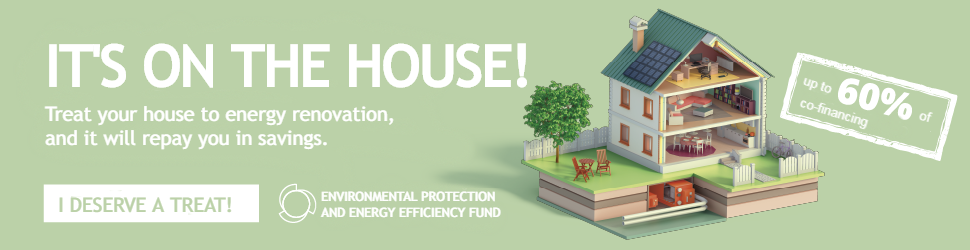
The Government of the Republic of Croatia, the Ministry of Construction and Physical Planning, and the Ministry of Environmental and Nature Protection, adopted on 27 March 2014 the Programme of energy renovation of family houses, which is implemented by the Environmental Protection and Energy Efficiency Fund. The goal of the Programme is to increase energy efficiency of the existing houses, to reduce energy consumption and emissions of CO2 into the atmosphere, and to reduce the monthly costs for the energy generating products, with the overall improvement of the quality of living. At the same time, the planning of such interventions implies the engagement of the local companies and experts, meaning it promotes economic activities. The first Amendments to the Programme were adopted in 2015, and the Second amendments in 2020.
After the adoption of the Amendments to the Programme, the Environmental Protection and Energy Efficiency Fund will continue with the national financing of the Programme of energy renovation of family houses in 2020. On 25 June 2020, the Public Call was invited for the citizens (co)owners of the existing family houses falling in the minimum energy category (according to QH,nd) D or below in the continental part of Croatia, or in the energy category C or below in the coastal part of Croatia.
For the purposes of this Programme, a family house is a building:
- where more than 50% of the gross surface area is used for dwelling, and
- which complies with one of these two requirements: has no more than three residential units, and has the gross construction surface area less or equal to 600 m2.
With up to 60% of grant funding, the citizens will be able to get co-financing to increase thermal protection of all elements of the building envelope of the conditioned area: energy renovation of the exterior wall, ceiling, floor, roof (all the required equipment and works related to improving thermal protection, including, for example, waterproofing, replacement of the structural elements of the roof, etc. – the details will be stipulated in the public call); the replacement of the windows and doors in the envelope of the conditioned area, and a comprehensive energy renovation, which implies a combination of measures on the building envelope and installation of RES systems (systems using solar thermal converters, systems using wood chippings/pellets, air-to-water, water-to-water or ground-to-water heat pumps, and photovoltaic systems for the production of electricity for own consumption).
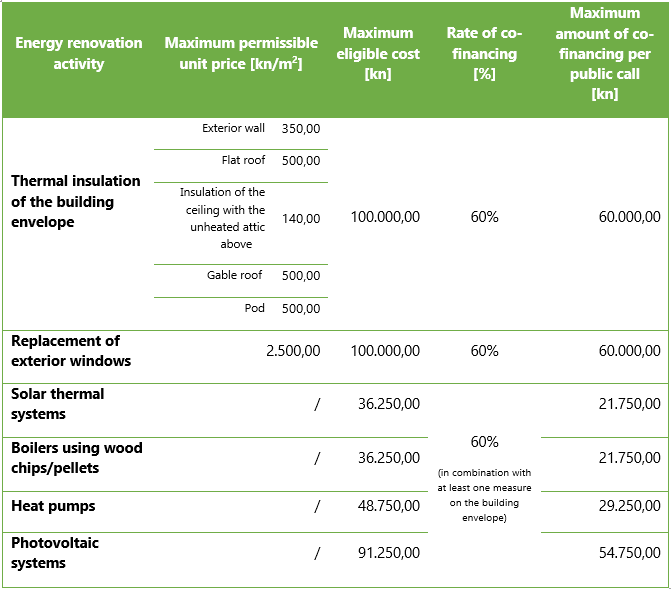
Detailed technical requirements have been set out in the text of the Public Call, as well as the contents of the application documentation. A person can apply to the Public Call using the e-Application system for the Fund’s public calls (they have to register and create a user account first), which must contain the following:
- The main application data (to be filled in online in the e-Application system for the Fund’s public calls)
- Copy of the ID on both sides or the electronic records of residence (the e-Citizens system) or the certificate of residence
- The latest valid proof of legality of the family house pursuant to the Building Act
- The Statement form filled out by the applicant and the Statement filled out by other co-owners (link)
- If the house is part of the listed cultural and historical whole, it requires the approval of the competent state administration body responsible for the protection of cultural and natural monuments
- Proof of ownership or co-ownership (land registry certificate in which the recorded owner is the person applying for the renovation, and it is not necessary for the house subject to energy renovation is recorded in it; or certificate from the court, where the land register has been destroyed or are not available, that they have either been destroyed or are not available and the Title deed from the local cadastral office)
- If the numbers of land plots un he proof of legality and the proof of ownership differ, the certificate has to be obtained from the competent cadastral office stating that the land plots are equivalent
- A detailed estimate of the contractor for the implementation of the measures specified in the report on energy audit, proving these measures will meet the technical requirements stipulated in the public call
- Photo documentation of the as-is situation
- The report on energy audit and the energy performance certificate (not older than 13 November 2012, which is eligible if there were no energy renovation measures implemented on the house, otherwise a new energy performance certificate has to be issued after implementing the measures)
- In the case of installation of the photovoltaic systems, the main design is required, pursuant to the Ordinance on simple and other buildings and works (Official Gazette 112/17, 34/18, 36/19, and 98/19).
The submission of the applications to the Public Call will start on 1 September 2020 (Tuesday) at 9:00.
Until this date, the citizens have to create and activate their user accounts in the e-Application system for the Fund’s public calls, and they will have the option to fill out the application form and upload the required documentation. (The “Apply” button will not become active until 1 September at 9:00.)
More information about the Public Call for the citizens can be obtained by e-mail at: obiteljske2020@fzoeu.hr
After the applications have been processed, the successful applicants granted the Fund’s resources will receive the Decision and Contract on co-financing. The beneficiaries will then have the period of 24 months from the date of signing the contract to implement energy renovation and submit the documentation required for the payment of the granted funding.
Of the total amount of HRK 203 million allocated for the energy renovation of family houses, HRK 32 million has been earmarked for the financing of energy renovation of family houses for the citizens at risk of energy poverty. Under the social criteria, set out in the Amendments to the Programme, which the Croatian Government adopted in May at the initiative of the Ministry of Construction and Physical Planning, social welfare centres will coordinate certified energy auditors to help in the application process to the citizens most at risk. The envisaged energy renovation measures and the cost of energy auditors for this group of citizens will be fully financed by the Fund.
> Public Call for the citizens at risk of energy poverty
More information about this part of the Programme can by obtained by e-mail at en.siromastvo@fzoeu.hr
Dedicated to advancing energy efficiency as a means of promoting both economic prosperity and environmental protection.Working to harvest this knowledge. The pioneering experience of corporations, governments and financiers will be captured, analyzed and made available for others to learn from. Zeljko Serdar, CCRES


