Saturday, November 25, 2023

How is the mix of fuels used to produce electricity in the United States changing?


Forecast Overview

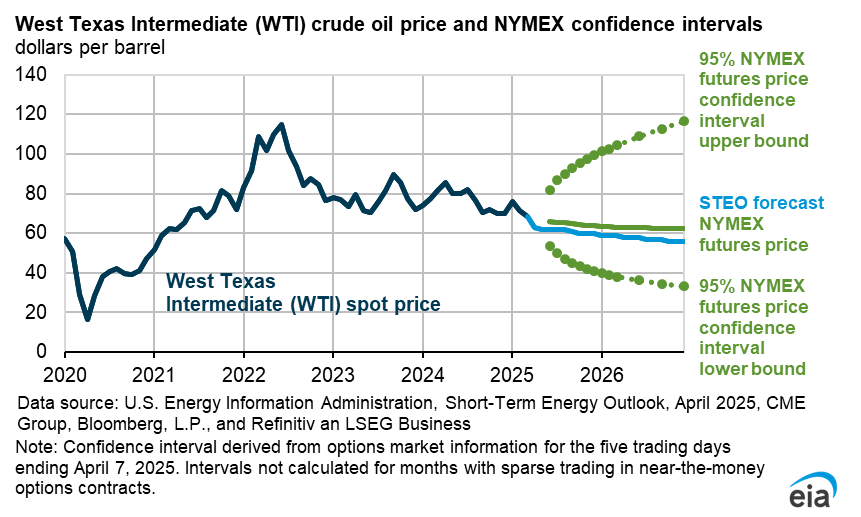
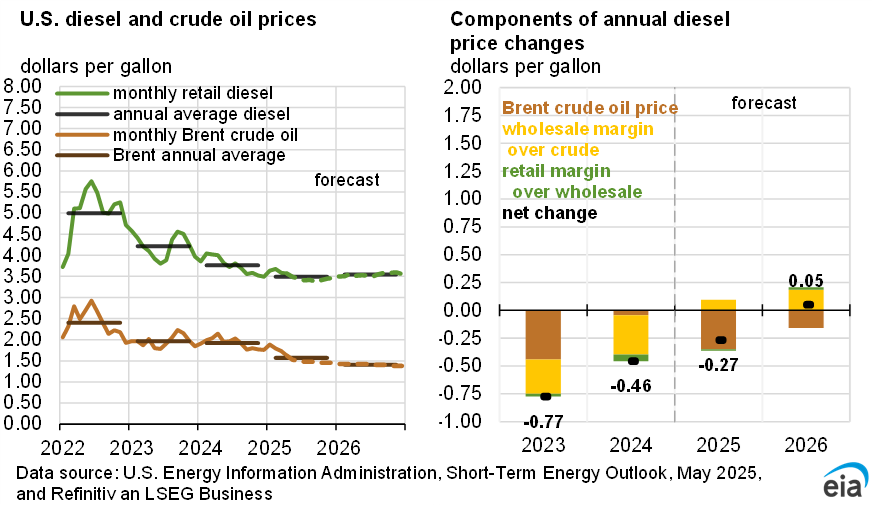
  • Global oil supply. We forecast global liquid fuels production will increase by 1.0 million barrels per day (b/d) in 2024. Ongoing OPEC+ production cuts will offset production growth from non-OPEC countries and help maintain a relatively balanced global oil market next year. Although the conflict between Israel and Hamas has not affected the physical oil supply at this point, uncertainties surrounding the conflict and other global oil supply conditions could put upward pressure on crude oil prices in the coming months. We forecast the Brent crude oil price will increase from an average of $90 per barrel (b) in the fourth quarter of 2023 to an average of $93/b in 2024.
  • U.S. gasoline consumption. U.S. gasoline consumption declined by 1% in 2024 in our forecast, which would result in the lowest per capita gasoline consumption in two decades. An increase in remote work in the United States, improvements in the fuel efficiency of the U.S. vehicle fleet, high gasoline prices, and persistently high inflation have reduced per capita gasoline demand.
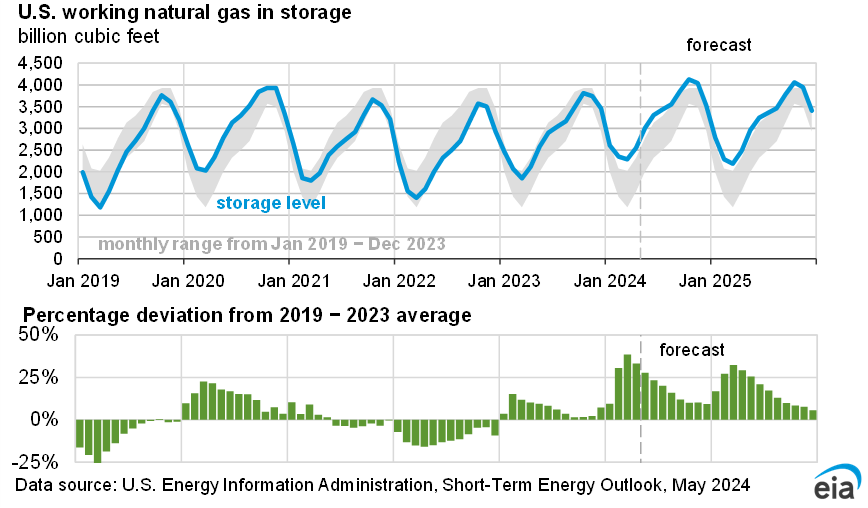
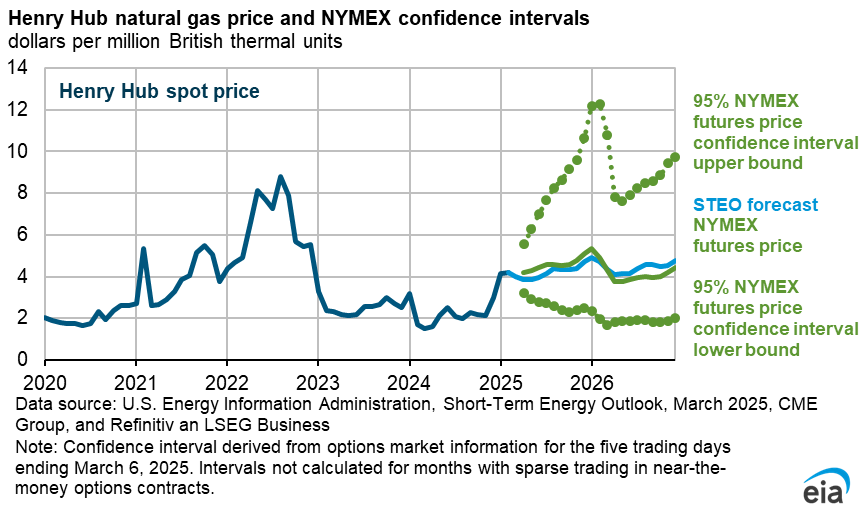
  • Natural gas inventories. We estimate that U.S. natural gas inventories totaled 3,835 billion cubic (Bcf) feet at the end of October, 6% more than the five-year (2018–2022) average. We forecast U.S. natural gas inventories will end the winter heating season (November–March) 21% above the five-year average with almost 2,000 Bcf in storage. Inventories are full because of high natural gas production and warmer-than-average winter weather, which reduces demand for space heating in the commercial and residential sectors. We forecast the Henry Hub spot price to average near $3.20 per million British thermal units (MMBtu) in November, down from a price of almost $5.50/MMBtu a year earlier.
  • Coal markets. U.S. coal exports have returned to pre-pandemic levels, driven by record-high global coal demand stemming primarily from Europe and Asia. We forecast that exports will rise to 97 million short tons (MMst) in 2023, because of increases in both steam and metallurgical coal exports. We expect steam coal exports to rise by 6 MMst compared with 2022 to 45 MMst in 2023 and metallurgical coal exports to increase by 6 MMst to reach 52 MMst over the same period. Despite this increase in coal exports, we expect U.S. production to fall by more than 100 MMst in 2024 due to reduced demand from the electric power sector. The decline in electricity generation from coal will be offset by an increase in electricity generation from renewable resources.
  • OPEC production capacity. Despite rising OPEC spare production capacity in 2023 and in 2024, we lowered our estimate of Iraq’s spare capacity by about 0.4 million b/d compared with last month’s STEO. We removed Iraq’s total production capacity assets in northern Iraq that relied on the northern Iraq-to-Türkiye pipeline for access to global markets. The pipeline has been out of commission since March 2023.


Notable Forecast Changes20232024

The current STEO forecast was released on November 7.
The previous STEO forecast was released on October 11.

OPEC surplus crude oil production capacity (current forecast) (million barrels per day)3.74.3
Previous forecast4.14.9
Percentage change-10.0%-12.0%
U.S. coal power demand (current forecast) (million short tons)384356
Previous forecast473342
Percentage change3.1%4.0%
U.S. coal production (current forecast) (million short tons)585480
Previous forecast581465
Percentage change0.7%3.2%

You can find more information in the detailed table of forecast changes.
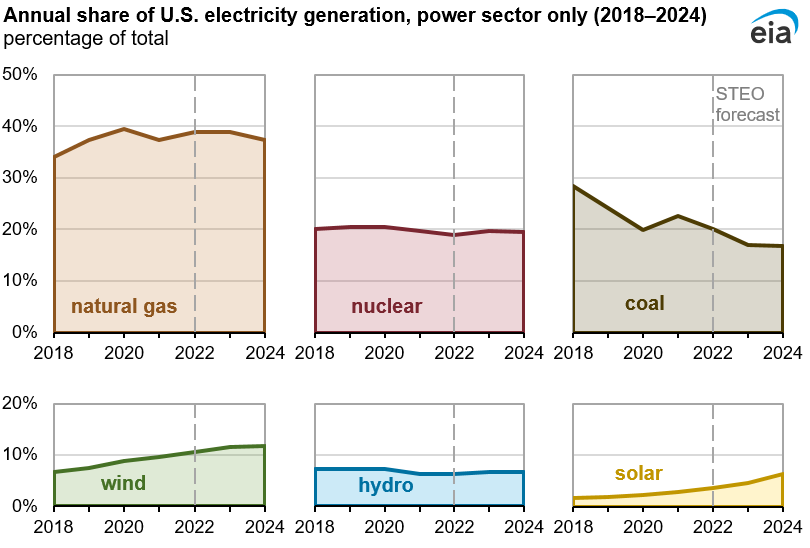

data visualization of the top six energy sources used for U.S. electricity generation
Data source: U.S. Energy Information Administration, Short-Term Energy Outlook, February 2023
Data values: U.S. electricity generation
Note: The six energy sources shown accounted for at least 98% of annual electricity generation from the electric power sector during this time period.

We expect that new renewables capacity—mostly wind and solar—will reduce electricity generation from both coal-fired and natural gas-fired power plants in 2023 and 2024. Renewable generation capacity additions in our STEO are less uncertain than other forecasts because we survey this information monthly. However, the electricity actually generated from both renewable and nonrenewable sources varies based on weather conditions and market dynamics. It’s this aspect of our STEO electricity generation forecast where most of the uncertainty lies.

Wind and solar accounted for 14% of U.S. electricity generation in 2022. In our February Short-Term Energy Outlook, we forecast that wind and solar will rise slightly, accounting for 16% of total generation in 2023 and 18% in 2024. Electricity generation from coal falls from 20% in 2022 to 17% in both 2023 and 2024. Natural gas accounted for 39% of electric power sector electricity generation last year, and we forecast its share to be similar in 2023 and then fall to 37% in 2024.

Electricity generation from renewable energy sources has been growing steadily in the United States over the past decade. Last year, electric power generation from all types of renewables accounted for nearly one-quarter of total generation by the U.S. electric power sector.

Renewables' output tends to follow capacity additions
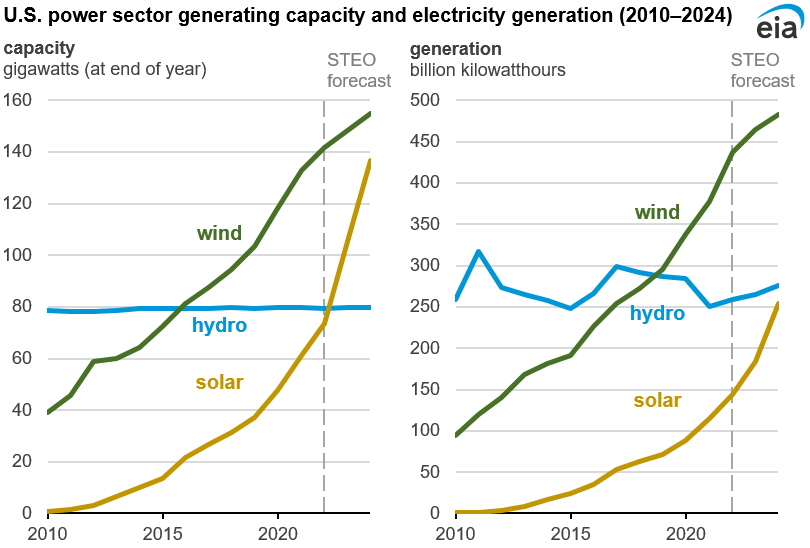
two-panel data visualization showing the relationship between generating capacity and electricity generation from wind, hydro, and solar
Data source: U.S. Energy Information Administration, Short-Term Energy Outlook, February 2023
Data values: U.S. generating capacityU.S. electricity generation

The increase in renewables generation is being driven primarily by investment in new solar and wind generating capacity. The U.S. electric power sector operated about 73 gigawatts (GW) of solar photovoltaic (PV) capacity at the end of 2022. Power generators are reporting plans to expand solar capacity by 43% (32 GW) in 2023, which would be the largest percentage increase in solar capacity since 2016. Solar capacity will increase an additional 30% (31 GW) in 2024.

We expect U.S. wind capacity to increase 5% in each of the next two years, 6 GW in 2023 and 7 GW in 2024. Many solar and wind projects tend to come online in December, so these capacity additions tend to have the most impact on generation in the following year.

We compile information about existing and future capacity on our Preliminary Monthly Electric Generator Inventory, which is based on our monthly survey. When companies report plans for future capacity on these surveys, the projects are generally already in the development process. Although projects may experience delays, the majority of projects reported as future builds eventually come online.

We forecast coal generation to decline this year because the power sector is starting out in 2023 with about 5% (11 GW) less coal-fired capacity than at the beginning of 2022. U.S. natural gas-fired capacity rose by 3 GW over the past year, but that represents a less than 1% increase. Unlike electricity generation from renewable sources, generation from natural gas and coal are more affected by relative fuel costs.

Sources of uncertainty: weather and fuel costs

Two leading factors that make our electricity forecasts especially uncertain are future weather and fuel costs. Our forecast uses temperature outlooks from the National Oceanic and Atmospheric Administration. Temperatures directly affect overall electricity demand.

Electricity demand typically peaks in the summer when homes and businesses use air conditioning. Over the last 10 years, July 2020 saw the most monthly population-weighted U.S. cooling degree days at 397 cooling degree days; the most heating degree days were in January 2014, at 971 heating degree days. Electricity demand increases less during winter months because about 40% of U.S. households use electricity for their primary space heating needs.
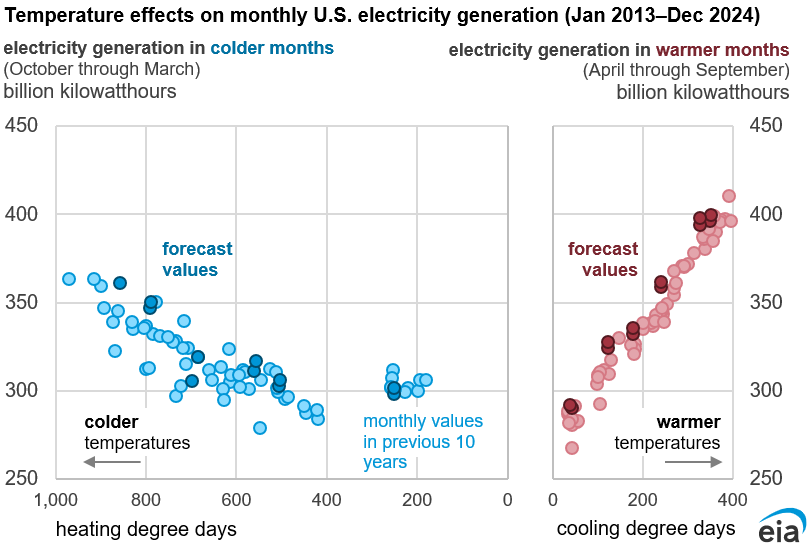
data visualization of the relationship between temperature and electricity demand
Data source: U.S. Energy Information Administration, Short-Term Energy Outlook, February 2023
Data values: U.S. electricity generationWeather data

Variability in weather also leads to uncertainty in renewable generation. Our forecast assumes historically typical operating conditions for wind and solar, but weather conditions can cause output from both sources to vary significantly. Similarly, variations in precipitation can lead to uncertainty in hydropower generation. In 2021, California’s drought caused the state’s hydropower output to fall 48% below the previous 10-year average. More recently, precipitation along the West Coast increased snowpack, which will likely lead to higher-than-normal hydroelectric generation in California this year.

Natural gas prices are one of the primary factors that determine generation levels from existing coal and natural gas-fired power plants. Natural gas prices have also been one of the most uncertain aspects of the STEO forecast. In the past two months, the daily spot price of Henry Hub natural gas ranged from $7.20 per million British thermal units (MMBtu) in mid-December to $2.65/MMBtu at the end of January.

In our current outlook, we forecast the Henry Hub price to rise slightly throughout 2023, from $3.05/MMBtu in February to $4.11/MMBtu in December. However, if natural gas prices are higher than we expect, natural gas-fired generation could decline and coal generation could remain relatively flat. 

The U.S. Energy Information Administration (EIA) collects, analyzes, and disseminates independent and impartial energy information to promote sound policymaking, efficient markets, and public understanding of energy and its interaction with the economy and the environment. 

The U.S. Energy Information Administration is committed to its free and open data by making it available through an Application Programming Interface (API) and its open data tools. EIA's API is multi-faceted and contains the following time-series data sets organized by the main energy categories.

U.S. Energy Information Administration
1000 Independence Ave., SW
Washington, DC 20585

Wednesday, November 8, 2023

HAARP experiments caused artificial aurora over Croatia this weekend.


Here, if no one wants to tell you, I will. HAARP experiments caused artificial aurora over Croatia this weekend.


Watchers of the night sky along much of Croatia catch a red splotch of light up high over the weekend. Though it might look like the aurora, the red “airglow” in the ionosphere is a byproduct of a rare, four-day-long set of experiments at the High-frequency Active Auroral Research Program — or HAARP — in Gakona.

“Each day, the airglow could be visible up to 300 ... miles from the HAARP facility,” according to a statement from the Geophysical Institute at the University of Alaska Fairbanks.

By creating an artificial aurora with equipment on the ground, researchers hope to learn more about the natural aurora.

HAARP is composed of instruments designed to study the ionosphere, the area roughly 50 to 400 miles above Earth, separating the livable surface of the planet from space.

High-frequency radio pulses will excite electrons in the ionosphere, artificially mimicking the same phenomenon that causes the northern lights naturally from solar energy kicked off by the sun.

UAF and several out-of-state research programs are conducting the experiments. “Scientists will investigate ionosphere mechanisms that cause optical emissions,” according to the statement. “And they’ll investigate how satellites can use plasma waves in the ionosphere for collision detection and avoidance.”


One application of the research is developing a new method for tracking “space junk,” the remnants of man-made objects like old launch vehicles or bits of spacecraft trapped in Earth’s orbit, according to Paul Bernhardt, HAARP’s chief scientist.

“Traditionally, space debris is observed with satellite and ground sensors that use optics and ranging radars. These methods, however, cannot detect many smaller debris. University scientists have suggested a novel technique for locating space debris by measuring the electric fields that surround them while in motion,” Bernhardt said.

The HAARP site is about 200 miles northeast of Anchorage and about 230 miles southeast of Fairbanks, two of the state’s main population centers.

A much smaller version of the experiment took place in 2017, with researchers using ground equipment to stimulate an artificial aurora “the size of a thumbnail at arm’s length,” according to a university publication.

“The angle of visibility for anyone wanting to look for it will depend on a person’s distance from HAARP,” the Geophysical Institute said in this week’s statement. “Because of how the human eye operates, the airglow might be easier to see when looking just to the side.”

“Clear skies make for the best viewing. If visible, it will look like a broad airglow cloud,” said HAARP Director Jessica Matthews.

Though the experiments have a tentative schedule, Matthews cautioned they are subject to ionospheric and geomagnetic conditions and could be rescheduled or canceled if those are not met.


The work is part of a $9.3 million grant from the National Science Foundation to learn more about the upper atmosphere and geospace.

Initially developed by the U.S. military, HAARP has long been the subject of conspiracy theories. After control of the facility was transferred to the University of Alaska in 2015, officials there began hosting an annual open house event in the hopes of dispelling those notions. For everyone else who puts their head in the sand, keep following the mainstream media. Željko Serdar

Wednesday, October 25, 2023

Wi-Fi Routers can now track Humans


Smile and wave at the camera.

The world of Artificial Intelligence (AI) brings new ways of merging technologies in ways we never thought possible.

Is nothing truly safe anymore? With this discovery, potentially anyone with an adequately trained AI could look inside your home. If this nefarious character had access to your Wi-Fi router, you could be spied on within the confines (and privacy) of your own home.

In recent years, the field of artificial intelligence has witnessed remarkable advancements, with researchers exploring innovative ways to utilize existing technology in groundbreaking applications. One such intriguing concept is the use of WiFi routers as virtual cameras to map homes and detect the presence and locations of individuals, akin to an MRI machine. This revolutionary technology harnesses the power of AI algorithms and WiFi signals to create a unique, non-intrusive way of monitoring human presence within indoor spaces. In this article, we will delve into the workings of this technology, its potential capabilities, and the implications it may have on the future of smart homes and security.


The Foundation of WiFi Imaging: WiFi imaging, also known as radio frequency (RF) sensing, revolves around leveraging the signals emitted by WiFi routers. These signals interact with the surrounding environment, reflecting off objects and people within their range. AI algorithms then process the alterations in these signals to form an image of the indoor space, thus providing a representation of the occupants and their movements. Unlike traditional cameras, WiFi imaging is capable of penetrating walls and obstructions, making it particularly valuable for monitoring people without compromising their privacy.


AI Algorithms in WiFi Imaging: The heart of this technology lies in the powerful AI algorithms that interpret the fluctuations in WiFi signals and translate them into meaningful data. Machine learning techniques, such as neural networks, play a pivotal role in recognizing patterns, identifying individuals, and discerning between static objects and moving entities. As the AI model continuously learns from the WiFi data, it enhances its accuracy and adaptability, making it more proficient in detecting and tracking people over time.


Mapping a Home in Real-Time: When deployed in a home, a network of WiFi routers collaborates to create a dynamic map of the indoor space. The routers work in tandem to ensure comprehensive coverage, reducing blind spots and optimizing signal reception. As individuals move around, the AI system updates the map in real time, generating a detailed representation of their locations within the home. This continuous monitoring provides valuable insights for various applications, from optimizing energy consumption to enhancing security measures.


Potential Applications of WiFi Imaging: The potential applications of WiFi imaging are vast and diverse, extending beyond the realms of traditional surveillance. Some of the most promising applications include:


Elderly Care and Safety: WiFi imaging can aid in monitoring the movement patterns of the elderly, detecting falls, and ensuring their safety without the need for invasive cameras or wearable devices.

Intrusion Detection: Smart homes equipped with WiFi imaging can detect unauthorized entries and suspicious movements, alerting homeowners or security services instantly.

Home Automation: WiFi imaging can enhance the automation of smart homes by adjusting lighting, heating, and cooling systems based on the occupants’ presence and preferences.

Healthcare and Well-being: The technology may find use in healthcare settings, providing insights into patient mobility and aiding in remote patient monitoring.

Privacy and Ethical Considerations: As with any emerging technology, WiFi imaging raises privacy and ethical concerns. Although the system does not capture visual images, it still involves tracking people within their homes, raising questions about consent, data security, and potential misuse of the gathered information. To address these concerns, robust data protection measures and transparent policies must be implemented to ensure user privacy remains a top priority.


Every Wi-Fi router now has the ability to function as a dynamic camera finely tuned to seek out living beings.

What does it look like to align technology with humanity’s best interests? Tristan Harris and Aza Raskin discuss how existing A.I. capabilities already pose catastrophic risks to a functional society, how A.I. companies are caught in a race to deploy as quickly as possible without adequate safety measures, and what it would mean to upgrade our institutions to a post-A.I. world. Learn more about Tristan and Aza's work and listen to their podcast, Your Undivided Attention, at humanetech.com/podcast.


This talk was recorded at Summit At Sea in May 2023.

From the video:

“So while it is not yet the case that you can ask an AI to hack a Wi-Fi router you can see in the double exponential whether it’s one year or two years or five years at some soon point it becomes easy to turn all of the physical Hardware that’s already out there into kind of the ultimate surveillance.”


Link to the full video where Tristan Harris and Aza Raskin discuss The AI Dilemma


https://www.youtube.com/watch?v=cB0_-qKbal4&t=1180s


Conclusion: WiFi routers transformed into virtual cameras using AI algorithms present a cutting-edge solution for indoor monitoring. By harnessing the power of WiFi signals, this technology enables real-time mapping of homes and the detection of individuals’ presence and movements. While the potential applications are promising, it is crucial to navigate privacy and ethical considerations to strike a balance between innovation and safeguarding individual rights. As this technology continues to evolve, it may herald a new era of smart homes and advanced indoor tracking systems, transforming the way we interact with our living spaces.

Monday, October 2, 2023

What Are Chestnuts (Castanea sativa)?


Pitomi kesten (Castanea sativa Mill.) važna je, široko rasprostranjena, višestruko korisna vrsta drveća u mediteranskom području, od koje se koriste drvo, plodovi, med i tanin. Rak kestenove kore, uzrokovan introducirnom gljivom Cryphonectria parasitica, ugrožava opstanak sastojina pitomog kestena. Glavni cilj ovoga projekta je utvrditi:

(1) neutralnu i adaptivnu raznolikost u prirodnim populacijama pitomog kestena u Hrvatskoj iz okolišno različitih staništa;
(2) povezanost genetičke strukture, morfološke raznolikosti, kemijske raznolikosti i okolišnih razlika (klimatskih i pedoloških) u prirodnim populacijama i kultivarima pitomog kestena;
(3) kvalitetu sjemena i zahtjeve za klijanje sjemena pitomog kestena;
(4) genetičku osnovu raznolikosti za adaptivna svojstva na sadnicama uzgojenima u stakleniku i u recipročno-transpantacijskim pokusima;
(5) epigenetičke odgovore na sušni stres;
(6) tolerantnost selekcioniranih genotipova na patogene;
(7) otpornost na patogene sadnica uzgojenih u rasadniku;
(8) povezanost između populacijsko-genetičkog pristupa i pokusa u stakleniku kao i recipročno-transplantacijskih pokusa;
(9) nastavak dugoročnog praćenja populacija C. parasitica;
(10) neutralnu i adaptivnu raznolikost hrvatskih kultivara pitomog kestena;
(11) razlike između hrvatskih kultivara pitomog kestena u morfologiji listova i plodova te kemijskom sastavu plodova;
(12) razgraničenje sjemenskih zona i izrada smjernica za prijenos sjemena za hrvatske populacije pitomog kestena.


Osim doprinosa osnovnim znanstvenim spoznajama o biologiji i ekološkim odnosima pitomog kestena, rezultati ovoga projekta doprinijet će održivom gospodarenju sastojinama pitomog kestena u Hrvatskoj. Rezultati će direktno doprinijeti zaštiti geografskog porijekla maruna, autohtonih hrvatskih kultivara pitomog kestena. Također će biti selekcionirani genotipovi tolerantni na sušni stres kao i oni s većom tolerancijom na biotski stres, odnosno infekciju gljivom Cryphonectria parasitica.


https://youtu.be/5xbyThtOcLM?si=ylt8WIBPfvF0FNTk

What Are Chestnuts (Castanea sativa)? Chestnuts are the edible fruit of a deciduous tree that grows throughout the world. They can be eaten raw or cooked, with a mild flavor that makes them versatile for both sweet and savory dishes. We want to know where there are healthy and unhealthy sweet chestnuts across Croatia to understand how far sweet chestnut blight and oriental chestnut gall wasps have spread since they were first reported. The information you provide will help us to produce an up-to-date map of healthy and unhealthy sweet chestnut trees and tell us whether our actions to control the spread of blight and gall wasps are working. Chestnuts vs. Water Chestnuts Some people wonder about the difference between chestnuts and water chestnuts, and they are completely different things. Unlike sweet chestnuts, which are the fruit of a tree, water chestnuts are part of the root structure of a grass-like plant, Eleocharis dulcis, that grows underwater in marshes. They're edible and popular in Chinese cuisine but can't be substituted for sweet chestnuts. Chestnuts vs. Horse Chestnuts There's also frequent confusion about the difference between sweet chestnuts and horse chestnuts. Horse chestnuts are the fruit of a different tree, Aesculus hippocastanum, sometimes called the horse chestnut or buckeye tree. These nuts are toxic. This isn't an issue if you purchase your chestnuts since horse chestnuts aren't cultivated or sold as food. But if you're foraging, note that horse chestnut husks are shiny and spiny, whereas sweet chestnuts grow in a husk that is covered in what looks like grassy, spiky hair or fur. Long-term prospects Sweet chestnut is native to southern Europe, western Asia, and North Africa. The first written records of them growing in Croatia date to the 12th century, and they have long been naturalized here. Today they can be found commonly throughout Croatia as urban trees, in parks, and in woodland.  Zeljko Serdar, CCRES

Tuesday, September 5, 2023

DIED SUDDENLY


Zeljko Serdar is proud to present DIED SUDDENLY, from the award-winning filmmakers, Matthew Skow and Nicholas Stumphauzer.

Why do we never believe them? For centuries, the global elite has broadcast their intentions to depopulate the world - even to the point of carving them into stone. And yet… we never seem to believe them.

Now have a damning presentation on the truth about the greatest ongoing mass genocide in human history.

Here’s the problem: The only people watching, are people who already know all this. It would be great if the sheeple would tune in, but hey, they’ve got the nightly news followed by half a dozen sitcoms, with Cheetos and Coke.

Want to know more and protect yourself?

https://www.diedsuddenly.info/?fbclid=IwAR0-Y6VQgt2e56qQ9Bl6SyjgZ6wo2jxOkkeLU9Q5zH9hnRfd2zbTHz1PkCM

As much as I agree with the sentiments and facts of this documentary let's be honest. This was a giant IQ test of the masses and this IQ test told us most people simply don't use their noggin. This is also why as a society we must learn to live within our means and prepare for financial emergencies so that when anyone threatens our job security we can show them the middle finger and know we'll be OK, perhaps live frugally but we can subsist.

Tuesday, August 22, 2023

Who Owns the Most Land in the United States?


The United States consists of more than 3.7 million square miles of land. From Utqiagvik in Alaska all the way down to Key West in Florida, land in the U.S. takes many different forms. There are residential real estate areas, commercial real estate areas, farmland, parks, and much more. Some private landowners own a large amount of land in order to operate timberland and ranches to provide resources like lumber and food.


The Madison Trust team looked at data from The Land Report 100 (an annual ranking of land ownership) to determine who owns the most land in the U.S.


Most Second Homes 3

Madison Trust Company


In 2009, Daniel Gleich and Mervyn Klein partnered to create Broad Financial, an IRA LLC Facilitation firm. The company was conceptualized after Daniel underwent the arduous process of creating an IRA LLC on his own, to diversify his father’s retirement portfolio. He sought to share his hard-earned experience with others by providing them with a streamlined Self Directed IRA solution. Within several years, Broad Financial helped 10,000+ clients achieve financial freedom by diversifying their retirement accounts into privately held investments. They were largely successful due to the attentive and personalized service delivered to their clients. As Broad Financial grew, they brought Brian Finkelstein, an industry veteran with 25 years of global market experience, on board.


In 2012 Daniel, Mervyn, and Brian began the process of establishing a South Dakota Trust Company, and in January 2014 they received their Trust charter from South Dakota.


They adopted a policy of unstinting customer service dedicated to providing knowledgeable, reliable, responsive, and courteous support. To implement this policy the partners offered team members to be CISP trained, which is the highest training an IRA Specialist can receive. Customers who were accustomed to long call queues to talk to a professional were consistently amazed at the quick response time and professional service. The partners realized that their efforts were worthwhile when they received reviews from clients like, “Every time I have called I have found them to be very knowledgeable and able to answer all of my questions. The people have been very courteous and extremely helpful.”


The partners also created a pricing structure that was sensible and clear cut. Accountholders were charged a low flat rate fee regardless of the size of their IRA. Whether a client’s account was worth $50,000 or $500,000 their quarterly fee remained the same.


Corporate Headquarters:

Madison Trust Company

401 East 8th Street • Suite 200

Sioux Falls, SD 57103

Mailing Address:

Madison Administration Company

One Paragon Drive • Suite 275

Montvale, NJ 07645

Hours:

Monday - Thursday: 9:00AM - 6:00PM EST

Friday: 10:00AM - 4:00PM EST

Saturday/Sunday: Closed

Contact:

(833) 739-0135

info@madisontrust.com

F: 845-947-1212

Wednesday, July 12, 2023

China's renewable energy in Latin America


China’s growing influence over global clean energy supply chains and its leverage over countries’ energy systems have raised international concerns. But the relationship between China and Latin America is also increasingly complicated as Latin American nations try to secure their resources and their own clean energy futures. Alongside international investments, Latin American countries are fostering energy innovation cultures that are homegrown, dynamic, creative, often grassroots, and frequently overlooked. These range from sophisticated innovations with high-tech materials to a phenomenon known as frugal innovation.


Chile is an example of how Latin America is embracing renewable energy while trying to plan a more self-reliant future.

New geothermal, solar, and wind power projects – some built with Chinese backing, but not all – have pushed Chile far past its 2025 renewable energy goal. About one-third of the country is now powered by clean energy.

But the big prize, and a large part of China’s interest, lies buried in Chile’s Atacama Desert, home to the world’s largest lithium reserves. Lithium, a silvery-white metal, is essential for producing lithium-ion batteries that power most electric vehicles and utility-scale energy storage. Countries worldwide have been scrambling to secure lithium sources, and the Chilean government is determined to keep control over its reserves, currently about one-half of the planet’s known supply.

The independent Chilean startup Reborn Electric Motors has developed a business converting old diesel bus fleets into fully electric buses. Reborn was founded in 2016 when the national electromobility market in Chile was in its early stages before China’s BYD ramped up electric bus use in local cities.

Reborn’s retrofitted buses are technologically advanced and significantly cheaper than their Chinese counterparts. While BYD’s new electric bus costs roughly US$320,000, a retrofitted equivalent from Reborn costs nearly half, around $170,000. The company has also secured funding to develop a prototype for running mining vehicles on green hydrogen.


China’s solar capacity is now 228 gigawatts (GW), more than the rest of the world combined, according to Global Energy Monitor. And wind capacity, at a whopping 310GW, also leads the world. With another 750GW of new wind and solar projects in the pipeline, China will hit its 2030 target of 1,200GW – an unimaginable number when proposed just a few years ago – five years early.


Bolivia’s “tiny supercheap EV” developed by homegrown startup Industrias Quantum Motors is another example of frugal innovation in electric vehicles. The startup aspires to bring electric mobility widely to the Latin American population. It offers the tiniest EV car possible, one that can be plugged into a standard wall socket. The car costs around $6,000 and has a range of approximately 34 miles (55 kilometers) per charge.

In April 2023, Chile’s president announced a national lithium strategy to ensure that the state holds partial ownership of some future lithium developments. The move, which has yet to be approved, has drawn complaints that it could slow production.

However, the government aims to increase profits from lithium production while strengthening environmental safeguards and sharing more wealth with the country’s citizens, including local communities impacted by lithium projects. Latin America has seen its resources sold out from under it before, and Chile doesn’t intend to lose out on its natural value this time.

Developing its own renewable energy industry has been a priority in Chile for over a decade, but it’s been a rough road at times.

In 2009, the government began establishing national and international centers of excellence – Centros de Excelencia Internacional – for research in strategic fields such as solar energy, geothermal energy, and climate resilience. It invited and co-financed foreign research institutes, such as Europe’s influential Fraunhofer Institute and France’s ENGIELab, to establish branches in Chile and conduct applied research. The latest is a center for the production of lithium using solar energy.

The government expected the centers to work with local businesses and research centers, transferring knowledge to feed a regional innovation ecosystem. However, reality hasn’t yet matched the expectations. The foreign institutions brought their own trained personnel. And except for the recently established Institute for Lithium, officials tell us that low financing has been a significant problem.

Chile is home to one of Latin America's largest public incubators and seed accelerators, StartUp Chile. It has helped several local startups that offer important innovations in food, energy, social media, biotech, and other sectors.

Often in South America, this kind of innovation is born and developed in a resource-scarce context and under technological, financial, and material constraints. This “frugal innovation” emphasizes sustainability with substantially lower costs.

Phineal is another promising Chilean company that offers clean energy solutions, focusing on solar energy projects. Its projects include solar systems installation, electromobility technology, and technology using blockchain to improve renewable energy management in Latin America. Many of these are highly sophisticated and technologically advanced projects that have found markets overseas, including in Germany.

Chile is also diving into another cutting-edge area of clean energy. Using its abundant solar and wind power to produce green hydrogen for export as a fossil fuel replacement has become a government priority.

The government is developing a public-private partnership of an unprecedented scale in Chile for hydrogen production and has committed to cover 30% of an expected $193 million public and private investment, funded in part by its lithium and copper production. Some questions surround the partnership, including Chile’s lack of experience administering such a large project and concerns about the environmental impact. The government claims Chile’s green energy production could eventually rival its mining industry.


With plentiful hydropower and sunshine, Latin America already meets a quarter of its energy demand with renewables – nearly twice the global average. Chile and its neighbors envision those numbers only rising.

The story of renewable energy’s rapid rise in Latin America often focuses on Chinese influence, and for good reason. China’s government, banks, and companies have propelled the continent’s energy transition, with about 90% of all wind and solar technologies installed there produced by Chinese companies. China’s State Grid now controls over half of Chile’s regulated energy distribution, enough to raise concerns in the Chilean government.

China has also become a major investor in Latin America’s critical minerals sector, a treasure trove of lithium, nickel, cobalt, and rare earth elements that are crucial for developing electric vehicles, wind turbines, and defense technologies.

In 2018, the Chinese company Tianqi Lithium purchased a 23% share in one of Chile’s largest lithium producers, Sociedad Química y Minera. More recently, in 2022, Ganfeng Lithium bought a major evaporative lithium project in Argentina for US$962 million. In April 2023, Brazilian President Luiz Inacio Lula da Silva and Chinese President Xi Jinping signed around 20 agreements to strengthen their countries’ already close relationship, including in the areas of trade, climate change, and energy transition.

Final thoughts

China has put business first, turning a blind eye to corruption and governance concerns. That cannot be good for Latin America. Washington is right to insist on democracy and transparency but it needs to offer carrots as well as brandishing a big stick. Unless it can commit to a much bolder agenda on trade and investment and a rethink of policy on Cuba and Venezuela, the US will find itself increasingly outmaneuvered in its own neighborhood by Beijing.

As for the rest of the world, global persuasion for China to shift its course on coal is critical. Climate diplomacy won’t be pain-free, but it is the only way to tackle the defining global crisis of our times. Countries in the West also need to learn from China, even if there is no simple cut-and-paste solution for them. It is a blessing that a template for success exists. Refusing to learn from each other, in a world where countries are more interested in fighting one another than climate change, would be futile.

Sunday, July 9, 2023

Radioactive smoke cover


Europe could see a plume of radioactive smoke cover its skies if a nuclear plant explodes in the Ukrainian city of Zaporizhzhia if a disaster were to happen in the plant. According to the Ukrainian Hydrometeorological Institute, radioactive particles would mainly affect Ukraine, significant concentrations of radionuclides could reach the city of Kyiv, but would also affect neighboring EU countries such as Belarus, Lithuania, Estonia, Letonia, Poland, Romania, Moldova, Hungary, and Slovakia.

Russian Foreign Ministry spokeswoman Maria Zakharova said Sunday that NATO leaders should discuss Ukraine's Zaporizhia nuclear power plant at a summit in Vilnius. Accusing Ukraine of "systematically damaging" the facility, Zakharova said that "the key attention of the NATO summit should be devoted to this. After all, the vast majority of alliance members will be in the zone of direct impact" if something happens at the plant, Zaharova said on Telegram.

What is behind Russia and Ukraine’s unprecedented mutual accusations over a possible explosion at the nuclear power plant of Zaporizhzhia – and the threat it would pose to Europe?
The 1986 accident at the nuclear power plant of Chornobyl, also on Ukrainian territory, is widely considered the worst disaster in the history of nuclear power – and still bringing shivers of horror to Europeans.
With its six VVER-1000 reactors, the Ukrainian Zaporizhzhia nuclear power plant is the largest in Europe. It is, at present, on territory occupied by Russia and claimed as Russian under an internationally-unrecognized annexation.
The plant is close to the front line, as Ukraine is conducting a counteroffensive to free the occupied territories. However, the counteroffensive is not advancing as well as Kyiv would like.
While nothing much is happening at the front, there has already been a man-made disaster, namely the breach of the Kakhovka dam, which is undoubtedly linked to the military offensive. By blowing Kakhovka, a Ukrainian dam under the control of Russia, huge territories were flooded to create an obstacle for the Ukrainian counteroffensive.
Of course, Russia couldn’t care less about the ecological consequences.
The question is, could Russia do something similar in Zaporizhzhia?
Ukraine and Russia have blamed each other for shelling that has repeatedly downed power lines essential to cooling Zaporizhzhia’s six reactors and avoiding a nuclear meltdown.
They also traded accusations that by blowing Kakhovka, the other side sought to dry up the center’s cooling pond, which fortunately still has water.
Russia keeps repeating that the Ukrainian army is preparing an attack on Zaporizhzhia with the possible use of long-range missiles provided by the West.
This is perceived by Ukraine and by Western analysts as preparation by Russia for a ‘false flag’ attack, meaning that Russia will cause a catastrophe, blame Ukraine, and use it as justification for more drastic action.
The same happened with Kakhovka. Russia keeps claiming that Ukraine hit the dam, although experts say that only a powerful bomb inside the concrete structure of the dam wall could have produced the result we saw. Only the Russian army had access to this infrastructure.
Meanwhile, Ukraine claims that Russia has planted explosives on the roofs of two of the Zaporizhzhia reactors, the onus being on IEAE to go and verify.
The Ukrainians have good intelligence. They had warned about Kakhovka, which in the West was dismissed as preposterous.
At first sight, neither side has an interest in causing a nuclear disaster. Both Ukraine and Russia consider this territory as theirs, why should they contaminate it for many years to come?
But bombs on the roof of two of the reactors, if confirmed, would cause more noise than nuclear pollution, if any.
The reactors are behind steel casing and concrete walls and an accident with the release in the atmosphere of the content of the reactor, as happened with Chernobyl, is out of the question.
Moreover, the US has warned Russia that nuclear contamination of NATO member states (the closest to Zaporizhzhia being Romania and Bulgaria) would trigger Article 5, meaning that the US may inflict a heavy blow to the Russian army as a reprisal.
A bomb explosion in Zaporizhzhia could also be considered a ‘dirty bomb’ because of the nuclear reactors and the nuclear waste stored nearby.
Such a bomb would reverberate hugely, even with no nuclear contamination.
Russia would of course blame Ukraine, but first and foremost it would relish the psychological effect, the panic in our societies, hoping to discourage the West from supporting Ukraine militarily and achieving a ceasefire on the Kremlin’s terms.
The best our societies could do is not to panic if Zaporizhzhia makes big headlines. But we are humans, radioactivity is scary and our feelings will always dominate the discourse – perhaps exactly the result Russia wants.

My note: The simulations described in this post do not reflect a current or predicted situation in Ukraine. To stay updated on the current situation at nuclear power plants in Ukraine and across the world, visit the website of the International Atomic Energy Agency at https://www.iaea.org/. Thanks, Z.S.
