Monday, January 30, 2012

KESTREL wind power


  Croatian Center of Renewable Energy Sources

promotes

KESTREL

Kestrel, a Proudly South African product, had developed a reputation across the globe for providing leading edge small wind turbine alternative energy solutions.
Kestrel Renewable Solutions is a subsidiary of Eveready (Pty) Ltd, South Africa’s icon battery manufacturer brand with a proud 70 year old history of providing portable power solutions in South Africa.
The combination of the Kestrel Renewable Solutions technology and Eveready’s ISO certified manufacturing and technical expertise has achieved recognition as Proudly South African Innovator of the Year and Best Exporter.
Eveready Kestrel provides small wind turbine solutions in the 600w, 800w, 1kW and 3kW range. Its robust construction and unique engineering makes it the product of choice for telecommunications, off grid, grid connect and water pumping solutions.
A wind turbine is a machine for converting the kinetic energy in wind into mechanical energy. If the mechanical energy is used directly by machinery, such as a pump or grinding stones, the machine is usually called a windmill. If the mechanical energy is then converted to electricity, the machine is called a wind generator.


Your choices - Wind and Solar energy -

Let's compare

So you want to install some renewable energy for your business or home and have come to the crossroad as to which is better, wind power or solar power?
Both wind power and solar power have been around for a long time now and both renewable energy sources have successfully been used to produce clean electricity for home and commercial users. But which renewable energy source is the best for you ?

Criteria
Wind Energy
Solar Energy
Description
Working hours per day
24 hours
±5 hours
Risk of theft/vandalism
Low
High
Solar panels are easier access than wind turbines
Effect of dirt
Low
High
When solar panels get dirty it loses some of its performance
Effect of snow
Low
High
The output of a wind turbine i not effected by snow
Temperature effect
Not effected by temperature
High
As the panel temperature increases, the electricity output reduces.
Footprint
Low
High
A 1000w solar panel would have a footprint of 7.3 sq.m whereas a 1000w wind turbine would have a footprint of 1 sq.m
Locally manufactured
Yes
No
Kestrel wind turbines are manufactured in Port Elizabeth

Wind / Solar Energy Output


e300i
Wind Speed (m/s)
Monthly Energy (kWh)
Equivalent Solar Panel Capacity (W)
3.0
49
327
3.5
77
513
4.0
110
733
4.5
146
973
5.0
184
1227
5.5
223
1487
6.0
261
1740
6.5
297
1980
7.0
330
2200

Eveready-Kestrel: Driving the winds of change.

Eveready Diversified Products (trading as Kestrel Renewable Solutions) is the renewable energy and energy efficiency subsidiary of Eveready SA.  With Eveready’s support Kestrel have developed technologies that provide the opportunity to customers to better use the natural resources available to them in an efficient and productive way that doesn’t hurt the environment.  Eveready-Kestrel now provides a full range of small wind turbine solutions in 600w, 800w, 1kW and 3kW range.  Because of their robust construction and unique engineering, Kestrel turbines have proven to be the product of choice for telecommunications, off-grid, grid connected and water pumping solutions.
For all these reasons, shouldn't you be riding on the winds of change too?

  • Kestrel e230i (800W) The e230i is a distinctive 3 blade turbine that has a low start up torque, increasing its efficiency. The axial flux permanent magnet brushless alternator is powered by an optimised three blade rotor, with patented pitch control. The e230i maintains rated output in excess wind speeds, optimising the potential power output and energy yield.


  • Kestrel e300i (1kW) The e300i is the next generation of small wind turbine. It is a low starting machine allowing it to generate electricity at relatively low wind speeds. The high performance three blade rotor with pitch control powers a twin axial flux permanent magnet brushless alternator, with good heat management. The e300i maintains its rated output in excess wind speeds, optimising the potential power output and energy yield. More usable power generated, stored and used. The e300i powers telecoms sites around the world .
  • Kestrel e160 (600W) The e160i is compact and virtually silent as it generates energy. Rotation speed is controlled by rotor turbulence, which accounts for the 6 blade design and its quiet efficiency that can save fuel costs and replaces noisy generators. The e160i is installed around the world powering public lighting, railway switching and radio towers as well as educating children.


  • Kestrel e400i (3kW) The new e400i is the next level in small wind turbines. By optimising renewable power output and performance, the efficiency of the e400i makes it a valuable asset for fulfilling energy requirements.

    Modern living requires a massive amount of energy that is depleting fossil fuels. The e400i generates regulated and optimised energy for increased energy efficiency that is adaptable to all installation requirements. 

KESTREL e230i

  • Available in 12, 24, 48, 110 and 200 Vdc
    • OFF-GRID ELECTRICITY SUPPLY
    • Charging batteries
    • Power water pumps
    • Supply the national grid
    • Boost hybrid systems for increased energy efficiency
The e230i is a distinctive 3 blade turbine that has a low start up torque, increasing its efficiency. The axial flux permanent magnet brushless alternator is powered by an optimised three blade rotor, with patented pitch control. The e230i maintains rated output in excess wind speeds, optimising the potential power output and energy yield.

Technical Specifications


Annual Energy Output:
Annual Energy (kWh) on a 12m tower at sea level


KESTREL e300i

  • Available in 12, 24, 48, 110 and 200 Vdc
      • OFF-GRID ELECTRICITY SUPPLY
      • Charging batteries
      • Power water pumps
      • Supply the national grid
      • Boost hybrid systems for increased energy efficiency
    The e300i is the next generation of small wind turbine. It is a low starting machine allowing it to generate electricity at relatively low wind speeds. The high performance three blade rotor with pitch control powers a twin axial flux permanent magnet brushless alternator, with good heat management. The e300i maintains its rated output in excess wind speeds, optimising the potential power output and energy yield. More usable power generated, stored and used. The e300i powers telecoms sites around the world

Technical Specifications


Annual Energy Output:


Contact Details

Telephone number: +27 (0)41 4012500
Fax number: +27 (0)41 394 5066
Email: kestrel.admin@eveready.co.za


Physical Address:
Eveready Road
Struandale
Port Elizabeth
Postal Address:
PO Box 3191,
North End
Port Elizabeth

National Sales Manager


Stuart Daniels

Stuart is the National Sales Manager for Kestrel Wind Turbines. He over sees the sales division and is based at the Kestrel Head Office in Port Elizabeth

Contact Stuart on: 041 401 2500
Email: stuart.daniels@eveready.co.za

Kestrel Sales Consultants

Otto Relling Sales Rep Eastern Cape Kestrel Wind

Otto Relling - EASTERN CAPE

Otto resides in Jansenville and serves the entire Eastern Cape. Otto comes from a strong farming background as he is a famer himself and has worked for numerous large companies within the agricultural sector.
Contact Otto on: 083 707 3863
Email: otto.relling@eveready.co.za
  Quintis Wiid Western Cape Sales Rep for Kestrel Wind Quintis Wiid - WESTERN CAPE

Quintis lives in Malmesbury and has been working in the agricultural sector for 18 years. Quintis serves the entire Western Cape with his office based in Paarl.
Contact Quintis on: 083 386 6810
Email: quintis.wiid@eveready.co.za
Hanrie Bergh Northern Cape Sales Rep for Kestrel Wind
Hanrie Bergh - NORTHERN CAPE

Hanrie grew up on a farm outside Upington and currently lives in Upington. He qualified as a fitter and turner but later pursued a career in the agricultural sector.
Contact Hanrie on: 083 386 6807
Email: hanrie.bergh@eveready.co.za


Croatian Center of Renewable Energy Sources (CCRES)

Sunday, January 29, 2012

Solaris d.o.o.


Hrvatski Centar Obnovljivih Izvora Energije 

predstavlja 

Solaris d.o.o.

Solaris d.o.o. je tvrtka čija je osnovna djelatnost proizvodnja i prodaja fotonaponskih modula i opreme. Od 1999. godine tvrtka konstantno prati tehnološke inovacije i proširuje proizvodnju a rezultat su najsuvremeniji i najefikasniji fotonaponski moduli na tržištu. Tvrtka je smještena u Novigradu (Hrvatska), zapošljava 180 djelatnika prosječne starosti 28g. Godišnja proizvodnja je 80MW u fotonaponskim modulima.
Solaris prati ekološke trendove u svijetu i proizvodnjom fotonaponskih modula i korištenjem ekološki prihvatljive tehnologije, doprinosi očuvanju energije i prirode.

 U svojoj ponudi tvrtka Solaris d.o.o. ima veliki izbor proizvoda za pokretanje i proizvodnju električne energije iz energije Sunca.

FOTONAPONSKE MODULE,MREŽNE SISTEME,REGULATORE PUNJENJA,AKUMULATORE,
PRETVARAČE NAPONA i ŠTEDNE ŽARULJE


Neki od Solaris proizvoda:

Solaris FN moduli

solaris-4modules_0.png Novi fotonaponski moduli Solaris predstavljaju jedne od najučinkovitijih na tržištu i posebno su pogodni za upotrebu kod izoliranih (stand-alone) i umreženih (grid) sistema te kod kampera gdje je potrebna snaga na maloj površini. Proizvedeni od visokoefikasnih ćelija od monokristalnog i polikristalnog silicija, ovi moduli osmišljeni su za rad u najnepovoljnijim uvjetima. Tipičan vijek trajanja ovih modula je više od 30 godina. Svaka pojedina ćelija i proizvedeni modul podvrgavaju se testiranju i kontroli kvalitete u svakoj fazi proizvodnog procesa. Instalacija i međusobno spajanje modula vrlo su jednostavni, praktični i optimalni za sve konfiguracije i voltaže. Dizajn okvira izrađenog od anodiziranog aluminija čini ovaj modul sigurnim, jednostavnim i brzim za instalaciju.
Više informacija: katalog
solaris-slc60.png
Maksimalna snaga 55-60 WP
Više...
slf70.jpg
Maksimalna snaga 65-70 WP
Više...
solaris-sld75.png
Maksimalna snaga 70-80 WP
Više...
solaris-slb90.png
Maksimalna snaga 80-90 WP
Više...
solaris-sld120.png
Maksimalna snaga 100-120 WP
Više...
solaris-slb130.png
Maksimalna snaga 125-145 WP
Više...
solaris-sla210p.png
Maksimalna snaga 210-245 WP
Više...
solaris-sla220m.png
Maksimalna snaga 225-250 WP
Više...


Regulatori punjenja


Steca PR Genius Steca Solarix PRS Steca SOLSUM Regulator punjenja namijenjen za foto-naponske module u stanju je kontrolirati i pratiti punjenje jednog ili više akumulatora na koje je spojen. Regulator je cijeli izrađen na tiskanoj pločici (bez releja, MOSFET tehnologija) i već posjeduje blok diode koje imaju funkciju zaštite od povratne struje tijekom noćnih sati. Zahvaljujući svom mikroprocesoru nadgledava sve funkcije i u stanju je zadovoljiti različite zahtjeve za sisteme na 12 ili 24 V sa olovno-kiselinskim akumulatorima ili olovni-gel akumulatorima.

Projekti

Solaris d.o.o. u suradnji sa hrvatskim tvrtkama partnerima sudjeluje u projektima zaštite okoliša, istraživanja, strukovnog obrazovanja i sl. Navodimo neke od projekata koji su uspješno realizirani:

Oceanografska plutača – tip: Jadran

plutaca.jpg Mjerenje oceanografskih parametara omogućava nadzor fizikalnih i bioloških procesa u moru. To je omogućeno stalnim radom senzora na oceanografskoj plutači koji se napajaju iz naših modula. Plutača je opremljena sa ukupno 880W snage fotonaponskih modula.

Projekt REVETIS

Cilj projekta je uspostavljanje djelotvornog i stručnog partnerstva između Graditeljske škole Čakovec i Energetskog instituta Hrvoje Požar. Projekt stavlja težište na široku lepezu tehničkih i tehnoloških znanja koja se pojavljuju na tržištu energetske efikasnosti pri gradnji i pri korištenju obnovljivih energija, stvaranje kapaciteta i sustavno uključivanje nastavnika u oblikovanje i podizanje svijesti te usmjerenog nastavnog procesa, poboljšanje znanja o procesima rada; tehnička i tehnološka znanja; praktične tehnike osmišljavanja nastavnog programa u skladu s očekivanim promjenama na tržištu rada. Projekt će pomoći pri osnivanju novog praktikuma za energetsku efikasnost i obnovljive izvore energije pri Graditeljske škole u Čakovcu, a koji će biti opremljen u potpunosti funkcionalnim i operativnim sustavima obnovljive energije, kao i nastavnim sredstvima i sredstvima za demonstraciju. Ciljne skupine su učenici Graditeljske škole kroz svoj redovni nastavni program i sveukupno pučanstvo Međimurske županije, ali i šire, putem formalnog i neformalnog obrazovanja koje će rezultirati boljom usklađenosti između kvalifikacija učenika i potreba tržišta rada.
revitis1s.jpg revitis2s.jpg

Solarni brod Aquabus 850T

Proizvođaču brodica iz Labinci isporučujemo fotonaponsnke module koje služe za punjenje akumulatora koji pokreću elektromotor. Takva vrsta brodice je u potpunosti ekološki prihvatljiva jer ne koristi fosilna goriva.
aquabus1.jpg aquabus2.jpg

Solarna elektrana Koper 2007

Među prvim solarnim elektranama u Sloveniji nalazi se ona u kopru koja koristi Solaris module. ukupna snaga elektrane je 20 kW.

Adresa

SOLARIS d.o.o.
HR-52466 NOVIGRAD, Rijeke Raše 7
Tel: +385 (0)52 758 630
       +385 (0)52 758 330
Fax: +385 (0)52 726 030
E-mail:


Hrvatski Centar Obnovljivih Izvora Energije (HCOIE)

Friday, January 27, 2012

7th Conference on Sustainable Development of Energy, Water and Environment Systems – SDEWES


 Croatian Center of Renewable energy Sources -CCRES

promotes

7th Conference on Sustainable Development of Energy, Water and Environment Systems – SDEWES


Date and Time: 1 July 2012–6 July 2012
Venue: Ohrid, FYRo Macedonia

SDEWES Conference, to be held in Ohrid on July 1-6, 2012, is dedicated to the improvement and dissemination of knowledge on methods, policies and technologies for increasing the sustainability of development by de-coupling growth from natural resources and replacing them with knowledge based economy, taking into account its economic, environmental and social pillars, as well as methods for assessing and measuring sustainability of development, regarding energy, transport, water, environment and food production systems and their many combinations.


Some of the topics to be covered by the conference:
  • Sustainability comparisons and measurements methodologies (metrics and indices, multi-criteria analysis, external costs, exergy analysis, footprint methods, emergy)
  • Thermodynamics in sustainability
  • Sustainable development as a driver for innovation and employment
  • Green economy and better governance (Green New Deal, energy and environment for jobs and regional development, poverty eradication, macroeconomic analysis, financial and regulatory mechanisms, trends and predictions, models and tools, rebound effects)
  • Decoupling growth from resources (potentials, models, costs and benefits, macroeconomic analysis, financial and regulatory mechanisms, trends and predictions, models and tools, rebound effects, de-growth)
  • Decarbonisation (wedges, policies, potentials, models, costs and benefits, macroeconomic analysis, financial and regulatory mechanisms, trends and predictions, models and tools, rebound effects)
  • Energy policy (security of supply, climate change mitigation, renewable energy support schemes, energy efficiency, employment generating, agriculture and forestry, financial mechanisms, tax, cap and trade, feed-in tariffs, green certificates)
Please refer to the conference website for more information: http://www.ohrid2012.sdewes.org/index.php
Related organisations:
Related resources
[Event Announcement and Call for papers] 7th Conference on Sustainable Development of Energy, Water and Environment Systems – SDEWES   [news]


The 7th Conference on Sustainable Development of Energy, Water and Environment Systems – SDEWES Conference, to be held in Ohrid in 2012, is dedicated to the improvement and dissemination of knowledge on methods, policies and technologies for increasing the sustainability of development by de-coupling growth from natural resources and replacing them with knowledge based economy, taking into account its economic, environmental and social pillars, as well as methods for assessing and measuring sustainability of development, regarding energy, transport, water, environment and food production systems and their many combinations. Sustainability being also a perfect field for interdisciplinary and multi-cultural evaluation of complex system, the SDEWES Conference has during the first decade of the 21st century become a significant venue for researchers in those areas to meet, and originate, discuss, share, and disseminate new ideas.
“...We, the representatives of sustainability science:-
URGE
1. Governments and investors to maximize the benefits to all three of the pillars of sustainable development which arise from sustainable energy deployment, particularly distributed generation, in the provision of “green growth”, environmental protection and the social advantage of substantial local job creation, both temporary and permanent, from the high multiplier of jobs per unit of RE generation
...
AND CALL UPON
All of the worlds governments to both access the available sources of scientific knowledge and technological development and ensure that adequate resources are provided for the rapid expansion into new and further research and development in the science of sustainability and its application....“
From the 2011 Dubrovnik Sustainable Development Conference Declaration and Communiqué
"Then I say the Earth belongs to each generation during its course, fully and in its right no generation can contract debts greater than may be paid during the course of its existence"

Thomas Jefferson, September 6, 1789
The scope of the Conference will continue to successfully cover the following areas (with examples in parentheses, but not confined to these examples only):

  • Sustainability comparisons and measurements methodologies (metrics and indices, multi-criteria analysis, external costs, exergy analysis, footprint methods, emergy)
  • Thermodynamics in sustainability
  • Sustainable development as a driver for innovation and employment
  • Green economy and better governance (Green New Deal, energy and environment for jobs and regional development, poverty eradication, macroeconomic analysis, financial and regulatory mechanisms, trends and predictions, models and tools, rebound effects)
  • Decoupling growth from resources (potentials, models, costs and benefits, macroeconomic analysis, financial and regulatory mechanisms, trends and predictions, models and tools, rebound effects, de-growth)
  • Decarbonisation (wedges, policies, potentials, models, costs and benefits, macroeconomic analysis, financial and regulatory mechanisms, trends and predictions, models and tools, rebound effects)
  • Energy policy (security of supply, climate change mitigation, renewable energy support schemes, energy efficiency, employment generating, agriculture and forestry, financial mechanisms, tax, cap and trade, feed-in tariffs, green certificates)
  • Transport policy (urban sprawl management, traffic management, congestion and road pricing, dynamic road pricing, modal management, alternative fuels, social aspects, rail vs. air)
  • Water policy and the energy-water interaction (water management, wastewater management, water reuse, water pricing)
  • Environmental policy (waste management, wastewater management, climate change, air pollution policy, water pollution policy, land management, biomass management, social aspects, emission tax, cap and trade, cap and trade vs. pollution tax)
  • Agricultural policy (energy use in agriculture and food processing, food vs. biofuels, sustainability of biofuels production, sustainability of food subsidies, subsidies vs. free trade, new green revolution, R&D in agriculture, sustainability of GMO(Genetically Modified Organisms) vs. Terroir)
  • Environment and corporate social responsibility (quality management systems, environment management systems, eco management and audit sheme, occupational health and safety assessment systems, hazard analysis and critical control point, integrated management systems)
  • Employment and energy, transport, water and environment systems (technology development, equipment production, installation, maintenance, macroeconomic analysis, financial and regulatory mechanisms, national, regional and municipal policy)
  • Technology transfer and development (emerging markets, developing countries, least developed countries, clean development mechanism, new opportunities)
  • Social acceptance (reform, NIMBY, nuclear, wind, biofuels, hydrogen, hidden and special interests)
  • Sustainable resilience of systems (resilience of energy systems, resilience of water systems, resilience of environmental systems, resilience of agricultural systems, resilience of social systems, resilience of engineering systems )
  • Sustainable tourism (energy systems, transport systems, water systems, environment systems, green hotels, certification, labelling proliferation)
  • Urbanism (urban planning, zoning, transport, modal shift, zero energy buildings and energy system planning, district heating, district cooling, Civitas, Concerto)
  • Regional planning and cooperation (energy and environment for jobs and development, financial and regulatory mechanisms, obligations and standards, energy and resource flow optimisation, 100% renewable regions, regional cooperation and networking, sustainable development across international borders)
  • Sustainable islands (energy and environment for jobs and development, financial and regulatory mechanisms, obligations and standards, energy and resource flow optimisation, 100% renewable islands, islands networking)
  • Research, innovation and development (demand side funding, supply side funding, researchers mobility, intrasectorial mobility, industry-academia partnership, knowledge based society)
  • Education in Sustainable Development (Governance, Environmental Awareness, Higher Education in SD, Engineering Education in SD)
  • Cooperation for Development (International Development Mechanisms, Clean Development Mechanisms, emerging markets, least developed countries, etc.)
  • Energy system analysis (Energy system analysis models, tools and methodologies, Energy system analysis surveys and results)
  • Water system analysis (models, tools and methodologies, surveys and results)
  • Transport system analysis (models, tools and methodologies, survey and results)
  • Life cycle assessment, Environmental impact assessment, Eco-design and Eco-labelling, Product cycle assessment
  • Energy planning (power system planning, smart energy networks, natural gas system planning, high penetration of renewables, island energy systems, development of energy planning tools, internalizing environmental externalities, electrification of transport)
  • Transport management (modelling, optimisation, tracking, GPS/mobile systems, dynamic road pricing system implementation, electrification of transport)
  • Renewable energy resources (forest and agricultural biomass, biofuels, second generation biofuels, biogas, hydro, wind, solar, geothermal, wave and ocean, technical and economic potentials, barriers, cost and benefits)
  • Primary energy resources (oil, gas, coal, uranium, thorium, oil peaking)
  • Water resources (surface, ground, desalination, etc.)
  • Food and agriculture (energy and water use, environmental impact, financial mechanisms, subsidies, free trade, impact of biofuels, new green revolution, R&D, GMO, biogas, using renewables in agriculture, solar and wind energy in agriculture)
  • Renewable electricity generation systems (biomass, grid and fluidized bed, biofuels, biogas, hydro, wind, photovoltaic, concentrated solar thermal power, geothermal, wave, tide, ocean thermal)
  • Thermal power plants (clean coal, fluidized bed, combined cycles, advanced cycles)
  • District heating and/or cooling infrastructures in future energy systems (Integration of renewable energy heat supply, Cogeneration, waste incineration and CHP, heat pumps, integration of CHP with district heating and electricity markets).
  • Nano and micro technologies and science for sustainable development of energy, water, and environment systems
  • Carbon capture and storage/sequestration (oxy-fuel combustion, pre-combustion capture, post-combustion capture, CO2 transport, enhanced oil/gas recovery, enhanced coal bed methane recovery, chemical fixation, aquifer storage, bedrock storage, ocean storage, leakage)
  • Nuclear energy (new power plant designs, waste, proliferation, fusion, transmutation, sustainability, policies, social acceptance)
  • Advanced sustainable energy conversion systems (fuel cells, thermoelectric, thermionic, organic, ORC, waste heat recycling)
  • Pyrolisis, torrefaction
  • Renewable heat systems (biomass, biofuels, biogas, solar, geothermal)
  • Biofuels and biorefineries (biodiesel, bioethanol, second generation biofuels, anaerobic digestion, BTL, biorefineries, vehicles, infrastructure, combustion modeling, sustainability assessment, pyrolisis, torrefaction)
  • Hydrogen production and use technologies (stationary, mobile, small applications, electrolysis, reforming, nuclear hydrogen, infrastructure)
  • Hybrid and electric vehicles (first generation, plug in, charging, batteries, infrastructure)
  • Other alternative fuels (BTL, DME, CNG, resources, production, vehicles, infrastructure)
  • Water treatment (methods, health issues, standards, grey water)
  • Water Desalination (distillation, reverse and forward osmosis, electrodialysis, energy recovery, discharge management)
  • Wastewater treatment (municipal, industrial, agricultural)
  • Waste treatment (composting, incineration, landfill, anaerobic digestion, gasification, mechanical biological treatment, mechanical heat treatment, plasma arc waste disposal, pyrolysis, recycling)
  • Waste to energy (incineration, landfill gas capture, biogas, RDF, cement industry, tyres, combustion modelling)
  • Recycling waste (glass, paper, metals, containers, tyres, textiles, batteries, biodegradable waste, electronic waste, separation, financial schemes)
  • Pollution modelling (CFD models, air pollution spreading, water pollution spreading, combustion modelling)
  • Heat and mass transfer modelling (CFD models, energy efficiency)
  • Cogeneration (heat and power, water and power, biofuels and power, transport and energy, food and energy, waste to energy)
  • Trigeneration, polygeneration
  • Storage (heat storage, hydrogen storage, hydropower as storage, pump storage, compressed air storage, batteries, water storage, biofuels storage, storage optimisation modelling, financial support mechanisms, maximising renewables, optimising load, power market arbitrage)
  • Electricity transmission (grid extension and robustness, long distance transmission, automation)
  • Smart energy networks (smart meters, dynamic electricity pricing, ICT, network-user interface)
  • Energy efficiency in industry and mining (cement and lime, construction material, glass, pulp and paper, food industry, metallurgy, chemical industry, process optimisation, kilns, boilers, heat exchangers, pinch analysis, exergy and exergoeconomic analysis, energy audits, waste minimisation)
  • Energy efficiency in agriculture and aquaculture
  • Energy efficient appliances (smart appliances, labelling and standards, user interfaces, user behaviour)
  • Buildings (zero energy buildings, passive buildings, smart buildings, smart metering, ICT, load and demand side management, green buildings, building standards, heating, ventilation, air-conditioning, cooling, insulation, renewables, heat pumps, storage, sustainable architecture, buildings certification)
  • Energy markets (liberalisation, deregulation, spot markets, pools, storage, renewables, merging and acquisitions, modelling)
  • Emission markets (Emission trading system, carbon taxing, carbon markets, GHG, SOx, CER, ERU, AAU, EUA, certification standards, VER, air transport participation)
  • Political aspects of sustainable development (long term planning, the role of political leaders and of voters, international conflict vs. sustainable development)
In addition, acknowledging that regional coordination is the only feasible solution for gaining synergy effects for the small and only partially connected emerging energy markets of the South East European Region, the Conference will address the core goals of the Energy Community (which regional aspects, after the recent enlargement, go beyond the geographic Western Balkan area):

  • Competitive integrated regional energy market (regional cooperation, market opening, price reform, regulatory framework and independence, coordination on regional projects)
  • Security of supply (diversification of fuels, energy efficiency, oil and gas storages, regional emergency response)
  • Climate change and environment (regional emissions reduction plans, fuel mix in power generation – renewable energy – gasification – energy efficiency, intelligent use of energy)
  • Infrastructure development (investment projects of regional interest – minimum definition criteria, investments in the gas sector, electricity interconnections, grid access and integration of renewable energy)
  • Social dimension (definition of vulnerable customers, protection schemes, stepwise phasing out of regulated energy prices)
  • External relations in light of sustainable development (enlargement - EU neighbours, cooperation with other international organizations)

Croatian Center of Renewable energy Sources -CCRES

SOLAR MANUFACTURERS list


Croatian Center of Renewable Energy Sources (CCRES)

promotes 

SOLAR MANUFACTURERS list


REC Solar
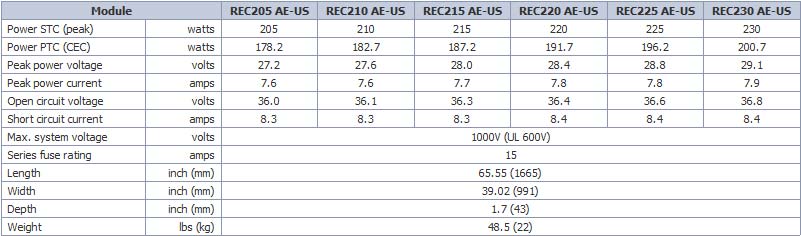
  • REC AE-US Series PV modulesThe REC AE-US Series modules, made in Sweden by REC, are a series of high quality solar modules designed to meet system demand for exceptional performance.
  • Quality and PerformanceRigorous quality control is applied throughout the production process, from cells to modules. Sixty 156 mm square multicrystalline solar cells in each module are optimized for low light conditions and increased light absorption. The modules have an innovative design that reduces shading effects in order to achieve maximum performance. A power output tolerance of -0/+5W guarantees minimum mismatch losses.
  • InstallationREC AE-US Series allows for quick and easy installation. The modules are equipped with PV Wire cables with MC4 locking connectors for problem-free inter-module connection. Cables meet 2008 NEC requirements for use with transformerless inverters.
  • Environmental PracticesThe REC AE-US Series generates environmentally sound electricity. Cell and module production processes are designed to maximize recycling and reduce environmental impact. REC’s wafers, cells and modules are produced within Scandinavia and the company’s activities are therefore subject to very high standards of regulation regarding environmental standards.
  • Warranty The REC AE-US Series comes with a 63-month workmanship warranty and a guarantee of 90% of rated power output for 10 years, and 80% of rated power output for 25 years.


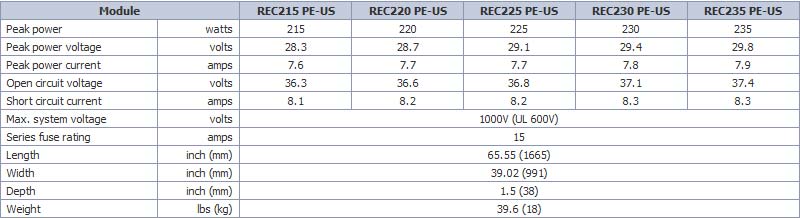
  • PE-US Series PV modulesThe REC PE-US Series modules, made by REC in Singapore, are a series of high quality solar modules designed to meet system demand for exceptional performance.
  • Quality and PerformanceRigorous quality control is applied throughout the production process, from cells to modules. Sixty acid-etched, 3-busbar, 156 mm square multicrystalline solar cells laminated behind high-transparency glass with an anti-reflective surface treatment give these modules an efficiency of up to 14.2%. A power output tolerance of -0/+5W guarantees you the power you pay for and minimum mismatch losses.
    The REC PE-US Series modules are made with silicon refined in the U.S. using renewable energy. Their energy payback is under one year and their cell and module production processes are designed to maximize recycling and reduce environmental impact.
  • InstallationThe comparatively low weight (39.6 lbs/18 kg) of the REC PE-US Series allows for quick and easy installation. The modules are equipped with an environmentally sealed junction box and PV Wire cables with MC4 locking connectors for problem-free inter-module connection. Cables meet 2008 NEC requirements for use with transformerless inverters.
  • Warranty The REC PE-US Series modules come with a 63-month workmanship warranty and a guarantee of 90% of rated power output for 10 years, and 80% of rated power output for 25 years.


Evergreen Solar
  • ES-A Modules Evergreen Solar modules are designed to deliver the best performance and dependability from Evergreen Solar’s patented String Ribbon wafer technology. These modules have one of the tightest power tolerances in the industry.
  • Performance Maximum power up to 5W above rated.

    Anti-reflection cover glass delivers more energy.

    A rigid, double-walled, deep frame with integrated water drainage holes

    Crimped frame corners – no screws to loosen

    Sealed junction box on ES-A modules never needs field maintenance
  • Environmental Credentials A rigid, double-walled, deep frame with integrated water drainage holes

    Crimped frame corners – no screws to loosen

    Sealed junction box on ES-A modules never needs field maintenance


    PV modules produced by Evergreen Solar are distinctive in their appearance because they incorporate a proprietary crystalline silicon technology known as String Ribbon. In the String Ribbon technique, two high-temperature strings are pulled vertically through a shallow silicon melt, and the molten silicon spans and freezes between the strings. The process is continuous: long strings are unwound from spools; the melt is replenished; and the silicon ribbon is cut to length for further processing, without interrupting growth.
  • Evergreen ES-A modules utilize three parallel strings of 38 cells in series giving an 18-volt peak power voltage which allows fewer strings in grid-tie systems and also provides optimum voltage for battery charging with conventional as well as MPPT charge controllers. They have Multi-Contact MC4 locking connectors, PV Wire, and black anodized frames. Made in USA.
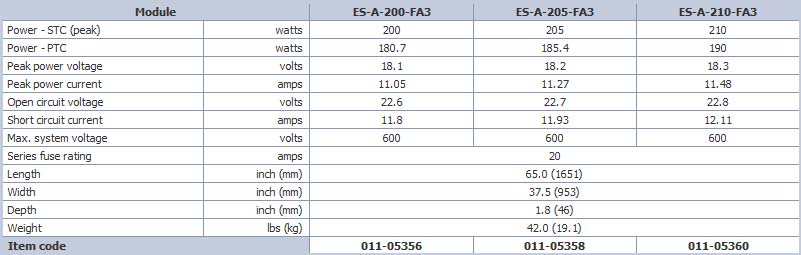
  • Evergreen modules are ETL listed to UL 1703 for U.S. and Canada. Modules have a 10-year 90% power warranty, 25-year 80% power warranty.


Sharp Solar


  • Sharp Solar Basics For 48 years, Sharp has led the industry with practical, efficient, and affordable solar electric systems. Sharp systems have been installed everywhere, from the demanding environments of satellites and lighthouses to commercial and industrial buildings, and even on the most beautiful, high-tech homes. Solar has come a long way since 1954 when the first solar cell was created. Yet, the basic principles of solar technology remain the same.


  • The Economical and Ecological ChoiceSharp is the #1 manufacturer of solar cells worldwide with nearly as much generating capacity as the next three largest manufacturers combined. They're cost-effective, quiet, attractive, safe, and reliable, with only minimal maintenance required over their long operational life. They're the right choice for your home and the right choice for the environment. It's no wonder why so many homeowners are making the move to Sharp Solar.
  • Tomorrow's Energy TodayImagine solar electricity not only powering businesses, large-scale utilities and neighborhoods, but also billboards, street lamps and portable electronics. Sharp's commitment towards environment-friendly products brings you tomorrow's energy today. 

Trina Solar

  • Overview Trina Solar Limited (TSL) is an internationally recognized manufacturer of mono and multicrystalline photovoltaic (PV) modules and has a long history as a solar PV pioneer since it was founded in 1997 as a system installation company in China. Our high-quality PV modules provide clean and reliable solar electric power to on-grid and off-grid residential, commercial, industrial and utility scale applications around the world. With local sales and marketing offices as well as installation partners throughout Asia, Europe and North-America, Trina Solar is committed to improving the competitiveness and efficiency of solar energy and developing a sustainable PV industry.


  • Trina Solar celebrated its 10th year Anniversary on April 22, 2008 in China with more than 800 guests from all over the world. The achievements of the last decade have laid a solid foundation for Trina's accelerated growth, and the global alternative energy development potential ensures Trina Solar an even brighter future. The company will continue to be dedicated to innovation, quality and improved efficiencies as it pursues grid parity to expand the global solar PV industry.
  • What We Do
    Trina Solar produces and commercializes a wide variety of photovoltaics (PV) modules, both monocrystalline and multicrystalline, with power outputs ranging from 165W to 230W. Adapting our product range to meet market demands allow us to provide our customers with a broader range of solutions.
  • Trina Solar research, development and manufacturing of ingots, wafers, cells and solar modules are conducted at its facilities in Changzhou, China, where Trina Solar occupies a site of approximately 152,526 square meters. Trina Solar's ongoing expansion plans include adding approximately 161,475 square meters to its existing facilities to increase its production capacity.
  • Trina Solar sells and markets its products in number of European counties, such as Germany, Spain, Italy, Netherland, France, and Belgium, where government incentives have accelerated the adoption of solar power. Trina Solar also targets in emerging PV markets such as France, the United States, South Korea, India, Australia, China and Mongolia. Trina Solar sells its products to distributors, wholesalers and PV system integrators around the globe.
  • HOW WE DO IT
  • Trina Solar has successfully developed into a leader in the PV industry based on its strong, vertically integrated business model, producing its own ingots, wafers, cells and modules in-house. The control and efficiency achieved from this integrated value chain helps to continuously improve the production process as well as ensure high quality products to our end customers. This commitment to quality is one of the cornerstones of our long-term partnerships. As we are committed to improving efficiencies and competitiveness, we also look to partner with downstream companies who share those same values, working together to bring solar PV mainstream.

SCHOTT Solar

  • SCHOTT POLY Solar Modules SCHOTT Solar is a world leader in the photovoltaic industry with more than 50 years of experience in the development and production of quality components for solar applications. The company has been in business for 125 years. The polycrystalline cells within each module are sorted to narrow performance tolerances, thereby allowing series interconnections with minimal mismatch losses.


  • SCHOTT bulk packs modules to reduce job site waste and disposal costs. Available with black or clear anodized frames, SCHOTT modules have PV Wire type cables for use with transformerless inverters.
  • Output ToleranceSCHOTT Solar POLY modules are among the industry leaders in power output tolerances. Produced in a facility in Albuquerque, NM, these modules are available in 4 wattages, with minus 0 watts output tolerance. This provides for a stable, high-energy output. 

 Kyocera Solar
  • Kyocera Solar Panels Kyocera Solar Panels offered by Surya Solar are an excellent choice for Grid-Tie and Off-Grid applications. We offer Kyocera Solar Panels with MC connectors (GT) or a Junction Box (TM) making them very adaptable to your needs. Kyocera solar panels with MC Connectors are great for large arrays making it a snap to interconnect large arrays or the handy Junction Box for making connections in a weather tight box on the back of the solar panel.

  • Kyocera is one of the world's largest vertically-integrated producers and suppliers of solar energy products.
  • Kyocera solar modules are a reliable, virtually maintenance-free power supply designed to convert sunlight into electricity at the highest possible efficiency. Kyocera began researching photovoltaics in 1975 and has installed thousands of systems throughout the world since 1978. These systems are ideal for charging storage batteries to power remote homes, recreational vehicles, boats, telecommunications systems and other consumer and commercial applications.
  • Kyocera's advanced cell-processing technology and automated production facilities produce highly efficient multi-crystal photovoltaic modules. To protect the cells from the most severe environmental conditions, they are encapsulated between a tempered glass cover and an EVA pottant with a PVF back sheet. The entire laminate is installed in an anodized aluminum frame for structural strength and ease of installation.
  • The Kyocera KC130TM, 130 Watt Solar Panel and Kyocera KC130GT, 130 Watt Solar Panel are a couple of our most popular solar panels for a wide variety of applications. 
  • ET Solar

  •   ET Solar Group is a vertically integrated solar energy equipment manufacturer and turnkey solutions provider.
  • With local sales and marketing subsidiaries and offices throughout Asia, Europe, and North America, we provide high quality photovoltaic modules, world leading solar tracking systems and smart turnkey solutions to our customers in more than 50 countries and areas. Our products have been delivering strong operating performance in a large number of residential and utility scaled solar PV projects around the world.
  • As one of the first solar energy turnkey solution providers from China, we have strong capabilities to tailor make the most efficient and economical solutions for our customers by factoring in a large variety of parameters such as project location, terrain condition, land size, land price, government subsidy and power density.
  • Solar energy will become an essential component of the global energy portfolio in the foreseeable future and our fast growing trajectory showcases our commitment, strength and aspiration to be a significant contributor to the industry’s exponential growth in the next few decades.

  LDK Solar
  • Overview Established in 2005 in China, LDK Solar is the world`s largest producer of solar wafers in terms of capacity and a leading high-purity polysilicon and solar module manufacturer. The company has expanded its business to meet the solar industry’s requirements for high-quality and low-cost solar materials and solutions. As a vertically integrated manufacturer and supplier of photovoltaic (PV) products, LDK Solar has more than 15.000 employees worldwide. The Company’s headquarters and manufacturing facilities are located in Hi-Tech Industrial Park, Xinyu City Jiangxi Province in the People’s Republic of China. LDK Solar maintains sales, marketing, and customer service offices throughout Asia, Europe and North America.


  • As one of the fastest growing solar module providers in the world, LDK Solar has an established track record of delivering consistently high quality solar modules to our valued customers. We take pride in providing technologically advanced and reliable solar modules and our product line is led by our passion to design and deliver energy solutions that not only keep pace with global needs, but anticipate them as well. We have three module manufacturing facilities located in Nanchang City in Jiangxi province , Suzhou City in Jiangsu province and Hefei City in Anhui province in China.
  • LDK Solar manufactures and markets multicrystalline and monocrystalline wafers to manufacturers of solar cells and modules. Solar wafers are the principal raw material used to produce solar cells, which are devices capable of converting sunlight into electricity. The company also markets solar materials, which include ingots, and chemicals (used to produce Polysilicon and solar wafers) as well as provides wafer processing services.
  • In 2009, LDK Solar expanded the scope of its vertical integration strategy to include sales of solar modules to developers, distributors and system integrators. LDK Solar acquired the crystalline module manufacturing plant of Best Solar in February 2010 to bring the manufacturing capability in-house.
  • As part of LDK Solar’s vertical integration strategy, it constructed a polysilicon plant with two production facilities near its wafer production plants in Xinyu, China. The first facility has a planned installed annualized production capacity of 3,000 metric tons and the second facility has three separate 5,000 MT trains, for a planned 15,000 MT annualized production capacity. Combining the two polysilicon plants, LDK Solar expects to reach 18,000 MT capacity by the end of 2011.

 Yingli Solar
  • Overview Yingli is a leading solar energy company and one of the world’s largest vertically integrated photovoltaic manufacturers.

    Yingli Green Energy Holding Company Limited (NYSE: YGE), who holds the brand Yingli Solar, is a leading solar energy company and one of the world's largest vertically integrated photovoltaic manufacturers. We develop, manufacture and sell photovoltaic modules to a wide range of markets, including Germany, Spain, Italy, Greece, France, South Korea, China, and the United States.


  • With a balanced production capacity of over 600 MW per year, our manufacturing covers the entire PV value chain, from the production of polysilicon through ingot casting and wafering, to solar cell production, and, finally, module assembly. We commenced trail production at our in-house polysilicon facility in December, 2009, with an initial production capacity of 3,000 metric tons per year. We supply high-quality PV modules under our brand name-Yingli Solar-to utilities, system developers and integrators, distributors, and other businesses around the world. Since we began commercial production in 2002, we have produced a total of 1 GW of PV modules.
  • At Yingli, we are responding to the worldwide growing demand for renewable and affordable energy by supplying products that convert sunlight into electricity.
  • We employ a balanced vertical integration strategy and utilize cutting-edge technologies to produce high-quality products with competitive cost structures. Maintaining both a global presence and local expertise, we are dedicated to serving our customers.
  • We aspire to be socially and environmentally responsible in every decision we make. As a leader in sustainable energy solutions, we are proud of our mission: to make solar power an enduring and cost-effective technology for all humankind.

CCRES SOLAR List

This category contains listing of companies dealing in Solar Products and Components.


  •     
  •     
  •     


  •     
  •     
  •     


  •     
  •     
  •     


  •     
  •     
  •     


  •     
  •     
  •     


  •     
  •     
  •     


  •     
  •     
  •     


  •     
  •     
  •     


  •     
  •     
  •     


  •     
  •     
  •     


  •     
  •     
  •     


  •     
  •     
  •     


  •     
  •  
     
     
Join the movement! 
Every day, CCRES supporters fight to make environmental education, clean energy solutions, and the green economy a reality.
     
Croatian Center of Renewable Energy Sources (CCRES)